
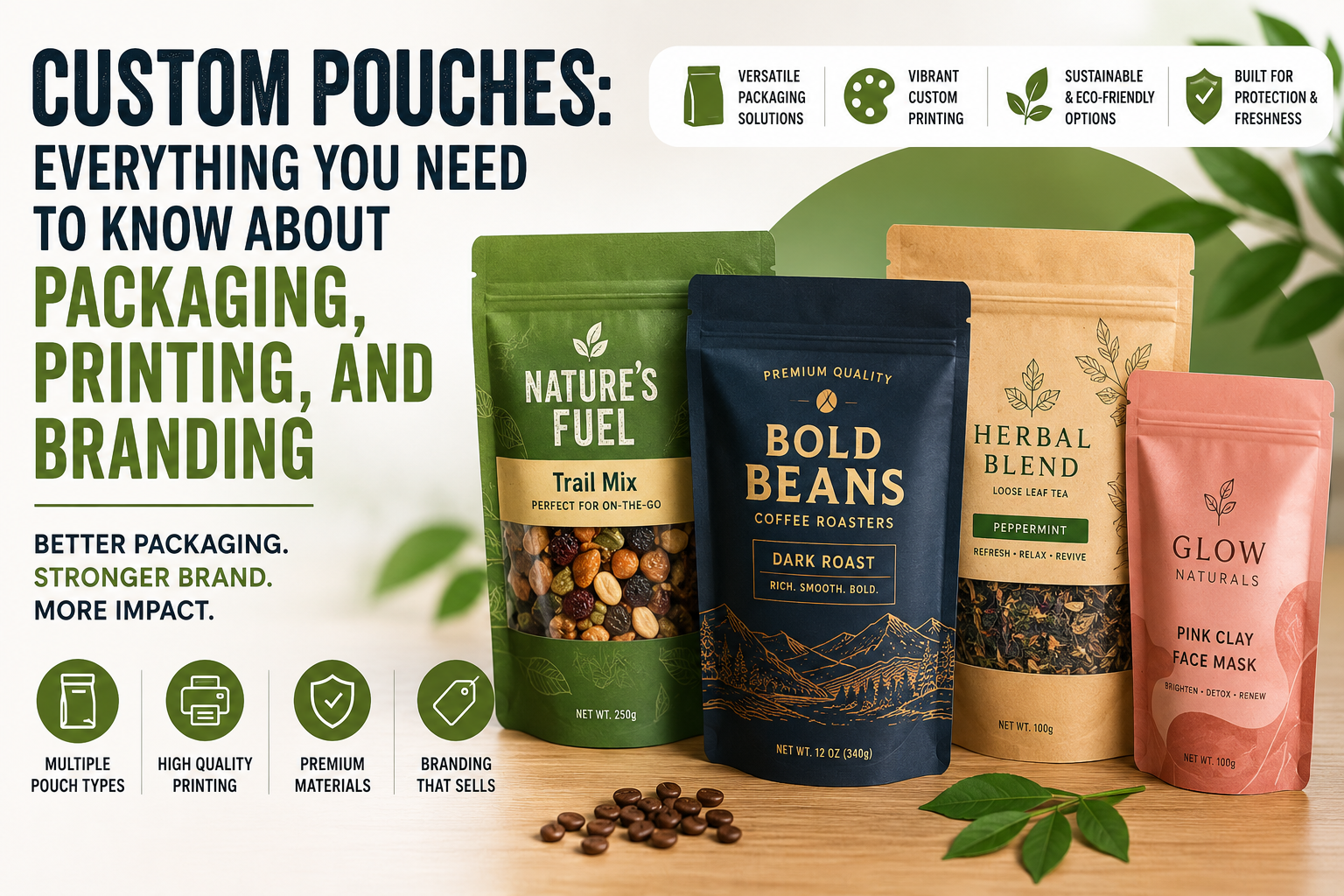
A product sitting in a plain, forgettable bag is already losing. Before a customer reads a single word on your label, they’ve made a snap judgment based on how it looks. That’s the reality of retail, and it’s exactly why more brands are moving toward custom pouches that do the talking before the product is even opened.
Custom pouches have taken over shelves across industries: snacks, coffee, supplements, pet food, cosmetics, and more. And it’s not just because they look good. They ship lighter, store flat, seal tighter, and give brands more printable real estate than most rigid containers can offer.
This guide walks through everything you need to know: the formats, the printing process, the material choices, and what actually makes pouch branding work. Whether you’re packaging a product for the first time or switching from rigid containers, this is where to start.
Why Custom Pouches Have Taken Over Product Packaging
Pouches have quietly replaced rigid packaging for a huge range of products. A decade ago, most dry goods came in boxes or cans. Today, that same product is likely to come in a resealable pouch with a full-color print job and a clear window so you can see what’s inside.
The shift makes sense when you think about it. Pouches are lighter than rigid containers, which cuts down on shipping costs. They take up less shelf space. They’re easy to open and close. And from a branding standpoint, they give you a larger printable surface to work with compared to a label on a bottle or can.
For smaller brands especially, this style of packaging offers a way to look polished and professional without committing to the kind of minimum order quantities that traditional rigid packaging often requires. Many suppliers now offer short-run options, which means you can test packaging designs without spending a fortune upfront.
The Main Types of Custom Pouches and What They’re Used For
Not all pouches are built the same. The format you choose affects how your product sits on a shelf, how it stores, and how your customers interact with it. Here’s a breakdown of the most common types.
Stand-Up Pouches
Stand-up pouch packaging is probably what comes to mind first when someone mentions a flexible pouch. These pouches have a gusseted bottom that lets them stand upright on their own, which makes them popular for retail display. They work well for everything from trail mix and protein powder to liquid soaps and baby food. Stand Up Pouches are typically available with or without a zipper reseal and can include a clear window on the front or back panel.
Flat Bottom Pouches
Similar to stand-up designs in that they sit upright, Flat Bottom Pouches have a wider, more structured base that gives them a very stable, block-like appearance. This style is especially popular in the coffee and tea space because it looks premium and displays well. The extra base material also adds structural integrity, which helps the pouch hold its shape even when partially empty.
Quad Seal Pouches
For products that need a square, boxy profile, Quad Seal Pouches are the go-to option. They have four vertical seals, one on each side, which gives them a very rigid, structured shape compared to most other pouch formats. They’re commonly used for bulk items like coffee, grains, and pet food, and they tend to hold their shape well even when stored in tight spaces.
Lay Flat Pouches
As the name suggests, Lay Flat Pouches lie flat rather than standing upright. They’re a practical option for products that don’t need to be displayed standing, such as jerky, dried fruits, and certain cosmetics or personal care items. They’re often less expensive to produce than stand-up formats and still offer a solid surface area for printing.
How Pouch Printing Works: A Practical Overview
Understanding the printing process helps you make better decisions when ordering. Pouch printing is different from printing on paper or cardboard; the materials, equipment, and processes involved are specific to flexible film substrates.
Gravure Printing
Gravure is a traditional method where the design is engraved onto a cylinder, which then transfers ink directly to the film. It produces very consistent, high-quality results and works well at high volumes. The downside is that the cylinders are expensive to make, so the setup costs are high. This method makes the most sense if you’re ordering large quantities and the per-unit cost savings justify the upfront investment.
Flexographic Printing
Flexo is the most widely used method in flexible packaging. It uses flexible plates and fast-drying inks, which makes it efficient for medium to large runs. Print quality has improved significantly over the years and is more than adequate for most commercial packaging needs. It handles a wide range of pouch materials and works well with spot colors.
Digital Printing for Pouches
This is where things have changed the most in recent years. Digital Printed Pouches don’t require plates or cylinders, which eliminates a big chunk of the setup cost. That makes digital printing ideal for small runs, seasonal packaging, and brands that want to test different designs without committing to large orders. Print quality has gotten very close to flexo and gravure, and turnaround times are much faster.
Which Print Method Is Right for You?
The right method depends on your order volume, budget, and how often your design changes. If you’re a startup testing the market, digital is almost always the better starting point. If you’re an established brand ordering tens of thousands of units per run and your design is locked in, flexo or gravure will give you a lower cost per unit. Talk to your supplier about projected volumes before committing to a method; switching later is possible but adds time and cost.
Custom Pouch Printing: What You Need to Get Right
Getting good results from custom printed pouches comes down to preparation. A lot of brands underestimate how much the technical side matters until they get their first sample and something looks off.
File Setup and Artwork Guidelines
Most suppliers want files in vector format, typically PDF or AI, at the actual print size. Images should be at least 300 DPI. Colors should be set up in CMYK or as Pantone (PMS) spot colors if color accuracy is critical. If you’re working with a food product where the regulatory text needs to appear in a specific way, make sure that’s reflected in the file and confirmed with the supplier before production begins.
Color Matching
What you see on your screen and what comes off the press are not always the same. If your brand color needs to match exactly across all your packaging, request a physical proof before approving the run. Digital proofs are useful for layout review, but they won’t catch color shift issues the way a printed sample will.
Finish Options
Matte finishes give a softer, more premium look. Glossy finishes make colors pop and are a bit more resistant to handling marks. Some brands mix the two, a matte base with gloss coating on specific design elements, which creates a visual contrast that works well on the shelf. Spot UV is another option if you want selective shine without going full gloss.
Branding Your Custom Pouches: What Actually Works
A well-branded pouch doesn’t just look good; it communicates something specific about your product. Here’s what goes into making that happen.
Use the Full Print Area
One of the biggest advantages of pouch packaging is the surface area available for printing. Use it. Don’t just slap a logo on the front and call it done. Think about what the back panel can do: ingredient lists, usage instructions, brand story, QR codes. Every surface of a pouch is printable, including the sides and gussets on certain formats.
Be Consistent With Your Brand System
Your fonts, colors, and graphic style should carry over consistently from your pouch to your website to your social media. Packaging is usually the first physical touchpoint a customer has with your brand, and it should feel like the same brand they’ve seen everywhere else.
Think About the Customer Experience
How does the pouch open? Is the zipper easy to close? Can the customer see the product through a clear window? These things matter more than people give them credit for. Custom stand-up pouches with resealable zippers, for instance, are especially popular in the food category because they make portion control and storage easy, and that convenience reflects well on your brand.
Wholesale Pouch Packaging: Ordering at Scale
If you’re ordering in volume, the economics of wholesale pouch packaging differ from those of small-run digital orders. Here’s what to keep in mind.
Minimum order quantities (MOQs) vary a lot depending on the supplier and the print method. Gravure and flexo suppliers typically have higher MOQs, often 10,000 units or more per SKU, because of the plate costs involved. Digital suppliers can often go much lower, sometimes as few as 500 or 1,000 units.
When comparing suppliers, look at the total landed cost, not just the per-unit price. Freight factor, customs (if ordering internationally), lead times, and any quality control costs. A slightly higher per-unit price from a supplier with faster lead times and better QC might save you more in the long run than a cheaper option that’s slower and less reliable.
Packaging suppliers that offer end-to-end services, design support, structural engineering, sampling, and production tend to be more efficient to work with, especially if you’re managing multiple SKUs. Contipack Inc is one example of a flexible packaging supplier that works with brands across different product categories, handling everything from material selection to finished pouch production.
Choosing the Right Material for Your Custom Pouches
The film you choose affects barrier properties, shelf life, printability, and feel. Here’s a quick breakdown of the most common options.
PET-Based Films
Polyethylene terephthalate (PET) films are widely used as the outer layer of multi-ply pouches because they print well, are rigid enough to hold structure, and provide a decent moisture barrier. They’re commonly laminated with other films to get the combination of properties needed for a specific product.
Foil Laminates
If your product is sensitive to light, oxygen, or moisture, an aluminum foil layer in the laminate structure adds serious barrier protection. This is common in coffee packaging, pharmaceuticals, and certain snack categories. The trade-off is that foil pouches aren’t as environmentally friendly as some alternatives, though recyclable foil films are becoming more available.
Kraft Paper Pouches
For brands going for a natural, organic look, kraft paper-based pouches are a good option. They can still be laminated with a moisture barrier on the inside, so they’re not just decorative — they’re functional. The texture and appearance of kraft paper carry a certain consumer association with clean-label and sustainable products, which many brands find useful from a positioning standpoint.
Custom Printed Zipper Pouches: Features Worth Paying For
Resealable closures have become almost standard in flexible packaging, and custom-printed zipper pouches are among the most requested formats across food, beauty, and supplement categories.
The quality of the zipper itself matters. A cheap zipper that doesn’t seal properly, or that requires excessive force to open, is going to frustrate your customers. Ask for zipper samples before committing to a supplier, and check how the zipper performs after multiple open-and-close cycles.
Press-to-close zippers are the most common type and work fine for most applications. Slide zippers, where a small slider moves along the track, are more user-friendly, especially for people with limited hand strength or dexterity. If your product targets an older demographic or has a premium price point, the slide zipper is worth the extra cost.
Tear notches are a small feature that makes a real difference. A clean tear notch means your customer can open the pouch on the first try without needing scissors. It’s the kind of thing that seems minor until your pouch doesn’t have one and the customer has to wrestle it open.
Sustainability in Flexible Pouch Packaging
Flexible packaging has gotten a lot of attention in recent years around sustainability, and the conversation is more complicated than it might seem at first.
On one hand, pouches use significantly less material than rigid packaging; a stand-up pouch requires around 70–80% less plastic than an equivalent rigid container. They’re also lighter, which reduces the carbon footprint of transport. On the other hand, multi-ply laminate structures, which are what most barrier pouches are made from, can be difficult to recycle because the different film layers are bonded together.
The industry is actively working on this. Mono-material pouches, which use a single polymer type and are much easier to recycle, are becoming more available, though they typically come with some trade-off in barrier performance. Compostable and bio-based films are also gaining ground, particularly in the natural and organic food space.
If sustainability is important to your brand, have an honest conversation with your supplier about what’s actually achievable given your product’s requirements. Don’t just take eco-friendly claims at face value; ask for specifics about what the material is, how it’s recycled or composted, and what certifications back that up.
Custom Stand Up Pouches: The Most Requested Format in Retail
Custom stand-up pouches continue to be the most ordered format in flexible packaging, and for good reason. They display well, store efficiently, and give brands a solid canvas for design.
For retail, the front panel real estate is critical. Your logo, product name, key claim (organic, non-GMO, 30g protein), and any regulatory callouts all need to fit on the front without looking cluttered. This is where a good designer makes a meaningful difference. A pouch that looks clean and clear on the shelf is not easy to design; it requires a lot of iteration and testing.
If you’re selling direct-to-consumer, think about how the pouch ships. Pouches in a box get jostled around. The zipper needs to stay closed. The seams need to hold. Request drop tests and transit simulations from your supplier. If you’re shipping to customers, it’s much better to find out about a weakness in testing than after a batch of damaged orders lands on your desk.
Final Thoughts on Custom Pouches
Custom pouches are a strong packaging choice for a wide range of products, but getting the most out of them takes some thought. The format you choose, the print method, the material structure, and the closure type, all of these decisions add up and affect how well your packaging performs in the real world.
The best way to approach it is to start with your product’s specific requirements, what it needs from a barrier standpoint, how it’ll be sold, and who’s buying it, and then work backward to find the right pouch format and specifications. From there, finding a supplier who can support both your current volume and your future growth makes everything easier.
Whether you’re ordering a few hundred units of these pouches to test a new product or scaling into wholesale pouch packaging territory, the fundamentals stay the same: use good materials, print well, and design with the customer in mind. Get those three things right, and your packaging will do its job.
Ready to Get Started With Your Custom Pouches?
If you’re looking for a packaging partner that handles everything from material selection to finished production, get in touch with Contipack Inc today. Whether you need a sample run to test your design, a bulk order for retail, or guidance on which pouch format fits your product best, their team can walk you through the options.