
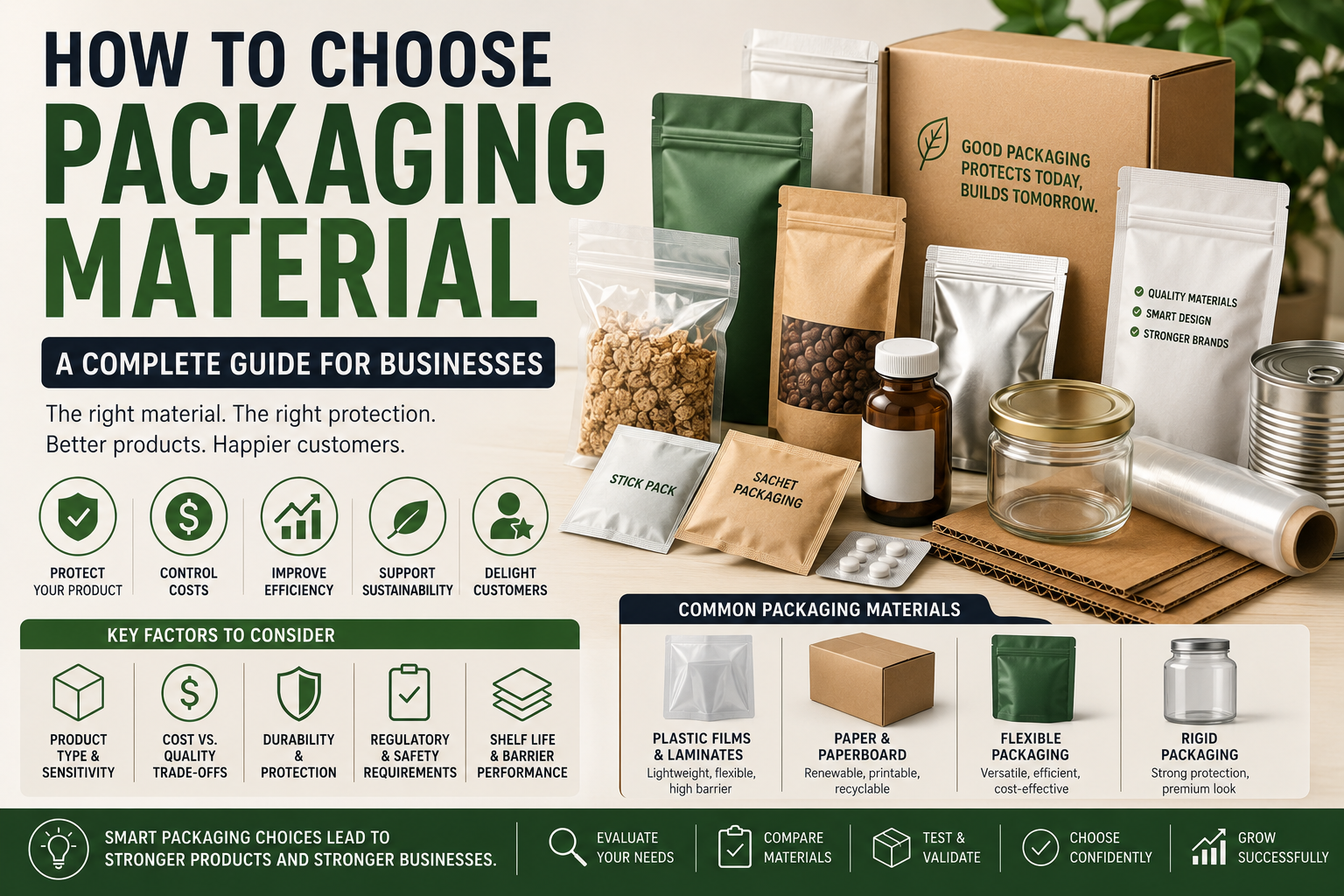
Picking the right packaging material is one of those decisions that looks simple on the surface but can make or break your product’s journey from factory to customer. Whether you’re running a food brand, a pharma company, or an e-commerce store, knowing how to choose packaging materials correctly saves you money, reduces product damage, and keeps customers happy.
Most businesses don’t think about packaging until something goes wrong. A shipment arrives damaged. A product loses freshness before its expiry date. A customer complains about leaks. These problems almost always trace back to the wrong material choice.
This guide walks you through everything you need to know about packaging material selection, from key factors to consider to a practical comparison of the most common materials available today.
What Is Packaging Material Selection and Why Does It Matter?
Packaging material selection is the process of evaluating and choosing the right type of material to protect, store, and present your product. It involves balancing several factors, including cost, product compatibility, shelf life requirements, shipping conditions, and customer expectations.
A poor packaging choice can lead to product spoilage, increased return rates, and wasted money on materials that are either too heavy, too weak, or too expensive for the job. On the other hand, the right material improves product integrity, reduces shipping costs, and adds perceived value to your brand.
Think of packaging material as the first and last line of defense for your product. It protects the item during manufacturing, storage, and transit. It also communicates quality to the end customer when they receive it.
Key Factors in Packaging Material Comparison
Before jumping into specific materials, it helps to understand the factors that should drive your packaging decision. Every business has different priorities, and the best packaging material for your product depends on your specific situation.
1. Product Type and Sensitivity
The nature of your product is the starting point. Is it a dry food product, a liquid, a pharmaceutical item, or a fragile consumer good? Food products often need barrier properties to block moisture and oxygen. Liquids need leak-proof seals. Fragile items need cushioning or rigid protection.
For example, a powdered supplement needs different packaging than a fresh snack. One requires moisture and oxygen barriers; the other may need breathability. Getting this wrong shortens shelf life and leads to customer complaints.
2. Cost vs. Quality Trade-Offs
Packaging cost vs. quality is always a real consideration, especially for businesses ordering at scale. Premium materials like multi-layer laminates or vacuum-sealed pouches cost more per unit but can significantly reduce product loss and returns.
The goal is not to find the cheapest material but to find the one that gives you the best value for your specific product. Sometimes spending a little more upfront on packaging durability factors saves you a lot more in refunds, replacements, and reputation damage down the line.
3. Durability and Protection
Packaging durability factors vary widely between materials. Paper and cardboard offer decent protection for lightweight items but can fail in humid conditions. Plastics provide stronger moisture resistance. Flexible packaging materials, like pouches and films, often outperform rigid options in terms of weight and adaptability.
Think about the conditions your packaging will face during storage and transit. Will it be stacked? Exposed to temperature changes? Handled by automated machinery? Each scenario requires a different level of structural strength.
4. Regulatory and Safety Requirements
Depending on your industry, packaging must meet specific regulatory standards. Food-grade materials need to be non-toxic and approved for direct food contact. Pharmaceutical packaging has strict compliance requirements around child resistance and tamper evidence. If your product targets households with young children, using
For products distributed in regulated environments, Child-Resistant Packaging is not optional. It is a legal requirement in many markets and a critical safety standard that protects both consumers and manufacturers from liability.
5. Shelf Life and Barrier Performance
If your product needs to stay fresh for weeks or months, barrier packaging materials are essential. These are materials designed to block moisture, oxygen, light, and other external factors that degrade product quality.
Barrier performance is measured in terms of oxygen transmission rate (OTR) and moisture vapor transmission rate (MVTR). The lower these numbers, the better the material performs as a barrier. High-barrier films are commonly used in food, pharmaceutical, and nutraceutical packaging.
Types of Packaging Materials
Understanding the types of packaging materials available helps you make a more informed decision. Here is a practical overview of the most commonly used materials across industries.
Plastic Films and Laminates
Plastic-based materials are among the most widely used in packaging today. They are lightweight, cost-effective, and can be engineered with barrier properties. Common plastics include polyethylene (PE), polypropylene (PP), polyester (PET), and nylon.
Laminated films combine multiple plastic layers to achieve specific performance characteristics. For example, a three-layer laminate might have an outer layer for printability, a middle barrier layer, and an inner layer for heat sealing. These are commonly used in snack, coffee, and supplement packaging.
Paper and Paperboard
Paper and paperboard are popular in retail packaging and outer cartons. They are easy to print on, lightweight, and widely accepted in recycling programs. However, standard paper has poor moisture resistance, which limits its use in food and liquid applications without additional coatings.
Kraft paper is a durable variant used in bags and shipping applications. Coated paperboard is used for cartons and boxes. Both offer good printability but need lamination or coating when barrier performance is required.
Flexible Packaging
Flexible packaging covers a range of formats including pouches, bags, films, and wraps. It is one of the fastest-growing segments in the packaging industry because it combines barrier performance with low material weight and high design flexibility.
Products like single-serve condiments or pharmaceutical powders often use Custom Sachet Packaging, which provides portion control, freshness, and convenience in a compact format.
Similarly, Stick Pack Packaging is a popular format for beverages, protein powders, and nutraceuticals, offering a slim, single-dose design that works well in both retail and on-the-go use cases.
Rigid Packaging
Rigid packaging includes glass jars, metal cans, hard plastic containers, and corrugated boxes. These materials offer strong protection and are well-suited for heavy or fragile products. They generally cost more per unit and require more storage space than flexible options.
Rigid options are preferred when the product requires structural support, when the packaging will be reused, or when premium presentation is a priority. Glass, for example, is favored in high-end food and beverage markets because it is inert and does not interact with the product.
Packaging Material Comparison: Flexible vs. Rigid
One of the most common packaging decisions businesses face is choosing between flexible and rigid packaging. Both have strengths and weaknesses, and the right choice depends on your product, budget, and logistics setup.
Flexible packaging is lighter, cheaper to ship, and takes up less warehouse space. It can be manufactured in a wide range of sizes and formats. The downside is that it generally provides less structural protection than rigid options, which can be an issue for fragile items.
Rigid packaging is stronger and offers better protection for products that are sensitive to pressure or impact. It is also easier to stack and store in retail environments. However, it costs more to produce and transport due to the heavier material and larger volume.
For businesses shipping at scale, many brands now use Flow Wrap Packaging, a format that tightly wraps products in a film seal. It reduces material use, speeds up production lines, and is widely used in food, bakery, and confectionery applications.
The packaging material comparison between plastic and paper also comes up frequently. Plastic offers better barrier performance and durability. Paper is easier to recycle in many markets and appeals to consumers who prefer natural materials. The decision usually comes down to product requirements and brand positioning.
Industry-Based Packaging Selection Guide
Different industries have different packaging needs. Here is a practical packaging selection guide broken down by sector.
Food and Beverage
Food packaging prioritizes freshness, safety, and shelf life. Materials must be food-grade and capable of maintaining product quality from production to consumption. Flexible laminates with high barrier properties are the most common choice for snacks, liquids, and dry goods.
For specialty products like cannabis, herbs, or premium coffee, Custom Mylar Bags are a popular option. Mylar provides excellent oxygen and moisture barrier performance, keeping products fresh for extended periods.
Packaging for food products also needs to consider temperature ranges. Frozen food packaging must withstand low temperatures without cracking. Retort packaging must handle high-heat sterilization processes.
Pharmaceutical and Nutraceutical
Pharma packaging has some of the strictest requirements of any industry. Materials must maintain product potency, prevent contamination, and comply with regulatory standards. Blister packs, sachets, and barrier films are commonly used for tablets, powders, and liquids.
Tamper evidence is a key requirement in this sector. Packaging must clearly show if it has been opened or compromised before reaching the consumer. This is a non-negotiable standard in most markets.
E-Commerce and Retail
E-commerce packaging faces a unique set of challenges. Products need to survive last-mile delivery, which often involves rough handling and multiple handoffs. Packaging must protect the product while keeping shipping costs low.
Retail packaging, on the other hand, prioritizes shelf presence and visual appeal. The packaging needs to stand out on a crowded shelf while still protecting the product inside. Many brands invest heavily in print quality and structural design for retail.
Working with an experienced manufacturer like Contipack Inc helps businesses get packaging solutions that meet both performance and visual requirements without over-engineering the design.
Common Mistakes in Packaging Material Selection
Even experienced businesses make mistakes when choosing packaging materials. Here are some of the most common ones to avoid.
Choosing material based on price alone is a frequent mistake. The cheapest option often leads to higher overall costs when you factor in product damage, returns, and customer dissatisfaction. Always evaluate the total cost of ownership, not just the unit price.
Ignoring the supply chain is another common error. A packaging material might work perfectly in the lab but fail in real-world conditions. Temperature fluctuations during transit, rough handling, and long storage times all need to be factored into the material decision.
Skipping testing before large orders is a costly mistake. Always test your packaging with actual product samples under realistic conditions before committing to a large production run. It is much cheaper to catch problems at the sample stage than after thousands of units have been produced.
Finally, overlooking sustainability considerations can hurt your brand in the long run. More buyers and retailers are asking about environmental impact, and packaging that cannot meet those expectations limits your market access. Many businesses today are adding a section of their packaging strategy toward
Adding even a small focus toward Sustainable Packaging practices, such as using recyclable materials or reducing excess packaging, can open new retail and export channels while reflecting positively on your brand’s values.
How to Start the Packaging Material Selection Process
If you are starting from scratch or re-evaluating your current packaging, here is a simple step-by-step approach to packaging decision-making.
Start by defining your product requirements. Write down what the product needs in terms of protection, shelf life, temperature range, and regulatory compliance. This becomes your non-negotiable list.
Next, shortlist material types that meet those requirements. Use the categories covered in this guide as a starting point. Compare their performance characteristics against your product needs.
Get samples and run tests. Contact packaging suppliers and request material samples. Test them with your actual product under real storage and shipping conditions. This is the most reliable way to validate your choice.
Evaluate cost at scale. Ask for pricing based on your expected order volumes. Packaging costs drop significantly at higher quantities, so understanding the per-unit economics at different volume levels is important for budget planning.
Finally, consider secondary factors like print capability, machine compatibility, and supplier reliability. A great material means little if your filling or sealing equipment cannot handle it, or if your supplier cannot deliver consistently.
FAQs
1. What is the most important factor when choosing packaging material?
The product itself is the most important factor. You need to understand what your product requires in terms of protection, shelf life, temperature range, and regulatory compliance before evaluating any material. Everything else, including cost, appearance, and sustainability, comes after you have covered the basic protection requirements.
2. What is the difference between flexible and rigid packaging?
Flexible packaging includes materials like pouches, films, and wraps that can bend and conform to the product shape. Rigid packaging includes glass, metal, and hard plastic containers that hold a fixed shape. Flexible packaging is lighter and cheaper to ship, while rigid packaging offers stronger structural protection. The right choice depends on your product type, budget, and distribution channel.
3. Which packaging material is best for food products?
For most food products, flexible laminates with barrier properties are the best choice. They block oxygen and moisture, which are the two main causes of food spoilage. The specific laminate structure depends on the product. Dry snacks, coffee, and supplements typically use multi-layer pouches, while fresh or frozen products may need additional sealing or temperature-resistant materials.
4. How does packaging material affect product shelf life?
Packaging material directly controls how much oxygen, moisture, and light reach your product over time. Materials with high barrier performance slow down the degradation process, extending shelf life significantly. A product packed in a low-barrier material may lose freshness in weeks, while the same product in a high-barrier laminate can stay fresh for months or even years.
5. Is sustainable packaging a good option for small businesses?
Yes, sustainable packaging options have become much more accessible and affordable in recent years. Many recyclable and compostable materials now perform at a level comparable to conventional plastics. For small businesses, starting with simple changes like switching to recyclable outer cartons or reducing excess packaging can make a meaningful difference without a major cost impact.
6. How do I know if my packaging meets regulatory requirements?
The best approach is to work with a packaging manufacturer who understands the regulations in your target market. Food-grade certifications, child-resistance standards, tamper-evidence requirements, and labeling laws vary by country and product category. Always request material safety data sheets from your supplier and verify compliance with your local regulatory authority before launching a product.
Conclusion
Knowing how to choose packaging material is a skill that pays dividends across your entire business. The right material protects your product, reduces waste, keeps costs in check, and signals quality to your customers.
Packaging material selection is not a one-time decision. As your product line grows, your markets change, and your volumes scale, your packaging needs will evolve too. Building a solid understanding of packaging material comparison principles now will help you make smarter decisions at every stage.
Whether you are dealing with food, pharma, or consumer goods, the principles covered in this packaging material guide apply across the board. Start with your product requirements, compare materials honestly, test before committing, and always think about the full journey your packaging takes before it reaches the end customer.
The businesses that get packaging right do not treat it as an afterthought. They treat it as a core part of their product strategy, and it shows in every shipment they send out.