
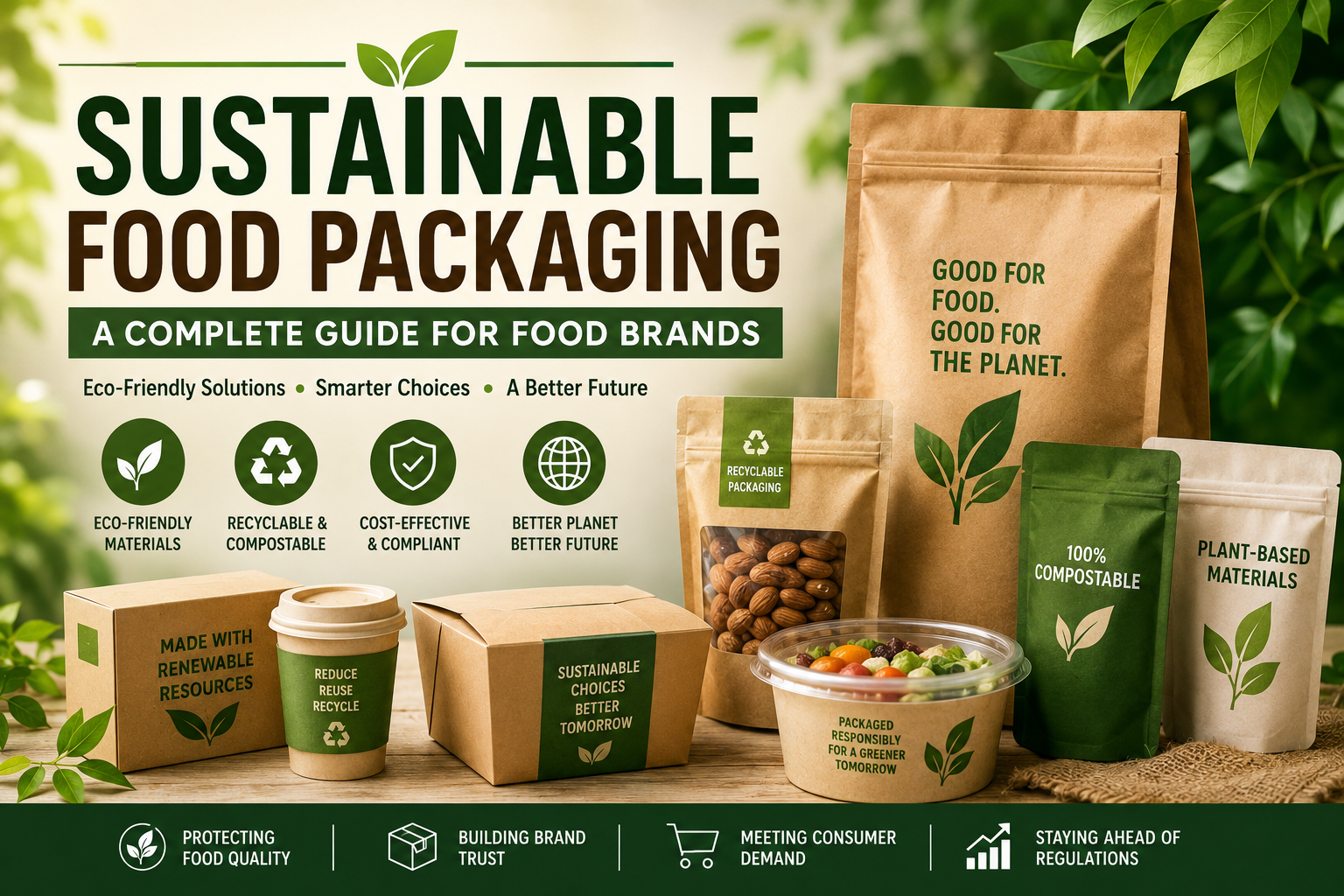
Sustainable food packaging refers to packaging materials and systems designed to lower environmental impact while maintaining food safety, freshness, and product protection throughout the supply chain.
Sustainable food packaging is no longer a side conversation in the food industry. It’s become a major purchasing factor. Shoppers check labels before they check prices, and food brands that ignore this shift are losing shelf space to competitors who don’t. Whether you sell cookies, chocolate, snacks, or ready-to-eat meals, the material wrapped around your product now says almost as much about your brand as the product itself.
This guide walks through what this shift actually means for a food brand, which food packaging solutions work best for different product types, and how a company can start making the switch without slowing down production or significantly increasing costs.
What Is Sustainable Food Packaging?
This refers to any packaging format designed to lower environmental impact across its full life cycle, from raw material sourcing to disposal. That covers a wide range of options: recycled paperboard, plant-based films, compostable pouches, and packaging built for reuse or easy recycling after the product is gone.
It’s a broad category on purpose. A Food and Beverage brand shipping frozen goods has very different packaging needs than a bakery selling fresh cookies at a farmers market. This isn’t one material or one format. It’s a design approach that weighs material sourcing, shelf life, transport weight, and end-of-life disposal together, rather than optimizing for cost alone.
For a packaging partner, this means working with a client’s product specs first and then figuring out which sustainable option actually holds up. A stand-up pouch that keeps chips fresh for six months isn’t automatically less eco-friendly than an unlined paper bag that goes stale in a week. Freshness and waste reduction are both part of the sustainability equation, and both feed into a brand’s overall carbon footprint.
Benefits of Eco-Friendly Packaging for Food Brands
The benefits go beyond a marketing checkbox. A well-built packaging strategy touches sales, compliance, and operations at the same time.
On the sales side, the numbers are hard to ignore. According to the Shorr 2025 Sustainable Packaging Consumer Report, which surveyed over 2,000 American consumers, 90% of shoppers said they are more likely to purchase from a brand whose packaging is eco-friendly, and 54% reported deliberately choosing sustainably packaged products in the past six months. Nearly 4 in 10 consumers switched to a competitor that offered more sustainable packaging over one that didn’t.
On the compliance side, sustainable packaging for food brands reduces exposure to state-level extended producer responsibility fees, which are calculated based on packaging recyclability and material type. On the operations side, mono-material and lightweight formats often reduce shipping weight and material cost per unit, which adds up at scale. Brands that treat environmentally friendly food packaging as a design requirement from day one, rather than a retrofit, tend to avoid the rework costs that come with switching materials mid-production run.
Why Are Food Brands Switching to Eco-Friendly Food Packaging?
Three forces are pushing food brands toward eco-friendly packaging for food products at the same time. Consumer demand is one. Regulation is another. Cost, surprisingly, is starting to work in favor of sustainable options too, as recycled and plant-based materials scale up and prices come down.
Retailers are adding pressure as well. Many grocery chains now ask suppliers for packaging disclosures before they’ll even list a new product. A brand that can show a documented sustainable packaging strategy has an easier time getting shelf placement than one that can’t answer basic questions about its materials.
There’s also a simple brand trust angle. A customer who sees a compostable label on a bag of granola forms an impression about the company behind it before they’ve tasted anything. That impression carries into repeat purchases, word of mouth, and online reviews.
Regulation is moving faster than most food brands expect. Several states have already passed extended producer responsibility laws that shift the cost of packaging waste back onto the brands that create it. The U.S. Environmental Protection Agency (EPA) reports that containers and packaging make up roughly 28% of everything sent to landfills and combustion facilities each year, which is one of the reasons packaging waste has become a specific regulatory target rather than being folded into general waste policy. Under EPR rules, a company selling snack food in a non-recyclable pouch may end up paying more in fees than a competitor using a recyclable or compostable format.
Cost Considerations When Switching to Eco-Friendly Food Packaging
Cost is usually the first objection food brands raise, and it’s a fair one. Compostable films and recycled paperboard have historically carried a price premium over conventional plastic, sometimes 15 to 30 percent higher per unit. That gap has narrowed as more converters invest in sustainable material lines and production volumes increase.
The smarter way to look at the cost question is total cost, not just per-unit price. A package that reduces spoilage, avoids state-level packaging fees, and supports a retail listing that a competitor can’t get is often cheaper over a full year, even if the unit cost on paper looks higher. Brands that run this comparison honestly, rather than only checking the invoice from their current supplier, tend to make the switch faster and with less internal pushback from finance teams.
Materials Used in Eco-Friendly Packaging
Food brands asking what materials are used in eco-friendly packaging usually find three main categories: biodegradable, compostable, and recyclable. Each solves a different problem, and picking the right one depends on the product going inside. Renewable materials such as plant-based films, kraft paper, and bio-based resins are increasingly used across all three categories.
1. Biodegradable Food Packaging
Biodegradable food packaging breaks down naturally through the action of bacteria, fungi, or other microorganisms, without needing an industrial facility. Materials like certain plant-based films and treated paperboard fall into this group. The tradeoff is that biodegradable materials can be less durable than plastic film, so they work best for products with shorter shelf lives, like fresh baked goods or refrigerated items.
Cookie Packaging is a common starting point for brands testing biodegradable formats, since cookies don’t need the extended barrier protection that oilier or more moisture-sensitive snacks require.
2. Compostable Food Packaging
Compostable food packaging goes a step further. It breaks down into nutrient-rich material under specific composting conditions, usually within 90 to 180 days, and leaves no toxic residue behind. This is different from biodegradable, even though the terms get used interchangeably. Compostable packaging has to meet certification standards, like ASTM D6400, to make that claim honestly.
Chocolate Packaging presents a tricky case here, since chocolate needs strong moisture and light barriers to stay fresh, and not every compostable film delivers that level of protection yet. Brands working with chocolate often combine a compostable outer layer with a thin functional barrier to get both freshness and a lower environmental footprint.
3. Recyclable Packaging for Food Brands
Recyclable packaging for food brands is the most familiar category, and often the easiest to adopt without redesigning a product line from scratch. Mono-material structures, where the whole pouch or box is made from a single recyclable polymer instead of mixed layers, are becoming the standard here because they’re easier for recycling facilities to process, which directly supports circular economy goals.
Chips Packaging has historically been one of the hardest formats to make recyclable, since traditional metallized films can’t go through standard recycling streams. Newer mono-material films are closing that gap, giving snack brands a genuine recyclable option that still holds up against grease and moisture.
Sustainable Food Packaging Trends for Empanadas and Other Handheld Foods
These trends are worth calling out separately for empanadas and similar handheld foods, because these products carry unique packaging demands. Empanadas are often sold hot, frozen, or fresh, and each state needs a different packaging response. Hot-hold packaging needs breathability so steam doesn’t turn the crust soggy. Frozen packaging needs a strong moisture barrier to prevent freezer burn. Fresh, refrigerated empanadas need a package that resists grease without relying on a plastic laminate.
Brands in this space are increasingly turning to compostable grease-resistant paper for hot-hold formats and recyclable rigid trays for frozen multipacks. The goal is matching the packaging function to the actual eating occasion, not applying one material across every version of the product.
Latin American and Mediterranean food brands, which sell a large share of frozen and ready-to-heat handheld items, are a good bellwether for where this category is heading. Several have started printing simple heating instructions directly on compostable sleeves instead of adding a second insert, cutting material use while keeping the package functional at the point of sale.
Is Biodegradable Packaging Safe for Food?
This is one of the most common questions brands and consumers ask, and the short answer is yes, when the packaging is designed and certified for food contact. Biodegradable materials used in food packaging go through food-safety testing that checks for migration of substances into food, in line with the U.S. Food and Drug Administration’s requirements for packaging and other food contact substances.
The safety question usually comes down to sourcing and certification rather than the biodegradable label itself. A packaging supplier that can provide documentation on food-contact compliance, migration testing, and material origin is giving a brand real assurance, not just a marketing claim.
Brands should also watch for vague or unverified claims on packaging, sometimes called greenwashing, where a supplier prints a leaf icon or the word “eco” on a bag without any certification behind it. Legitimate sustainable materials come with paperwork: a compostability certificate, a recyclability code, or a third-party audit report. Asking a supplier for that paperwork before signing off on a new package is a simple step that protects a brand from a claim it can’t back up if a customer or regulator asks questions later.
How Food Brands Can Transition to Sustainable Packaging?
Switching doesn’t have to happen all at once. A staged rollout lowers risk and gives a brand real data before committing across the full catalog.
The first step is usually a packaging audit: listing every SKU, its current material, and its actual shelf-life requirement. From there, brands typically pick one product line to pilot a new material, test it against real shipping and storage conditions, and confirm it holds up before expanding further. Working with a custom eco-friendly food packaging manufacturer during this phase helps, since a converter that runs its own material testing can flag barrier or seal issues before a brand commits to a full production run. Once a pilot performs well, brands generally roll the material out to adjacent product lines, then update labeling to reflect the new packaging accurately, since overstating a material’s environmental benefit is a genuine legal exposure, not just a reputational one.
Where to Buy Sustainable Food Packaging Bags?
Brands searching for where to buy these bags usually start with two paths: working directly with a manufacturer, or going through a distributor that stocks pre-made stock sizes. Distributors are faster for small orders and quick turnarounds, but manufacturers give more control over material choice, printing, and structural design, which matters once volume grows.
Dried Fruits & Nuts Packaging is a good example of why this choice matters. These products need strong oxygen and moisture barriers to prevent rancidity, so a generic stock bag from a distributor may not hold up as well as a bag engineered specifically for that product’s shelf-life target.
Choosing a Sustainable Food Packaging Supplier
Picking the right partner comes down to a few practical checks: material certifications, minimum order quantities, printing capability, and lead times. Brands should ask suppliers directly for third-party certification documents rather than taking sustainability claims at face value, since self-reported claims vary widely in accuracy.
Granola Packaging is a useful test case when evaluating a supplier’s range. A supplier that can produce a resealable, oxygen-barrier pouch in a compostable or recyclable format for granola is generally equipped to handle a wide spread of dry goods, snacks, and baked products too.
Lead times are worth confirming early, since sustainable material stock isn’t always as readily available as conventional plastic film, and some converters run limited batches of specific compostable substrates. A brand launching a seasonal product on a tight timeline should ask a prospective supplier about current material lead times before committing to a launch date, rather than finding out about a delay after artwork and orders are already locked in. Suppliers offering a wider range of green packaging solutions across paper, film, and rigid formats tend to be better positioned to support a brand as its product line grows.
Working with a Custom Eco-Friendly Food Packaging Manufacturer
A custom food packaging partner becomes worth the investment once a brand outgrows stock bag sizes or needs specific barrier properties that off-the-shelf packaging can’t match. Custom development takes longer upfront, since it usually involves material testing and sample rounds, but it pays off in shelf appearance, product protection, and a packaging format that actually fits the product instead of the other way around.
Contipack Inc works with food and beverage brands on exactly this kind of custom development, building material specifications around each product’s shelf-life and barrier requirements rather than starting from a generic template.
Frequently Asked Questions
1. What is sustainable food packaging?
It’s packaging designed to lower environmental impact across its full life cycle, from sourcing raw materials through disposal, while still protecting food safety and shelf life. Common formats include recycled paperboard, compostable films, and mono-material recyclable pouches.
2. Is compostable packaging better than recyclable packaging?
Neither is universally better. Compostable formats break down into usable material under the right conditions but need access to composting infrastructure, which isn’t available everywhere. Recyclable formats rely on existing curbside and municipal recycling facilities, which have wider reach in most regions but only work if the material is actually accepted by local programs.
3. Is biodegradable packaging safe for food?
Yes, when it’s designed and certified for food contact. Materials used in food-contact packaging must meet FDA requirements around substance migration and food safety before they can legally touch food.
4. How much does eco-friendly food packaging cost?
Sustainable materials have historically run 15 to 30 percent higher per unit than conventional plastic, though that gap has narrowed as production scales up. Total cost, including reduced spoilage and avoided packaging fees, is often more competitive than the per-unit price suggests.
5. What materials are used in eco-friendly food packaging?
The main categories are biodegradable materials like plant-based films and treated paperboard, compostable materials certified to standards like ASTM D6400, and recyclable mono-material structures made from a single polymer.
Final Thoughts
Sustainable food packaging is a design decision that touches product freshness, brand reputation, and regulatory readiness all at once. There isn’t a single correct material for every product; a bag of chips, a box of cookies, and a batch of frozen empanadas all call for different sustainable packaging solutions for food brands. The brands getting this right start by defining what their product actually needs, then work backward to find a material and a supplier that can deliver it without compromising shelf life or safety.
Food brands that treat this as part of product development, not an afterthought bolted on at the end, tend to end up with packaging that performs well and communicates the right message to shoppers standing in front of the shelf. Looking for custom eco-friendly packaging solutions? Work with Contipack Inc to develop recyclable, compostable, and product-specific packaging that protects freshness while supporting your sustainability goals.