
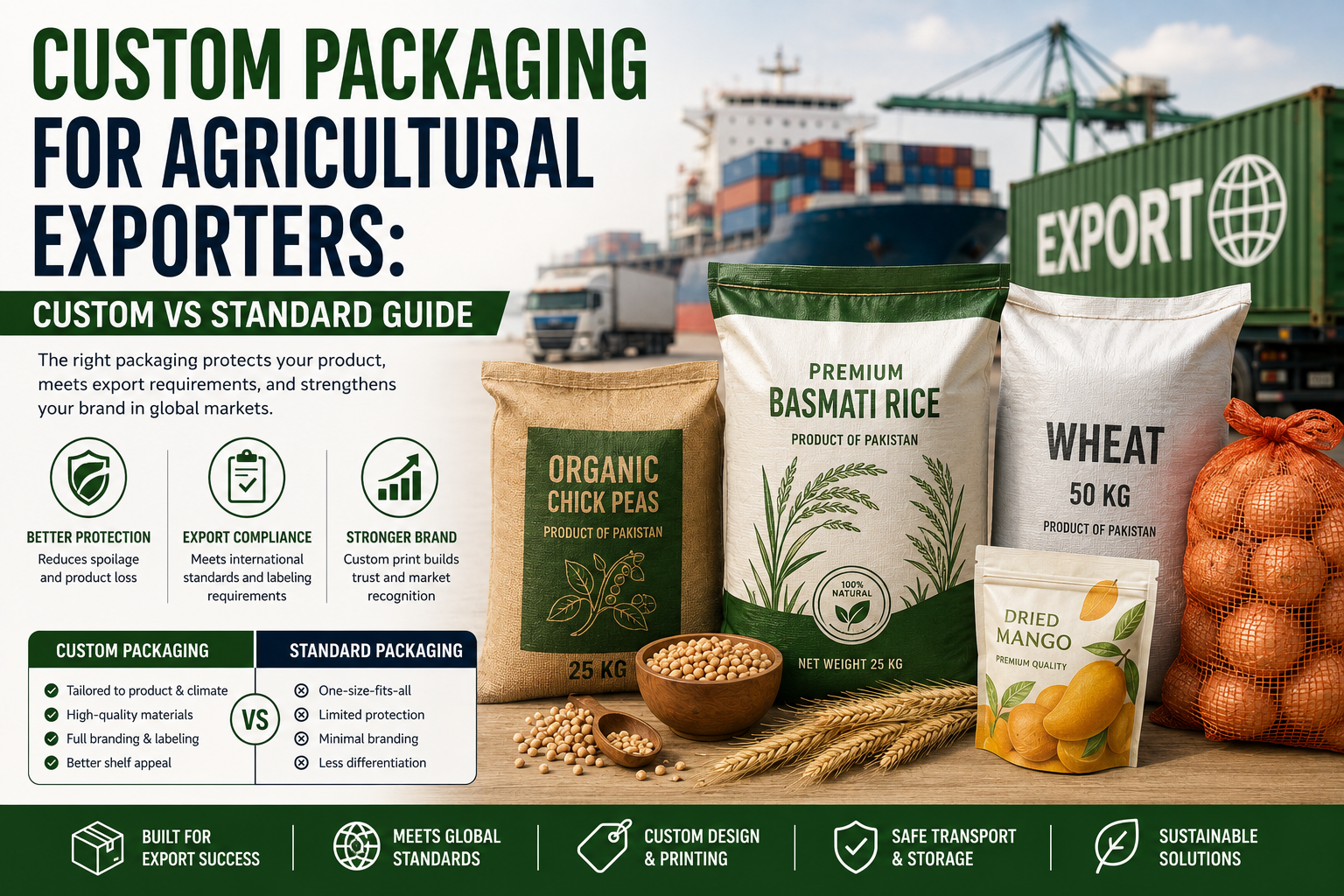
Custom packaging for agricultural exporters refers to bags, sacks, or pouches engineered around a specific product, climate, and shipping route, rather than pulled from a distributor’s stock sizes. The purpose is to reduce spoilage, meet destination-market compliance, and support stronger branding, which standard, off-the-shelf packaging usually can’t match on any of the three.
Every agricultural exporter eventually hits the same question: buy a generic bag from a distributor, or invest in packaging built specifically around the product and the route it’s traveling. The answer isn’t always obvious.
Custom packaging for agricultural exporters costs more upfront and takes longer to set up. But it solves problems that a standard bag simply wasn’t designed to handle, like a six-week ocean transit through variable humidity or a buyer’s specific labeling requirements at the port of entry.
This guide breaks down when custom packaging earns its cost, when standard bags are the smarter call, and what exporters should check before committing either way. The goal isn’t to push every exporter toward the more expensive option; it’s to give a clear framework for matching export packaging for agriculture to the actual shipment, product value, and destination market.
What Is Custom Packaging for Agricultural Exporters?
Custom packaging means a bag or pouch built to a specific set of requirements. That includes the exact product, the climate at origin and destination, the shipping method, and often the buyer’s own labeling or certification demands.
A converter builds the structure, film thickness, and printing around those specifics rather than offering a one-size-fits-most bag. Agriculture & Produce exporters most often turn to custom packaging after a standard bag has failed them before, whether that’s a shipment that arrived with moisture damage or a buyer who rejected a load over incorrect labeling.
Once that happens, the cost of a custom solution starts looking a lot more reasonable next to the cost of a rejected container. Some exporters also move to custom packaging proactively once they scale into new markets, recognizing that generic bags limit how competitively they can present product against local suppliers who already package to retail standards.
Benefits of Custom Packaging for Agricultural Exporters
The core benefits of custom packaging for agricultural exporters fall into three categories: product protection, compliance, and brand presentation. Each one addresses a different failure point that standard bags tend to run into on longer export routes.
On product protection, custom barrier structures are built around the specific product’s moisture, oxygen, and pest sensitivity rather than a generic average. This directly reduces spoilage and rejected shipments on longer transit times.
On compliance, custom packaging can carry destination-specific labeling, language, and certification marks printed directly into the design. This avoids the delays that come from relabeling shipments at customs.
On branding, custom printing lets an exporter present product at retail quality rather than generic bulk packaging. For exporters selling into retail chains rather than through a distributor, this difference alone can determine whether a shipment gets accepted or held.
Custom vs Standard Agricultural Packaging
The table below breaks down the core differences exporters run into when comparing custom vs standard produce bags and dry-good packaging formats.
| Factor | Custom Packaging | Standard Packaging |
| Cost per unit | Higher, especially at low volume | Lower, due to bulk manufacturing |
| Branding | Full customization, retail-ready | Limited to generic or minimal printing |
| Compliance | Built to destination requirements | Basic, may need relabeling |
| Minimum order quantity | Typically higher | Typically lower |
| Product protection | Optimized for specific product and route | Generic, one-size-fits-most |
| Lead time | Longer, requires sampling and testing | Shorter, ready-made stock |
1. Material Specifications
Standard bags are manufactured in bulk to general specifications, which keeps unit costs low but means the barrier properties and film thickness are fixed regardless of what’s going inside. Custom bags let an exporter dial in film thickness, barrier layers, and ventilation to match the specific product.
Fresh Vegetables & Fruits moving through humid coastal ports need different ventilation than the same product moving through a dry inland route. A custom bag can be built around that specific journey, while a standard mesh bag treats every shipment the same way.
2. Branding & Printing
Standard bags typically ship with minimal or generic branding. Custom packaging can carry full retail-ready graphics, multilingual labeling for the destination market, and compliance markings required by the importing country.
Custom printed agricultural bags also give exporters more control over how a product looks next to competitors on a foreign retail shelf, which matters more as an exporter moves from bulk supply into branded retail relationships.
3. Compliance Requirements
Standard bags can meet basic requirements for straightforward, low-risk shipments. Destinations with strict phytosanitary, labeling, or material rules often require packaging built specifically to meet those standards.
Building compliance features into the packaging from the start, rather than adding stickers or supplemental labels later, tends to hold up better under customs inspection.
4. Cost Differences
Per-unit cost is almost always higher for custom packaging, particularly at low order volumes. That gap narrows significantly as order volume increases and tooling costs get spread across more units.
The real comparison isn’t unit price alone. It’s unit price weighed against reduced spoilage, avoided customs delays, and fewer rejected shipments over a full export season.
When Should Exporters Use Custom Packaging?
Should exporters use custom packaging? The honest answer depends on shipment value, destination requirements, and how often the same product moves the same route.
A one-off shipment to a new market rarely justifies the tooling and minimum order quantities that custom packaging usually requires. Recurring, high-value shipments are where custom packaging for agricultural exporters pays for itself.
Dried Fruits & Nuts Packaging is a good example, since these products are prone to rancidity from oxygen exposure and often carry high per-unit value. That combination makes the added cost of a multi-layer barrier bag easy to justify against the cost of a spoiled container.
Exporters entering markets with strict labeling or phytosanitary requirements also lean toward custom packaging. Standard bags rarely carry the specific certification marks or multilingual text that some importing countries require, and building this in from the start avoids relabeling shipments at the port.
Bulk Agricultural Packaging: Where Standard Bags Still Work
Standard bags aren’t obsolete just because custom options exist. Bulk agricultural packaging for domestic or short-route shipments, where climate and handling conditions are predictable, often performs just as well in a standard woven PP sack as it would in a custom-built alternative.
Grain and Pulses moving short distances to a nearby mill or regional buyer rarely need the added barrier properties or branding that custom packaging provides. Standard bags keep unit costs down without sacrificing product quality on these shorter, more predictable routes.
The general rule holds across most agricultural categories: the more predictable the route and the lower the per-unit product value, the less an exporter has to gain from moving to custom packaging.
Cost of Custom Agricultural Packaging
The cost of custom agricultural packaging breaks down into a few distinct line items, and exporters evaluating the switch should ask about each one separately rather than accepting a single bundled quote.
Tooling costs cover the setup work for a new bag design, print plates, and any specialized barrier structure. This is typically a one-time cost that gets absorbed more easily on larger, recurring orders.
Minimum order quantity is the next factor, and it varies significantly between converters. Some overseas manufacturers set MOQs that don’t make sense for a mid-size exporter still testing a new market, while others offer smaller custom runs at a modest premium.
Per-unit cost naturally runs higher for custom bags than for stock standard packaging, especially at low volumes. That premium typically shrinks as order size grows and tooling costs spread across more units.
Long-term savings are where the comparison actually favors custom packaging for many exporters. Reduced spoilage, fewer rejected shipments, and avoided relabeling at customs often outweigh the higher per-unit cost once a full export season is factored in.
Export Packaging Compliance and Documentation
Compliance is often the deciding factor that pushes an exporter toward custom packaging, even when cost alone might favor a standard bag. Many importing countries have specific agricultural export packaging requirements around labeling, materials, or phytosanitary treatment that generic packaging doesn’t meet out of the box.
Wood pallets and crates used alongside flexible packaging fall under their own set of export packaging regulations. According to USDA APHIS, wood packaging material moving internationally must be treated and certified under International Standards for Phytosanitary Measures No. 15 (ISPM 15), regardless of what product is packed inside the crate.
Exporters who overlook this detail on the wood packaging side of a shipment can face the same customs delays as those who get the primary product packaging wrong. Meat & Frozen Food Packaging carries its own layer of compliance on top of general export rules, since cold-chain products typically require temperature logging and documentation proving the packaging maintained integrity throughout transit.
Documentation requirements also vary significantly by destination. Some countries require specific language on labels.
Others require particular certification marks printed directly on the packaging rather than as a separate attached label. Working with an export-ready packaging supplier who already understands these requirements saves an exporter from learning them the hard way at a foreign customs checkpoint.
Choosing Custom Packaging for Agricultural Exporters
Choosing custom packaging for agricultural exporters starts with picking the right manufacturing partner, not just the right material. A custom agricultural packaging manufacturer earns its higher price point by handling the technical side of a shipment that a distributor simply can’t.
This includes running material tests specific to a product, adjusting film structures for a particular climate, and producing smaller custom runs without the massive minimum order quantities that some overseas converters demand. Tea & Coffee Packaging is a useful example of how specialized this can get, since these products need aroma-lock barriers and sometimes degassing valves that a generic bag manufacturer won’t offer as a standard option.
A converter with in-house lamination and printing capability can build these features directly into a bag rather than requiring a separate supplier for each component. Buyers should ask a prospective manufacturer for material test data specific to their product category, not just general claims about barrier performance.
A converter that can show real transit testing results, rather than lab specifications alone, is a stronger long-term partner for export volume.
What to Look for in an Export-Ready Packaging Supplier?
An export-ready packaging supplier needs to prove more than manufacturing capability. Lead time reliability matters as much as material quality, since agricultural export windows are often fixed by harvest timing and shipping schedules that don’t move for a production delay.
Ask a supplier directly about their experience with the specific destination market. A packaging partner that has already shipped similar products into the same country will know the labeling quirks and customs expectations that a first-time exporter might miss entirely.
Contipack Inc works with agricultural exporters on custom bag structures built around destination-specific requirements, drawing on production experience across both bulk and retail formats. Minimum order quantities are worth confirming early too, since some overseas converters set MOQs that don’t make sense for a mid-size exporter testing a new market.
Pricing conversations with a potential supplier should go beyond the per-bag quote. Ask about tooling costs, sample charges, and whether pricing improves at higher volumes once a route proves out.
Frequently Asked Questions
1. Should exporters use custom packaging?
It depends on shipment value, route predictability, and destination requirements. High-value, recurring shipments into markets with strict labeling or barrier requirements usually justify custom packaging, while low-value, short-route, domestic-style shipments often don’t need it.
2. What’s the difference between custom and standard agricultural packaging?
Standard packaging uses generic, pre-made bag sizes and materials built for general use, while custom packaging is engineered around a specific product, climate, shipping route, and destination market’s labeling or compliance requirements.
3. Is custom packaging always more expensive than standard bags?
Per-unit cost is usually higher for custom packaging, especially at low volumes, but total cost can come out lower once reduced spoilage, avoided customs delays, and fewer rejected shipments are factored in.
4. How long does it take to develop custom agricultural packaging?
Development timelines vary by converter, but exporters should expect several weeks for material testing and sample rounds before a custom structure is ready for full production, so this needs to be planned around harvest and shipping schedules, not added at the last minute.
5. Do standard bags meet export compliance requirements?
Sometimes, but not always. Standard bags can meet basic requirements for straightforward shipments, but destinations with strict phytosanitary, labeling, or material rules often require packaging built specifically to meet those standards.
Final Thoughts
Custom packaging for agricultural exporters isn’t automatically the right call for every shipment, and standard bags aren’t automatically the cheaper mistake. The decision comes down to what the product needs to survive the actual route it’s traveling and what the destination market requires.
It also comes down to how much a single rejected or spoiled shipment would actually cost against the price of building packaging correctly the first time.
Exporters dealing with moisture damage, labeling challenges, or destination-specific compliance requirements should evaluate whether a custom packaging program can reduce risk and improve product presentation. Working with an experienced packaging supplier helps align packaging performance with export market requirements, so shipments arrive in the condition and with the documentation that the destination market expects.