
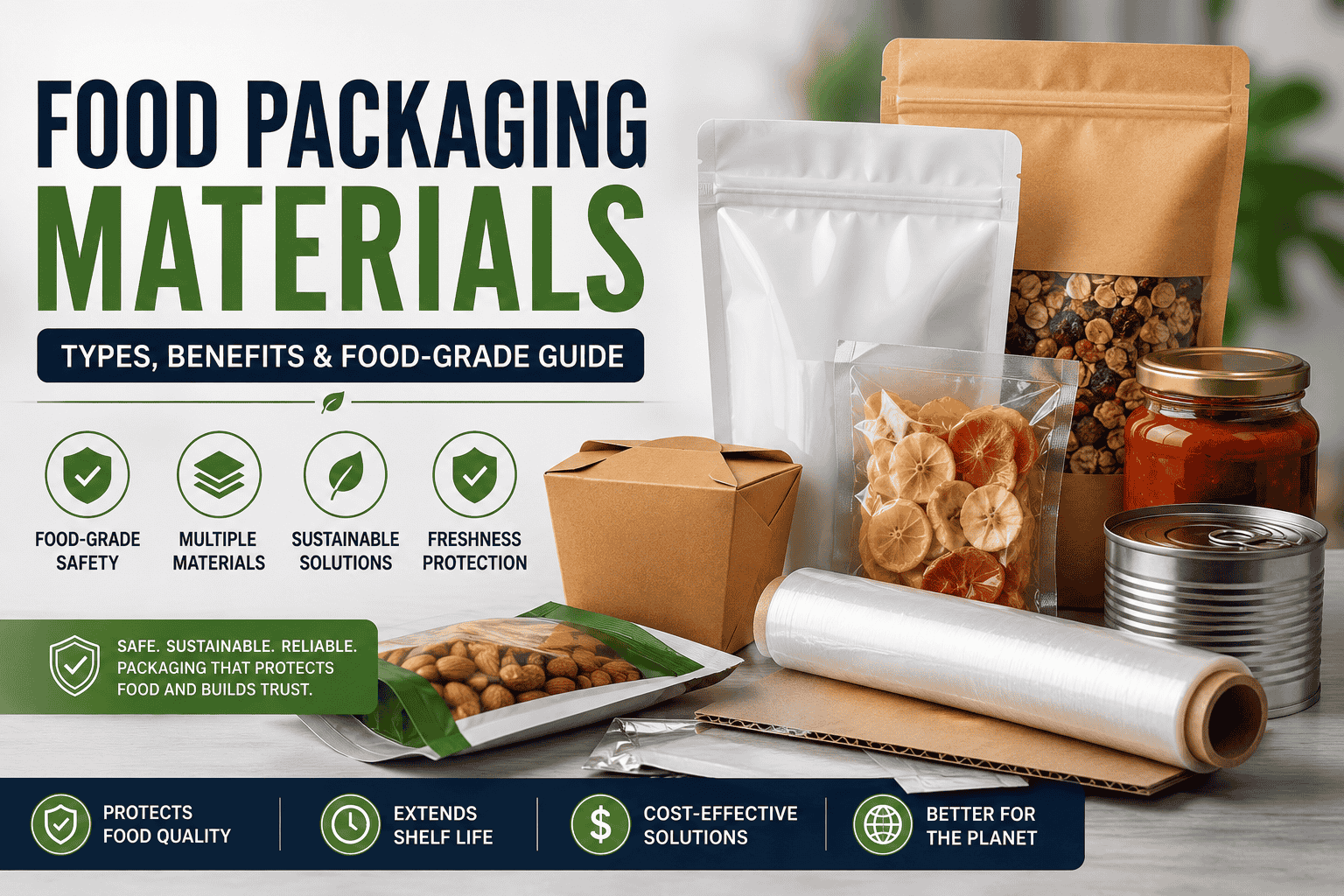
Roughly a third of the food produced worldwide is lost or wasted before it ever reaches a plate, and packaging failure quietly drives a meaningful share of that number. A seal that fails, a film that lets moisture through, or a can that lets in oxygen can spoil a product long before its intended shelf life runs out, turning a food safety issue into a financial one overnight. For manufacturers, restaurants, and small food brands alike, choosing the right food packaging materials isn’t just a design decision. It’s a safety decision, a cost decision, and often the thing that shapes how customers see a brand on a store shelf. This guide walks through the materials used in food packaging today, what actually counts as food-grade, and which food packaging materials hold up best over time.
What Are Food Packaging Materials?
Food packaging materials are the substances, films, and structures used to contain, protect, and preserve food products from production through consumption. They include plastics, glass, metal, paperboard, and laminates, each tested and approved for direct or indirect food contact under recognized food safety standards.
Common Food Packaging Materials
- Plastic films and rigid plastics
- Paperboard and corrugated cardboard
- Glass
- Metal (aluminum and tin-coated steel)
- Laminates
- Biodegradable and compostable materials
What Materials Are Used For Food Packaging?
Ask ten people in the packaging industry what materials matter most, and you’ll get ten different answers, but a few names show up on every list. Plastic films like polyethylene and polypropylene handle everything from snack bags to frozen food pouches. Paperboard and corrugated cardboard carry dry goods, bakery items, and take-out boxes. Glass jars still hold their place for sauces, jams, and preserves because they don’t react with acidic foods over long storage periods. Metal cans, particularly aluminum and tin-coated steel, protect food from light and oxygen for years at a time without changing the taste of what’s inside.
Each of these only counts as a true food-grade packaging material once it’s manufactured and tested to keep contaminants away from what’s inside it. That’s the real dividing line between packaging built for a hardware store and packaging trusted with a sandwich or a jar of baby food. The food & beverage industry relies on this distinction every single day, since one non-compliant batch of packaging can pull a product off shelves fast and cost a brand its reputation.
Material choice also affects cost in ways that aren’t obvious at first glance. A cheaper material that lets a product spoil faster ends up costing more in returns, complaints, and wasted inventory than a slightly pricier option built to protect the product properly. Brands that treat packaging as an afterthought usually learn this the hard way, often after a batch comes back damaged,d or a customer complains about stale product on a shelf.
Types Of Food Packaging Materials And Their Uses
Beyond the raw material itself, the format a package takes plays just as big a role in how well it protects food and how it performs on a shelf. The right combination of material and format depends on the product, its sensitivity to air and moisture, and how it moves through the supply chain.
1. Plastics, Films, and Laminates
Plastic remains the workhorse of the packaging world because it’s light, cheap to produce, and easy to shape into almost any format. Rigid plastics like PET and HDPE show up in bottles and tubs, while flexible films handle pouches, wraps, and bags. Laminates combine two or more layers, such as a plastic film bonded to foil, so the finished material picks up strengths from each layer instead of relying on just one.
2. Paper, Glass, and Metal Options
Paper and cardboard work well for dry, low-moisture products and for outer packaging that doesn’t touch food directly. When brands need a stronger barrier without adding plastic bulk, paperboard is increasingly paired with thin coatings that boost moisture resistance while keeping the package recyclable.
Glass gives brands a premium look and doesn’t pick up odors or flavors from what it holds, though it adds weight and breaks if handled carelessly during shipping or on the retail floor. It remains a favorite for sauces, oils, and preserves where flavor integrity matters more than shipping cost.
Metal cans and foil pouches sit at the top of the list for shelf life, since almost no light or oxygen gets through a properly sealed can. Canned vegetables, soups, and pet food routinely sit on a shelf for one to five years without any noticeable quality loss, which is difficult to match with most other food packaging materials.
3. Common Flexible Formats
Flexible packaging shows up in several standard formats, each suited to a different kind of product.
- Flat Bottom Pouches stand upright on shelves and work well for coffee, granola, and pet treats where shelf presence matters.
- Stick Pack formats handle single-serve powders like protein mixes, seasonings, and instant beverages.
- Flow Wrap packaging suits bars, baked goods, and confectionery that need a fast, low-cost seal.
- Child-Resistant packaging is increasingly required for edible products and supplements that need to stay out of reach of young children while remaining easy for adults to open.
What Is Food-Grade Packaging?
Food-grade packaging is packaging specifically manufactured and tested for direct food contact. It prevents contamination, does not transfer harmful substances into food, and complies with food safety regulations such as FDA and CFIA standards.
Food-grade packaging refers to any material approved for direct contact with food, meaning it won’t leach chemicals, transfer odors, or react with the product sitting inside it. In Canada, that approval generally follows Health Canada guidelines with oversight from the CFIA. In the US, the FDA sets the standard. Suppliers run migration testing to measure how much of a material, if any, transfers into the food itself under normal storage, heating, and handling conditions.
A material doesn’t earn food-grade status just because it looks clean or feels sturdy in your hand. It has to pass specific chemical and physical testing before it ever touches a real product, and that testing has to be repeated whenever the formulation or supplier changes. This is why testing matters so much for food packaging materials before they ever reach a filling line.
It’s also worth knowing that food-grade status applies to the whole package, not just the layer that touches the food. Inks, adhesives, and coatings used on the outside of a pouch or the inside of a lid all need to meet the same standards, since heat, pressure, or long storage can sometimes cause components to migrate between layers over time. A packaging line that only tests the inner layer and skips the rest of the structure is cutting a corner that regulators and buyers both tend to notice sooner or later.
Food Packaging Regulations And Compliance
Compliance sits at the center of every decision involving food packaging materials, and the rules differ slightly depending on where a product is sold.
- FDA (United States): Regulates food-contact substances under Title 21 of the Code of Federal Regulations, requiring premarket approval for new materials that touch food.
- CFIA (Canada): Oversees food packaging compliance alongside Health Canada, focusing on labeling accuracy and food-contact material safety.
- Food-Contact Testing: Confirms a material performs safely under real handling, heating, and storage conditions before it reaches production.
- Migration Testing: Measures how much of a packaging component, if any, transfers into food over time, which is central to food-grade approval.
- Food Safety Standards: Set the baseline every food packaging solution must meet, covering everything from raw material sourcing to finished-pouch sealing.
Working with a supplier who can produce current certificates and migration test data on request is one of the fastest ways to confirm a packaging structure meets food safety standards before a production run begins.
Barrier Packaging for Food: Keeping Freshness Locked In
Barrier packaging for food is built around one job: keeping oxygen, moisture, and light away from the product inside. Multi-layer films combine materials like EVOH, nylon, and polyethylene to slow gas transfer, which cuts down on oxidation and keeps flavors from fading over weeks in storage. Coffee bags are a good example, since they pair one-way degassing valves with barrier layers so the beans stay fresh without trapping the natural gases coffee releases after roasting.
A properly built food-safe packaging film does more than look good sitting on a shelf. It gets tested for oxygen transmission rate and moisture vapor transmission rate, two numbers that tell a manufacturer roughly how long a product will stay fresh once it’s sealed. Choosing a proven food-safe packaging film matters even more for products with a longer required shelf life, since a weak seal or thin barrier layer shows up as spoilage long before the sell-by date.
That evaluation process is what separates a food packaging solution built on real performance data from one chosen on price alone. It’s also what good food packaging materials are designed to do in the first place: protect the product long after it leaves the production line.
Sustainable Packaging has pushed barrier technology forward too, since paper-based barrier laminates now perform closer to plastic than they did even five years ago. That gives food brands a lower-impact option without giving up much on shelf life, which matters more each year as retailers push suppliers toward greener formats.
Flexible Packaging Materials For Food
Flexible packaging materials for food have taken over a large share of the market once dominated by rigid containers. Stand-up pouches, flat-bottom bags, and rollstock film use less raw material per unit than jars or rigid tubs, which lowers shipping weight and cuts down on storage space at both the warehouse and the store. Snack foods, pet treats, and ready meals all lean on flexible formats now because they seal well, print well, and cost less to ship across long distances. Most flexible formats today are built around some version of a food-safe packaging film, which keeps costs down while still meeting basic safety and freshness requirements. That shift explains why flexible options now dominate conversations about food packaging materials across the industry.
Flexible Packaging also gives smaller food brands a way to compete with larger companies on shelf presence, since custom printing on film has become far more affordable than it used to be even a decade ago. A small batch producer can now order a few thousand pouches with full color branding instead of committing to a run of a hundred thousand units just to make custom printing worthwhile.
Custom Mylar Bags show up often in this category, especially for products that need a strong barrier against light and oxygen, like coffee, jerky, and freeze-dried meals meant to sit in storage for months at a time. The metallic layer inside a mylar bag blocks nearly all light transmission, which matters a lot for products sensitive to UV exposure.
For smaller portions, Custom Sachet Packaging handles single-serve condiments, spice mixes, and supplement powders without wasting material on packaging that’s bigger than the product itself. Sachets also cut down on food waste for the end user, since a smaller pack means less gets thrown out after opening.
Other Packaging Formats Worth Knowing
A handful of specialized formats extend the shelf life or safety profile of food packaging materials even further, and each fits a different production and distribution need.
- Vacuum Packaging: Removes air before sealing to slow oxidation and microbial growth, commonly used for meats, cheeses, and sous-vide products.
- Modified Atmosphere Packaging (MAP): Replaces oxygen inside the pack with nitrogen or another inert gas before sealing. This slows bacterial growth and oxidation without needing the thick, rigid walls of a can or jar.
- Retort Packaging: Uses heat-resistant pouches or trays that can be sterilized after sealing, giving shelf-stable meals a long shelf life without refrigeration.
- Aseptic Packaging: Sterilizes the product and package separately before filling in a sterile environment, a common approach for shelf-stable dairy and juice cartons.
Which Packaging Material Keeps Food Fresh Longest?
This is the question most food brands actually care about, and the honest answer is that it depends on the product. Canned goods in metal packaging can last for years because the seal is airtight and the material blocks light completely. Glass performs almost as well, minus a small risk of breakage during shipping and handling. Multi-layer barrier film sits close behind both, often matching can-level shelf life for dry and shelf-stable products while weighing a fraction as much and costing less to transport.
Paper and cardboard, on their own, don’t keep food fresh for very long. They’re usually paired with a liner or coating, like wax or a thin plastic film, whenever freshness actually matters for the product inside. On their own, they’re better suited to dry goods that aren’t sensitive to moisture or oxygen exposure.
Fresh Vegetables & Fruits Packaging works differently than most of these examples, since produce needs to breathe even after it’s sealed. Micro-perforated films let a small amount of air exchange happen so vegetables and fruit don’t sweat, rot, or ripen too quickly inside a sealed bag. Getting that balance right takes testing specific to each type of produce, since a leafy green and a root vegetable release moisture at very different rates.
A few real-world examples show how this plays out across categories:
- Coffee: Foil-lined pouches with degassing valves preserve aroma and slow staling for months.
- Frozen Foods: Moisture-barrier films prevent freezer burn and ice crystal formation.
- Dairy Products: Aseptic cartons and HDPE bottles protect against light exposure that breaks down vitamins and flavor.
- Fresh Produce: Micro-perforated films balance breathability with moisture control.
- Pet Food: Multi-layer laminate bags and cans both deliver long shelf life for kibble and wet formulas alike.
Food Packaging Material Comparison
The table below compares common food packaging materials based on their typical applications, barrier performance, and recyclability.
| Material | Best Use | Barrier Protection | Recyclability |
| Plastic Films | Snacks | High | Moderate |
| Glass | Sauces | Excellent | High |
| Metal | Canned Foods | Excellent | High |
| Paperboard | Dry Foods | Low | High |
Pros And Cons Of Common Food Packaging Materials
Each packaging material offers unique advantages and trade-offs. Understanding these differences helps brands choose the right solution for their products.
| Material | Pros | Cons |
| Plastic | Lightweight, low cost, adaptable | Environmental concerns, limited recyclability in some formats |
| Glass | Premium appearance, no flavor transfer | Heavy, breakable, higher shipping cost |
| Metal | Long shelf life, excellent barrier | Higher production cost, adds weight |
| Paper | Recyclable, low cost | Limited barrier without added coatings |
What Is the Best Food Packaging Material?
There is no single best food packaging material for every product. Metal, glass, flexible barrier films, and paper-based structures each serve different purposes depending on shelf-life requirements, moisture sensitivity, oxygen exposure, and distribution conditions.
Sustainable Food Packaging Materials
Sustainability has moved from a nice-to-have to a baseline expectation for most food brands, and food packaging materials are evolving quickly to keep up.
- Recyclable Packaging: Structures made from a single material stream, such as PET or paperboard, that existing recycling systems can process.
- Compostable Packaging: Plant-based films and coatings designed to break down under industrial or, in some cases, home composting conditions.
- Mono-Material Packaging: Pouches and films built from a single polymer type instead of mixed laminates, making them far easier to recycle at scale.
- Eco-Friendly Packaging: A broader category covering reduced material weight, recycled content, and lower-impact printing and inks.
None of these options are worth much if they compromise food safety or shelf life, so brands moving toward sustainable food packaging materials should ask suppliers for barrier performance data alongside recyclability claims.
How to Choose the Right Food Packaging Material
Choosing among food packaging materials gets easier once a brand works through the same set of questions every packaging engineer asks before recommending a structure.
- Product Type: Liquid, powder, solid, and fresh produce all behave differently inside a sealed package.
- Moisture Sensitivity: Products that absorb humidity need a stronger moisture barrier than shelf-stable dry goods.
- Oxygen Sensitivity: Fats and oils oxidize quickly, so high-fat products usually need a higher oxygen barrier.
- Shelf Life Goals: A product meant to sit in a warehouse for a year needs different protection than one sold within a week.
- Shipping Conditions: Temperature swings, rough handling, and long transit times all affect which material holds up best.
- Budget: The lowest-cost material per unit isn’t always the lowest total cost once spoilage and returns are factored in.
Choosing the Right Food Packaging Material Supplier
Picking a food packaging material supplier comes down to more than price per unit. A reliable food packaging material supplier should provide compliance documentation, barrier testing data, and consistent production quality. A supplier should also be able to explain exactly what’s in the material they’re selling without dodging the question. Lead times matter too, since a supplier that can’t keep up with order volume during a busy season can stall production for weeks and cost a brand real sales.
Ask for samples before committing to a full order. A film or laminate that looks fine on paper can behave differently once it runs through actual filling and sealing equipment, and small issues like seal strength or print adhesion often only show up once production starts.
It’s also worth asking a supplier how they handle formulation changes. Any adjustment to a resin formulation, adhesive, or coating can affect food-grade status, so a supplier that re-tests after every material change is a stronger long-term partner than one that treats certification as a one-time checkbox.
Working With A Custom Food Packaging Manufacturer
A custom food packaging manufacturer builds structures around a product instead of asking a brand to fit its product into a standard bag or box. That might mean adjusting the barrier layer for a product with high oil content, adding a resealable zipper for a snack meant to be eaten over several days, or matching a pouch size exactly to an existing filling line so production doesn’t slow down. Working with an experienced custom food packaging manufacturer allows brands to tailor packaging structures to specific shelf-life, branding, and distribution requirements.
For brands sourcing internationally, shipping timelines and minimum order quantities deserve just as much attention as the material itself. A supplier overseas might offer a lower unit price, but longer transit times mean brands need to plan inventory further ahead, and any mistake in the artwork or spec sheet takes weeks to fix instead of days. Local or regional suppliers often cost more per unit but make it easier to run smaller test batches before committing to a large production order.
A good manufacturing partner will also flag packaging performance issues before they reach a filling line, such as a seal width too narrow for a heavier product or a pouch structure that won’t hold up in cold-chain shipping. Catching those problems on paper is far cheaper than catching them after a batch ships.
Companies like Contipack Inc work directly with food brands across Canada to build packaging around the product first, rather than forcing a product into an off-the-shelf format that doesn’t quite fit its shape, weight, or shelf life needs. That kind of back-and-forth between a brand and a manufacturer usually produces a better result than picking a size off a catalog page.
Frequently Asked Questions
1. What materials are used for food packaging?
Food packaging commonly uses plastic films, paperboard, glass, metal, and laminates, with the choice depending on the product’s sensitivity to moisture, oxygen, and light.
2. What is food-grade packaging?
Food-grade packaging is any material tested and approved for direct food contact, meaning it won’t leach chemicals or react with the product it holds.
3. Which packaging material keeps food fresh longest?
Metal cans and glass typically offer the longest shelf life due to their airtight seals, with multi-layer barrier films close behind for dry and shelf-stable products.
4. Is flexible packaging safe for food?
Yes, as long as the film and any inks, adhesives, or coatings used in it are tested and certified as food-grade under FDA or CFIA standards.
5. How do I choose a food packaging supplier?
Look for current certifications, migration and barrier test data, sample availability, and consistent lead times before committing to a full production order.
Final Thoughts on Food Packaging Materials
Choosing the right food packaging materials isn’t a one-size-fits-all decision. What works for a bag of frozen vegetables won’t work for a jar of pasta sauce, and what keeps coffee fresh won’t do much for produce that needs airflow to stay crisp. The best approach starts with understanding the product itself: how sensitive it is to oxygen, light, and moisture, how long it needs to stay fresh on a shelf, and how it will move through shipping and storage before it reaches a customer. From there, matching the material, whether that’s a barrier film, a glass jar, or a custom pouch, gets a lot more straightforward.
Need help selecting the right food packaging materials for your product? Contact Contipack Inc to discuss custom food packaging solutions tailored to your product, shelf-life requirements, and branding goals.