
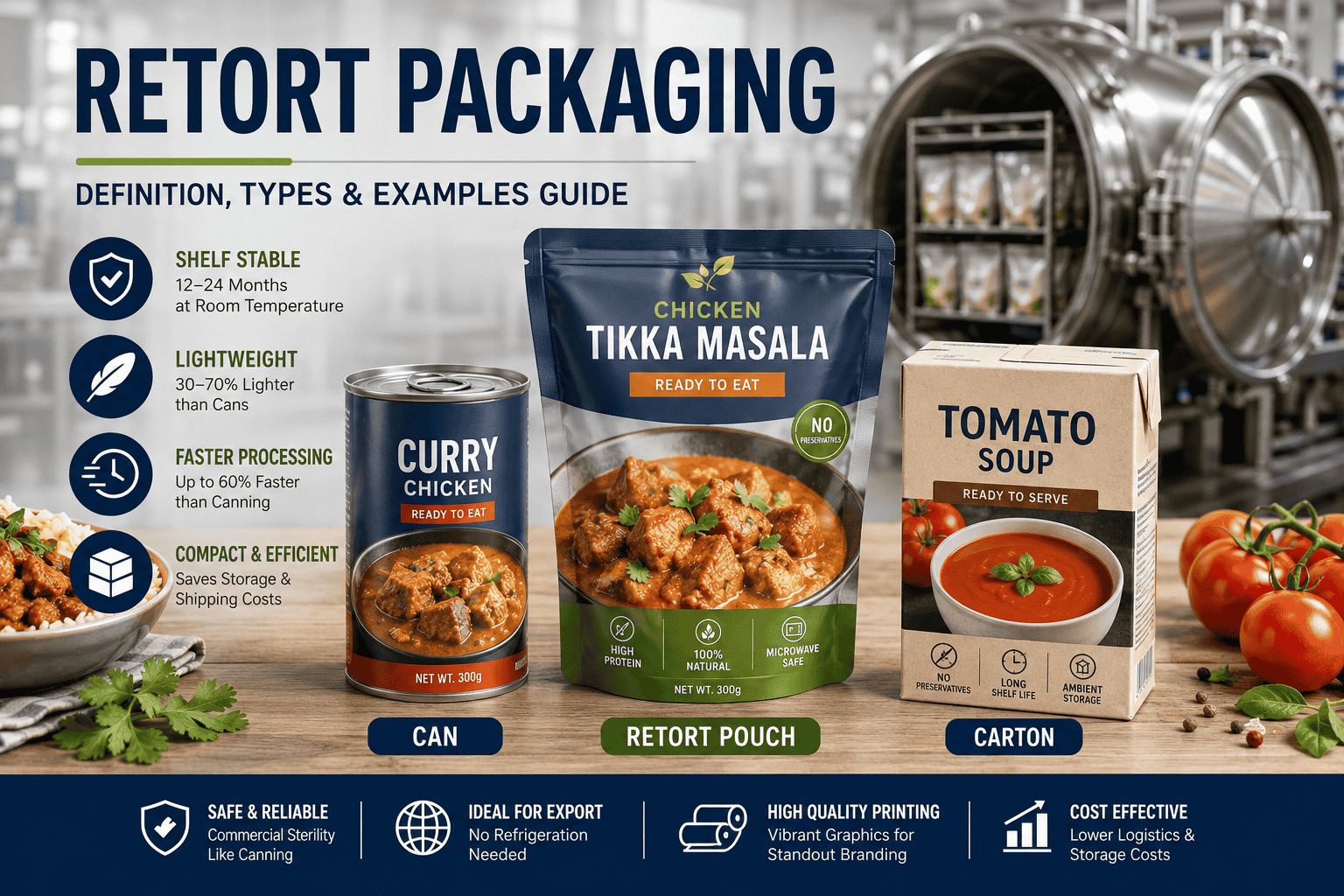
Retort packaging is one of those terms that gets thrown around a lot in the food industry without much explanation. If you’ve ever wondered what retort packaging actually means, how it’s different from a can, or whether it’s the right call for your next product, this guide covers it from the ground up. We’ll walk through the definition, the technology behind it, the materials, real examples on store shelves, and the questions most brands ask before switching.
Retort Packaging Definition
The simplest retort packaging definition is this: it’s food packaging engineered to survive a sterilization process that uses high heat and pressure at the same time. That process, called retorting, kills bacteria and other microorganisms inside a sealed package, which is what makes the food inside shelf-stable at room temperature.
The retort packaging meaning gets clearer once you understand where the word comes from. A “retort” is the pressurized vessel, similar to an industrial pressure cooker, where filled and sealed packages are processed. Anything described as retortable, whether that’s a retortable pouch, tray, or carton, has been built with films and seals strong enough to survive that heat-and-pressure cycle without failing.
So what is a retort pouch, specifically? It’s a flexible, laminated bag made from multiple film layers, filled with food, heat-sealed, then run through the retort cycle. What retort pouch packaging in practice comes down to is that combination: a flexible format that behaves like a can once it’s been through processing. In some markets, especially across South Asia and the Gulf, you’ll also hear the term retort packing used interchangeably with retort packaging, referring to the same sterilized, shelf-stable pouch format.
How Retort Packaging Technology Works?
Retort packaging technology starts with the pouch itself. Food is filled and heat-sealed into a laminated pouch or tray, then loaded onto racks and rolled into the retort chamber. Inside, temperatures typically reach around 250°F, and pressure rises right along with them.
That pressure isn’t incidental. It offsets the internal pressure building in the sealed pouch as the contents heat up, preventing the seals from bulging or bursting mid-cycle. Once the process finishes, packages are cooled under controlled pressure before moving to labeling and distribution.
One advantage worth knowing about: because a pouch is thinner than a can, heat penetrates it faster. Industry data shows pouch processing can cut retort time by as much as 60% compared to canning the same product, which means less time under heat and better texture and flavor retention by the time the food reaches a customer.
Food manufacturers increasingly adopt retort packaging because of lower logistics costs and reduced storage requirements. That shift shows up across categories, from seafood to ready meals to pet food, and it’s a large part of why pouch formats keep gaining ground on traditional canning.
Retort Pouch Layers: What’s Inside a Retort Pouch
A retort pouch isn’t a single sheet of film. It’s a laminate of layers, each with a specific job, and understanding them helps explain why retort packaging materials cost more to develop than a standard snack pouch.
1. Outer Layer
The outer layer is usually polyester, or PET. This is the layer that gets printed on, and it also resists scuffing and puncture during shipping and handling. Brands running Custom Printed Pouches rely on this layer most, since it’s where rotogravure and flexographic printing produce the sharp, shelf-standout graphics customers notice first. It has to hold its shape through the retort cycle without warping or discoloring.
2. Barrier Layer
The barrier layer is where the real protection happens. Most retort pouches use aluminum foil here, which blocks oxygen, light, and moisture almost completely. Brands that want a microwaveable retort packaging option, or one where the product is visible, use a clear high-barrier film instead of foil. These food-grade barrier films, often EVOH or metallized PET, trade a little protection for transparency and microwave compatibility.
3. Sealant Layer
The inside layer, the one that actually touches the food, is typically cast polypropylene. This layer forms the heat seal and has to survive retort temperatures without breaking down or transferring anything into the food. A weak seal in this layer is the single most common cause of pouch failure, either during processing or months later on a shelf.
Types of Retort Packaging: Pouches, Trays, And Cartons
Retort pouches get most of the attention, but they’re not the only format. Retort trays are semi-rigid, shaped containers used for products like meals or single-serve entrées where a bowl-like shape makes more sense than a flat pouch. Cartons, meanwhile, are used less often for retort processing since paperboard doesn’t handle pressure and heat as well as flexible film or rigid trays.
Between the three, pouches remain the most widely used because they’re the lightest, the cheapest to ship, and the easiest to print with shelf-standout graphics. Many brands choose Stand Up Pouches specifically because they hold their shape on a shelf the way a can does, while still weighing a fraction as much. But for products that need to stand upright on a plate, like a microwaveable retort packaging meal, a tray often makes more practical sense than a pouch.
Retort Packaging Examples
It helps to see where this format actually shows up. Here are some of the most common retort packaging examples found on store shelves today:
- Ready-to-eat meals like rice bowls, curries, and pasta dishes
- Soups, stews, and broths
- Seafood, especially tuna and salmon pouches that replaced traditional cans
- Pet Food Packaging for wet dog and cat food
- Baby food packaging for pouch-format purées and snacks
- Sauces and Ketchup Packaging for condiments that don’t need refrigeration until opened
Military rations and emergency food kits also rely heavily on this format, since long shelf life and light weight both matter when supplies need to travel far without refrigeration.
Retort Pouch vs Can vs Carton
Seeing the three formats side by side makes the tradeoffs easier to weigh.
| Feature | Retort Pouch | Can | Carton |
|---|---|---|---|
| Shelf stability | 12–24 months, ambient | 2–5 years, ambient | Limited, rarely retort-processed |
| Weight vs. contents | 30–70% lighter than an equivalent can | Heavy | Light, but not pressure-rated |
| Processing time | Up to 60% faster than canning | Longer heat penetration time | Not typically retorted |
| Storage footprint | Compact, stacks flat | Bulky, rigid shape | Compact but structurally weak under heat |
| Opening | Tear notch, no tools | Can opener often needed | Not applicable |
| Best suited for | Ready meals, sauces, pet food, seafood | Long-life staples, canned vegetables | Non-retort dry or ambient goods |
Retort pouches land in the middle in a good way. Shelf stability sits close to a can, while shipping weight and storage footprint stay close to a standard flexible pouch. That combination is why so many brands that started on cans have made the switch as volume increases.
Retort Packaging Materials And Barrier Films
Choosing the right retort packaging materials comes down to matching the film structure to the product going inside. A high-acid tomato sauce behaves differently under heat than a low-acid meat product, and the fill weight changes how long the sterilization cycle needs to run.
Most retortable structures rely on a three-layer laminate: PET outer, foil or EVOH barrier, and CPP sealant. Food-grade barrier films matter most for products sensitive to oxygen or light, like anything with fat content that can turn rancid or a sauce that loses color under UV exposure. Getting this wrong doesn’t just shorten shelf life. It can lead to a product recall if a seal fails after the fact.
Retort Pouches For Exporters And International Brands
This format has an extra advantage that domestic brands sometimes overlook: it travels well. A retort pouch weighs a fraction of an equivalent can, and that difference compounds fast across a full container load.
For food brands exporting from Pakistan, the Gulf, or other regions where cold-chain infrastructure isn’t consistent from port to retailer, that matters even more. A shelf-stable pouch doesn’t need a refrigerated container, doesn’t need cold storage at a distribution hub, and doesn’t fail if a shipment sits on a hot dock for a few extra hours. That reliability is part of why export-focused manufacturers keep gravitating toward retort formats over traditional canning, even when the upfront tooling costs more.
Humidity and temperature swings during transit are worth planning for early, not after a shipment fails. A pouch built with the right barrier layer holds up through a long ocean crossing and months in an uncontrolled warehouse. Brands that skip this step and use an under-specified film often find out the hard way, months later, when a batch starts showing seal issues or flavor loss on a retailer’s shelf.
Choosing A Packaging Partner For Retort Pouch Food
Picking the right partner matters more here than with most other formats, because there’s less room for error. A seal that’s slightly off on a standard snack pouch might mean a stale bag of chips. A seal that’s slightly off on a retort pouch can mean a food safety recall.
Contipack Inc works with food and beverage brands across several of these categories, from meat and frozen entrées to sauces and pet food, helping them figure out the right film structure, barrier requirements, and print specifications before a single pouch goes into production.
Retort isn’t the only format most of these brands need. A lot of them also run standard Flexible Packaging lines for products that don’t require sterilization, and switch between the two depending on the product’s shelf-life requirements.
Brands moving frozen products into a shelf-stable line often start by comparing their existing Frozen Food Packaging costs against what a retort pouch would run, since freezer storage and cold-chain freight add up fast at scale.
The same conversation comes up outside food, too. Soap Packaging and other personal care pouches are often produced on the same flexible packaging equipment, just without the sterilization step, so brands expanding into new categories can sometimes consolidate suppliers.
Pet brands ask a similar question when they’re deciding between wet and dry formats. Dog Food Packaging built for retort needs a tougher outer layer than a standard pouch, since these bags get tossed in cabinets, cars, and bags without much care.
The same logic applies outside pet products. Any brand running a general Food Packaging line alongside a retort category should expect different film specs for each, since a snack pouch and a shelf-stable meal pouch are built to survive very different conditions.
Ask any potential partner about their validated process schedules, their track record with your specific food category, and how they handle print and branding on the outer layer. Retort pouches give you a lot of room for shelf-standout graphics since the outer PET layer takes high-resolution printing well.
Frequently Asked Questions
1. What is retort packaging?
Retort packaging is flexible or semi-rigid packaging built to withstand retort processing, a sterilization method using high heat and pressure, so food inside stays shelf-stable at room temperature for 12 to 24 months.
2. What is a retort pouch?
A retort pouch is a laminated, flexible bag made from an outer PET layer, a barrier layer of foil or EVOH, and an inner sealant layer, built specifically to survive the heat and pressure of retort processing.
3. How long do retort pouches last?
Most retort pouches give a shelf life of 12 to 24 months at room temperature, depending on the product and the barrier film used. Some low-acid products can last even longer under the right conditions.
4. Are retort pouches safe?
Yes, when manufactured and processed correctly. Retort pouches reach the same level of commercial sterility as canned food, since both formats rely on validated thermal process schedules designed to destroy harmful bacteria.
5. What foods use retort packaging?
Ready meals, soups, sauces, seafood, pet food, baby food, and military rations are among the most common products packaged using retort technology.
Wrapping Up
Retort packaging isn’t a trend. It’s a proven sterilization method that’s been steadily replacing cans across dozens of food categories because it costs less to ship, takes up less space, and gives customers an easier product to use. Whether you’re launching a ready meal, a pouch of seafood, or a pet food line, understanding the definition, the layers, and the material choices behind retort packaging will save time and money before you ever get to production.
Looking for custom retort pouch packaging? Contact Contipack Inc to discuss material structures, barrier requirements, and custom printing options for your next product launch.