
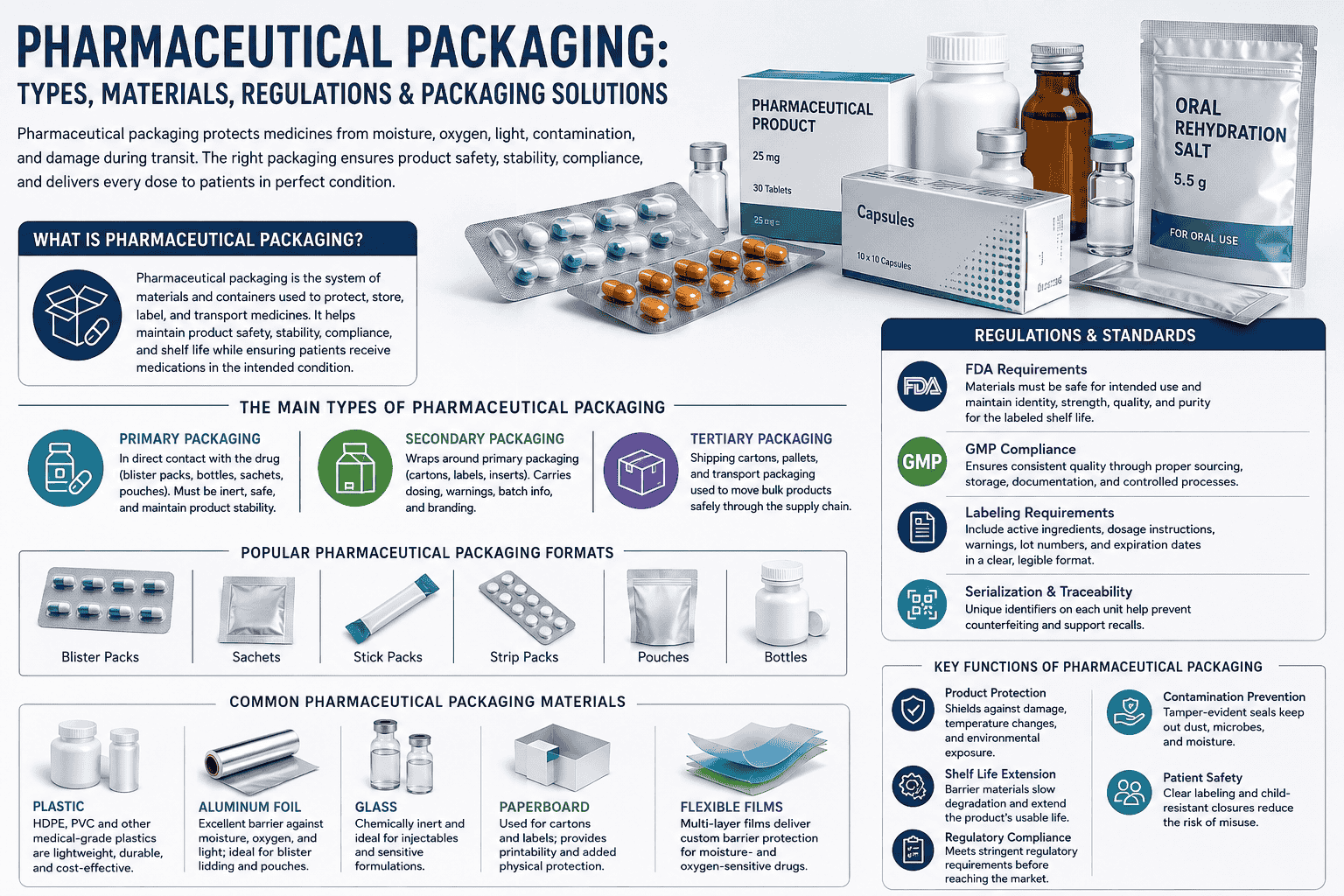
Pharmaceutical packaging is the layer of protection standing between a life-saving medicine and everything that can compromise it: moisture, oxygen, light, contamination, and mishandling in transit. For manufacturers, choosing the right pharma packaging isn’t a cosmetic decision. It’s a compliance requirement, a shelf-life determinant, and a patient-safety measure all at once. This guide walks through the types, materials, regulations, and healthcare packaging solutions that shape how medicines reach patients safely and intact.
What Is Pharmaceutical Packaging?
Pharmaceutical packaging is the system of materials and containers used to protect, store, label, and transport medicines. It helps maintain product safety, stability, compliance, and shelf life while ensuring patients receive medications in their intended condition.
1. Pharmaceutical Packaging Definition
Pharmaceutical packaging refers to the materials and systems used to contain, protect, identify, and deliver pharmaceutical products, from tablets and capsules to liquids, powders, and injectables. It spans everything from the blister pack holding an individual dose to the carton, label, and shipping box that carry it through the supply chain.
2. Why Pharmaceutical Packaging Matters?
Every stage of a drug’s life, from manufacturing to the patient’s hand, depends on packaging that holds up. Poor pharmaceutical product packaging can lead to degraded active ingredients, failed inspections, recalls, or, in the worst cases, harm to the patient. Strong packaging protects potency, supports accurate dosing, and gives regulators and patients confidence that what’s inside the package matches what’s on the label.
The Main Types of Pharmaceutical Packaging
Pharma packaging is generally organized into three tiers, each with a distinct job.
1. Primary Pharmaceutical Packaging
Primary pharmaceutical packaging is the material in direct contact with the drug itself. This includes blister packs, bottles, sachets, and pouches. Because it touches the product directly, primary packaging carries the heaviest compliance burden. It must be inert, non-reactive, and capable of maintaining product stability for the full shelf life.
2. Secondary Pharmaceutical Packaging
Secondary pharmaceutical packaging wraps around the primary layer and typically includes cartons, labels, and package inserts. This tier carries dosing instructions, warnings, batch numbers, and regulatory information, and it plays a major role in brand identification on pharmacy shelves.
3. Tertiary Pharmaceutical Packaging
Tertiary packaging covers shipping cartons, pallets, and transport packaging used to move bulk quantities of product from manufacturing facilities to distributors and pharmacies. It’s built for durability during freight handling rather than direct product contact.
Common Pharmaceutical Packaging Materials
The right pharma packaging materials depend on the drug’s sensitivity to moisture, oxygen, and light, along with cost and sustainability goals.
1. Plastic Packaging Materials
Plastics such as HDPE and PVC are widely used for bottles, blister packs, and closures because they’re lightweight, moldable, and available in medical-grade formulations that meet purity standards.
2. Aluminum Foil Packaging
Aluminum foil is prized for its near-total barrier against moisture, oxygen, and light, which makes it a common lidding material for blister packs and a core layer in laminated pouches for moisture-sensitive drugs. Reliable foil sourcing and lamination quality are a core piece of dependable pharmaceutical packaging solutions, since even minor barrier inconsistencies can shorten a drug’s shelf life.
3. Glass Packaging
Glass remains the standard for injectable vials and ampoules because it’s chemically inert and doesn’t interact with sensitive formulations, though its weight and breakability push many manufacturers toward flexible alternatives where possible.
4. Paperboard Packaging
Paperboard cartons form the secondary layer for most retail pharmaceutical products, offering a printable surface for branding, dosing information, and regulatory text while adding a layer of physical protection. Getting this right is part of what separates generic cartons from true pharmaceutical packaging solutions built to withstand regulatory scrutiny.
5. Flexible Packaging Films
Multi-layer flexible films combine plastics, foil, and specialty coatings into a single structure engineered for a specific barrier target. This is where custom pharma packaging design has the most room to optimize for a product’s exact stability needs. Contipack’s Flexible Packaging capabilities cover exactly this kind of multi-layer film engineering for pharmaceutical-grade barrier requirements.
Essential Functions of Pharmaceutical Packaging
1. Product Protection
Packaging shields the drug from physical damage, temperature swings, and environmental exposure throughout its journey from the production line to the patient.
2. Contamination Prevention
Sealed, tamper-evident structures keep out dust, microbes, and moisture that could compromise a formulation before it’s ever opened.
3. Shelf Life Extension
Barrier materials slow the chemical degradation that shortens a drug’s usable life, which is why oxygen and moisture barrier performance is often the deciding factor when specifying medicine packaging solutions.
4. Patient Safety
Clear labeling, child-resistant closures, and accurate dosing information reduce the risk of misuse and give patients confidence in what they’re taking. This is one of the clearest reasons manufacturers invest in dependable pharma packaging solutions rather than treating packaging as an afterthought.
5. Regulatory Compliance
Packaging has to satisfy a detailed set of regulatory checkpoints before a drug can legally reach a pharmacy shelf, which is covered in more detail below.
Pharmaceutical Packaging Regulations and Standards
1. FDA Requirements
In the United States, the FDA requires that pharmaceutical packaging materials be proven safe for their intended contact use and that container closure systems maintain product identity, strength, quality, and purity for the labeled shelf life.
2. GMP Compliance
Good Manufacturing Practice standards govern how packaging materials are sourced, stored, and applied during production, with documentation required at every step to demonstrate consistent quality control.
3. Labeling Requirements
Regulators mandate specific label content: active ingredients, dosage instructions, warnings, lot numbers, and expiration dates, presented in a legible, standardized format.
4. Serialization and Traceability
Serialization assigns a unique identifier to each saleable unit of a drug, allowing it to be tracked through the supply chain to combat counterfeiting and support recalls when needed.
Popular Pharmaceutical Packaging Formats
1. Blister Packaging
Blister packaging seals individual doses of tablets or capsules between a formed plastic cavity and a foil or film lid, offering strong barrier protection along with built-in dose tracking for patients.
2. Sachet Packaging
Sachets are compact, sealed pouches suited to single-dose powders, granules, and liquids, offering a low-material-use format that’s easy to distribute and carry.
3. Stick Pack Packaging
Stick pack packaging holds a narrow, single-serve column of product, common for powders and granular formulations, and is valued for portability and precise portioning.
4. Strip Packaging
Strip packaging seals tablets or capsules between two layers of film or foil in a continuous strip, commonly used where individual unit separation and moisture protection both matter.
5. Pharmaceutical Pouches
Pharmaceutical pouches are flexible, heat-sealed structures used for powders, liquids, and unit-dose products, and they can be engineered with multiple barrier layers for sensitive formulations. Because pouches fall under the broader category of pharmaceutical flexible packaging, they inherit the same layered barrier engineering used across foil laminates and multi-layer films.
6. Pharmaceutical Bottles
Bottles, typically HDPE plastic or glass, remain the standard format for capsules, tablets, and liquid medications that require multi-dose access with a resealable closure. Choosing the right pharma packaging supplier for bottle sourcing matters just as much as material selection, since consistency in cap torque and seal integrity affects patient safety.
Pharmaceutical Packaging for Different Drug Types
Not every drug needs the same packaging approach. The formulation itself, solid, liquid, powder, or injectable, largely determines which materials and formats are viable.
1. Tablets and Capsules
Tablets and capsules are typically packaged in blister packs or bottles. Blisters offer unit-dose isolation and moisture protection, while bottles suit multi-dose prescriptions where cost and shelf space matter more than individual dose separation.
2. Liquid Medicines
Liquid formulations need leak-proof, chemically compatible containers, usually glass or HDPE bottles with tamper-evident closures. Viscosity, dosing method, and light sensitivity all influence the final container choice.
3. Powders
Powdered drugs and supplements are commonly packed in sachets, stick packs, or pouches. These formats keep the product moisture-free until use and allow precise, single-serve portioning.
4. Injectable Drugs
Injectable formulations demand the highest barrier and sterility standards, which is why glass vials and ampoules remain the default. Packaging for injectables also has to account for compatibility with needles, syringes, and cold-chain storage.
Benefits of Flexible Pharma Packaging
1. Superior Barrier Protection
Multi-layer flexible films can be engineered to match a specific product’s moisture and oxygen sensitivity, often outperforming rigid alternatives on a layer-for-layer basis.
2. Lightweight and Cost-Efficient
Flexible packaging materials use less raw material than rigid bottles or glass containers, which lowers both production and freight costs.
3. Improved Sustainability
Reduced material use and lighter shipping weights give pharmaceutical flexible packaging a smaller environmental footprint compared to heavier rigid formats.
4. Better Storage and Transportation
Flexible formats take up less space per unit, allowing more product to move per shipment and easing storage demands at distribution centers and pharmacies alike.
Challenges in Pharmaceutical Packaging
1. Counterfeit Medicines
Counterfeit products remain a persistent threat to the pharmaceutical supply chain, which is why tamper-evident packaging and serialization have become standard defenses.
2. Moisture and Oxygen Exposure
Even small barrier failures can accelerate degradation in moisture- or oxygen-sensitive formulations, making material selection and seal integrity critical.
3. Product Stability
Temperature fluctuations, light exposure, and packaging defects can all undermine a formulation’s stability before it reaches the patient.
4. Regulatory Changes
Packaging teams have to track evolving FDA, GMP, and international requirements, since a compliant package today can fall out of step with new labeling or serialization rules tomorrow.
Emerging Trends in Pharma Packaging
1. Sustainable Pharmaceutical Packaging
Manufacturers are increasingly shifting toward recyclable and mono-material structures that reduce environmental impact without compromising barrier performance. Contipack’s Sustainable Packaging solutions are built around this same balance of environmental responsibility and product protection.
2. Smart Packaging Technologies
Sensors and indicators embedded in packaging can now flag temperature excursions or tampering, adding a layer of real-time product monitoring.
3. QR Code Tracking
QR codes printed directly on packaging give patients and pharmacists instant access to dosing information, authenticity verification, and recall alerts.
4. Recyclable Packaging Materials
Mono-material flexible films are gaining traction because they maintain barrier performance while being easier to recycle than traditional multi-material laminates.
How to Choose the Right Pharmaceutical Packaging Solution
1. Product Requirements
Start with the formulation itself. Its sensitivity to moisture, light, and oxygen determines the minimum barrier performance the packaging needs to deliver.
2. Material Selection
Match the material to the product and format: foil laminates for high-barrier needs, HDPE for cost-effective multi-dose bottles, or glass for injectables.
3. Compliance Standards
Confirm the packaging materials and processes align with FDA requirements and GMP compliance from the outset, rather than retrofitting compliance later.
4. Barrier Performance
Test moisture vapor transmission and oxygen transmission rates against the product’s actual shelf-life target, not just industry averages.
5. Supplier Capabilities
Work with a pharmaceutical packaging manufacturer that can validate materials, support regulatory documentation, and scale production without compromising quality. Groups like Contipack Inc work across several regulated categories, which tends to mean fewer surprises when a project moves from small-batch testing to full production.
Why Custom Pharmaceutical Packaging Matters
Custom pharmaceutical packaging goes beyond a functional container. It’s a branding and differentiation tool. A well-designed package reinforces brand recognition on crowded pharmacy shelves, communicates dosing clearly to reduce patient error, and can be tailored to exact compliance requirements rather than forced into a generic format. For manufacturers managing multiple SKUs, custom pharmaceutical packaging design also simplifies inventory and reduces the risk of mix-ups between similar-looking products, which directly supports patient safety and a smoother customer experience.
Comparison: Common Pharmaceutical Packaging Formats
| Format | Best For | Barrier Level | Typical Material |
| Blister Packs | Tablets, capsules | High | Plastic + foil/film lid |
| Sachets | Single-dose powders, liquids | Medium-High | Laminated film |
| Stick Packs | Powders, granules | Medium-High | Laminated film |
| Strip Packs | Tablets, capsules | High | Foil/film laminate |
| Pouches | Powders, liquids, unit doses | Medium-High | Multi-layer flexible film |
| Bottles | Multi-dose tablets, liquids | Medium | HDPE plastic or glass |
Contipack’s Approach to Regulated Packaging
Pharmaceutical packaging shares many of the same barrier, safety, and compliance demands found in other regulated industries. Contipack applies the same engineering discipline used for pharma projects to its Food Packaging Solutions, giving manufacturers a single partner experienced across multiple regulated categories.
Frequently Asked Questions
Q1: What is pharmaceutical packaging?
Pharma packaging is the system of materials, primary, secondary, and tertiary, used to contain, protect, label, and transport pharmaceutical products from manufacturing through to the patient.
Q2: What materials are used in pharmaceutical packaging?
Common pharma packaging materials include plastics like HDPE and PVC, aluminum foil, glass, paperboard, and multi-layer flexible films, each selected based on the product’s barrier and stability needs.
Q3: What is the difference between primary and secondary pharmaceutical packaging?
Primary packaging is in direct contact with the drug, such as a blister pack or bottle, while secondary packaging (cartons, labels, and inserts) wraps around the primary layer and carries branding and regulatory information.
Q4: Why is tamper-evident packaging important?
Tamper-evident packaging shows a clear, visible sign if a package has been opened or altered, which protects patients from counterfeit or contaminated products and supports compliance with pharmaceutical packaging regulations.
Q5: How do pharmaceutical companies choose packaging materials?
Companies weigh the formulation’s sensitivity to moisture, oxygen, and light, along with compliance standards, barrier performance testing, and the capabilities of their pharmaceutical packaging supplier, before finalizing a material and format.