
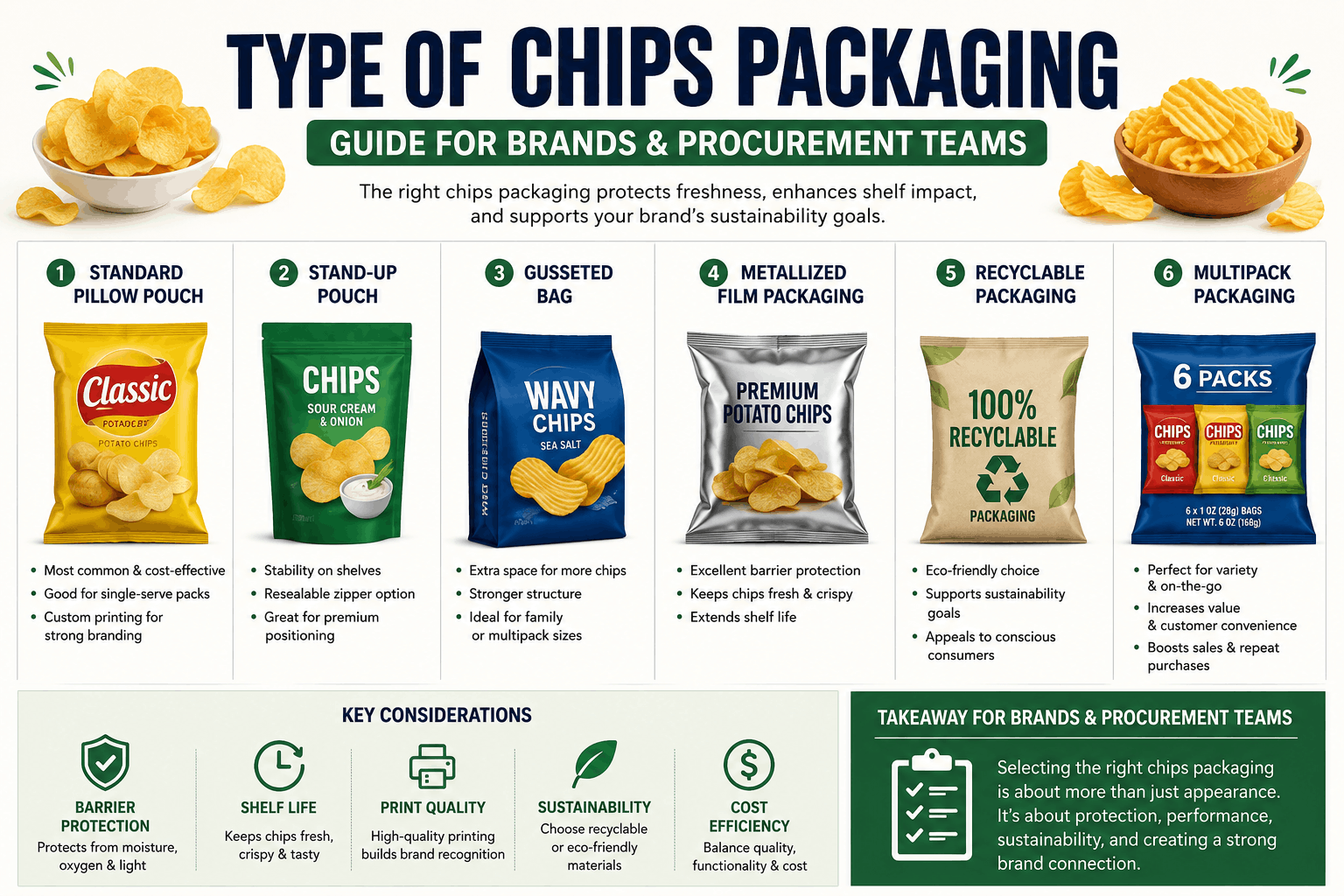
Walk down any snack aisle and you’ll notice something most shoppers never stop to think about no two chip bags look, feel, or open quite the same way. Some crinkle loudly and puff up with air. Others stand upright on the shelf like a small tent. Some have a resealable zipper strip, while others rely on a simple fold-and-clip. None of this is random. Every format is the result of deliberate sourcing decisions about protecting the product, extending shelf life, and catching a shopper’s eye in the two or three seconds it takes to scan a shelf.
For procurement managers, brand owners, and B2B packaging buyers, understanding the type of chips packaging available on the market isn’t just a design exercise. It’s a sourcing decision with real cost, compliance, and brand implications. Whether you’re evaluating suppliers for a new product launch or auditing an existing line, knowing the different types of chips packaging and how they compare across different types of chips brands helps you ask sharper questions in vendor conversations and avoid costly mismatches between product and format.
This guide breaks down the major types of chips packaging and types of potato chips formats on the market today, the materials behind them, and the factors procurement and packaging teams should weigh before committing to a supplier or format. We’ll also touch on how different types of chips brands from national names to private-label manufacturers tend to gravitate toward different formats depending on positioning, budget, and product type, so you have a clearer picture of what “standard” actually looks like in this category.
Why Chips Packaging Matters More Than It Seems
Chips are more fragile than most people realize. They’re porous, oily, and highly sensitive to oxygen, moisture, and light all of which accelerate staleness, rancidity, and loss of crunch. A potato chip that’s perfectly crisp on the production line can turn soft and stale within days if the packaging doesn’t do its job.
That’s why chips packaging typically has to accomplish several things at once:
- Preserve freshness by blocking oxygen and moisture from reaching the product
- Protect against physical damage during transport, stacking, and shelf handling
- Provide a barrier against light, which can degrade oils and flavor compounds
- Support branding and shelf appeal through print quality, finish, and shape
- Enable practical use, such as resealing, portioning, or easy opening
Because chips packaging has to balance all of these functional and marketing demands, manufacturers have developed several distinct formats, each suited to different product types, price points, and consumer habits.
Different Types of Chips Packaging You’ll Run Into As Buyer
Before comparing suppliers, it helps to know what you’re actually choosing between. Below are the formats that show up most often across the different types of chips brands sell from single-serve impulse buys to family-size sharing bags.
1. Pillow Pouches
The pillow pouch is the classic, most recognizable format in the snack world. The pillow-shaped bag with sealed ends and a seam running down the back or center. It gets its name simply from its shape, which resembles a plump pillow once it’s filled with product and air.
Pillow pouches are popular for chips because they’re efficient to produce at high speed, use less material than more structured formats, and still offer strong barrier protection when made with the right laminate. The trapped air inside a pillow pouch isn’t just filler. It acts as a cushion that helps prevent chips from crushing during transit and handling.
This format works particularly well for lightweight, single-serve, or standard multi-serve chip bags, and it remains one of the most cost-effective options for brands producing at scale. If you’re comparing packaging formats for a new product line, our detailed breakdown of pillow pouch packaging covers construction, sealing methods, and ideal use cases in more depth.
2. Stand-Up Pouches
Stand-up pouches, often shortened to SUPs, have become increasingly common for premium and mid-tier chip brands. Unlike a pillow pouch, which typically lies flat or leans on a shelf, a stand-up pouch has a gusseted bottom that lets it stay upright on its own a small design detail that has a big impact on shelf presence.
This format tends to appeal to brands trying to differentiate visually, since the flat front and back panels offer more usable print space for bold branding, nutritional call-outs, or premium finishes like matte and spot-gloss combinations. Stand-up pouches are also frequently used with press-to-close zippers or tin-tie closures, making them a practical choice for chips marketed as resealable or “better for sharing.”
Because they take up more shelf footprint per unit and generally require more material than a simple pillow pouch, stand-up pouches are often positioned for higher price points or specialty snack categories. For a closer look at construction options, gusset types, and closure systems, see our guide to stand-up pouch packaging.
3. Gusseted Bags
Gusseted bags sit somewhere between pillow pouches and stand-up pouches. They include side or bottom folds (gussets) that allow the bag to expand and hold more volume without becoming overly bulky or hard to stack. This format is common for family-size or party-size chip bags, where a wider base helps distribute product weight and reduce the risk of chips being crushed at the bottom of the bag.
Gusseted formats are also favored when brands want a bag that can stand reasonably well on a shelf without the full cost of a true stand-up pouch construction.
4. Flat-Bottom Bags
Flat-bottom bags, sometimes called box pouches, use a fully flat, rectangular base that gives the packaging a more rigid, block-like shape when filled. This format maximizes shelf stability and is often chosen for premium chip brands that want their packaging to look closer to a small box than a traditional bag.
Flat-bottom bags typically use heavier laminate structures, which adds cost but also improves puncture resistance and structural integrity useful for thicker-cut or kettle-style chips that are more prone to breakage.
5. Canisters and Tubes
Rigid canister or tube packaging most associated with stackable chip formats takes a different approach entirely. Instead of a flexible film pouch, the product sits inside a cylindrical container, often made of cardboard with a metal or plastic base and a peelable foil seal.
This format offers the highest level of physical protection against crushing, since the rigid walls prevent the kind of compression damage that can occur in flexible bags. It’s particularly suited to uniformly shaped, stackable chips, since the cylindrical shape only works efficiently when product pieces can nest closely together.
6. Box and Carton Packaging
Some chip brands, particularly those selling multipacks or bulk-portioned snacks, use folding cartons or boxes as either the primary package or as a secondary layer around individual bags. Cartons don’t typically offer the same moisture and oxygen barrier as flexible pouches on their own, so they’re usually paired with an internal liner or individually wrapped portions inside.
This format is less about extending shelf life and more about organization, retail display, and portion control useful for lunchbox-style multipacks or bulk variety packs.
What’s Actually Inside the Bag: A Materials Breakdown
Regardless of format, most chips packaging relies on multi-layer laminate structures rather than a single material. A typical structure might include:
- An outer print layer (often BOPP or PET) for graphics, gloss, and print clarity
- A metallized or foil layer to block light and provide an oxygen and moisture barrier
- An inner sealant layer (commonly polyethylene) that allows the pouch to be heat-sealed and provides a food-safe surface in contact with the chips
This layered approach is what allows a thin, flexible bag to match and in some cases exceed the shelf-life performance of more rigid packaging. Brands focused on sustainability are increasingly exploring recyclable mono-material structures, which use a single type of plastic across all layers to make the packaging easier to recycle, though these structures often require trade-offs in barrier performance or cost.
How to Pick the Right Format For Your Product
There’s no single “best” packaging type the right choice depends on several practical factors:
Product characteristics
Different types of potato chips behave differently on a packaging line: thicker, sturdier cuts can tolerate more flexible packaging, while delicate or kettle-cooked styles often need more structural protection to avoid breakage.
Shelf life requirements
Products with longer intended shelf lives typically need higher-barrier laminates or rigid packaging to control oxygen and moisture over time.
Brand positioning
Premium or specialty brands often lean toward stand-up pouches or flat-bottom bags for the added shelf presence and print real estate, while value-tier products commonly use cost-efficient pillow pouches.
Portion size and use case
Single-serve snacks favor small pillow pouches, while family-size or sharing formats benefit from gusseted or stand-up designs that offer more stability and reseal options.
Sustainability goals
Brands prioritizing recyclability may need to weigh mono-material films against traditional multi-layer laminates, since each comes with different barrier and cost implications.
Production and cost constraints
Simpler formats like pillow pouches are generally faster and cheaper to produce at scale, while structural formats like stand-up pouches or canisters carry higher material and equipment costs.
How Chips Bags Actually Open & Why It’s Worth Caring About
The format of a chip package is only part of the story how it opens and closes matters just as much for everyday usability. A few common mechanisms show up across the formats above:
1.Tear notches and easy-open seals are standard on most pillow pouches, letting consumers tear across the top without scissors. These are simple and inexpensive but don’t offer resealability once opened.
2. Zippers and press-to-close seals are increasingly common on stand-up pouches and gusseted bags, particularly for family-size or “better-for-you” snack lines where consumers are more likely to save leftovers for later.
3. Peelable foil seals are typically found on canister-style packaging, providing an airtight seal until the product’s first use, after which the plastic lid takes over as the resealable closure.
4. Fold-and-clip or twist closures are less common in commercial packaging but still appear on some bulk or bakery-style snack formats, relying on the consumer to fold the bag and secure it manually.
Choosing a closure isn’t purely about convenience it also affects barrier performance after the first opening, since a poorly sealing zipper can undo much of the protection the original packaging provided.
Frequently Asked Question For Type Of Chips Packaging
1. What is the most common type of chips packaging?
Across the types of chips sold today, pillow pouches remain the most widely used format, largely because they’re cost-efficient to produce at high volumes while still offering solid barrier protection through multi-layer laminates.
2. Why do some chip bags stand upright while others don’t?
Bags that stand upright, such as stand-up pouches and flat-bottom bags, include a gusseted or flat base built into the construction. Standard pillow pouches don’t have this structural base, so they typically lie flat or lean rather than stand.
3. Does chips packaging affect shelf life?
Yes. The barrier properties of the packaging material particularly its ability to block oxygen, moisture, and light have a direct impact on how long chips stay fresh and crisp after production.
4. Is chips packaging recyclable?
It depends on the material structure. Traditional multi-layer laminates with metallized or foil layers are generally harder to recycle through standard programs, while newer mono-material films are being developed specifically to improve recyclability without sacrificing too much barrier performance.
5. Are chips packaging types different from other snack packaging?
The core formats pillow pouches, stand-up pouches, gusseted bags are shared across most of the snack aisle, including gummies and crackers. The differences usually come down to barrier requirements and closure choices suited to each product’s specific sensitivity to moisture, oxygen, or crushing.
What This Means If You’re Packaging Gummies OR Crackers Too
While this guide focuses on chips, the same packaging principles extend across the broader snack category. For example, gummy packaging needs to manage moisture carefully to avoid clumping or drying out, while crackers packaging require formats that guard against crushing and staleness in a way that closely mirrors chips packaging needs.
Many of the formats discussed here pillow pouches, stand-up pouches, and gusseted bags are used interchangeably across these snack categories, with adjustments made to barrier properties and closure systems based on the specific product. For a broader look at how packaging strategy applies across gummies, crackers, and other snack formats, explore our full guide to snack packaging solutions.
Final Thoughts
Chips packaging might seem like a background detail, but it’s doing a surprising amount of work: preserving freshness, preventing damage, communicating brand identity, and shaping the buying decision at the shelf. From simple pillow pouches to structural stand-up pouches, gusseted bags, flat-bottom formats, and rigid canisters, each type of packaging solves a slightly different set of problems.
For brands developing or refining a chip product, understanding these formats and how they compare to options used for chips bags more broadly is a useful starting point for making informed packaging decisions that support both product quality and shelf performance.