
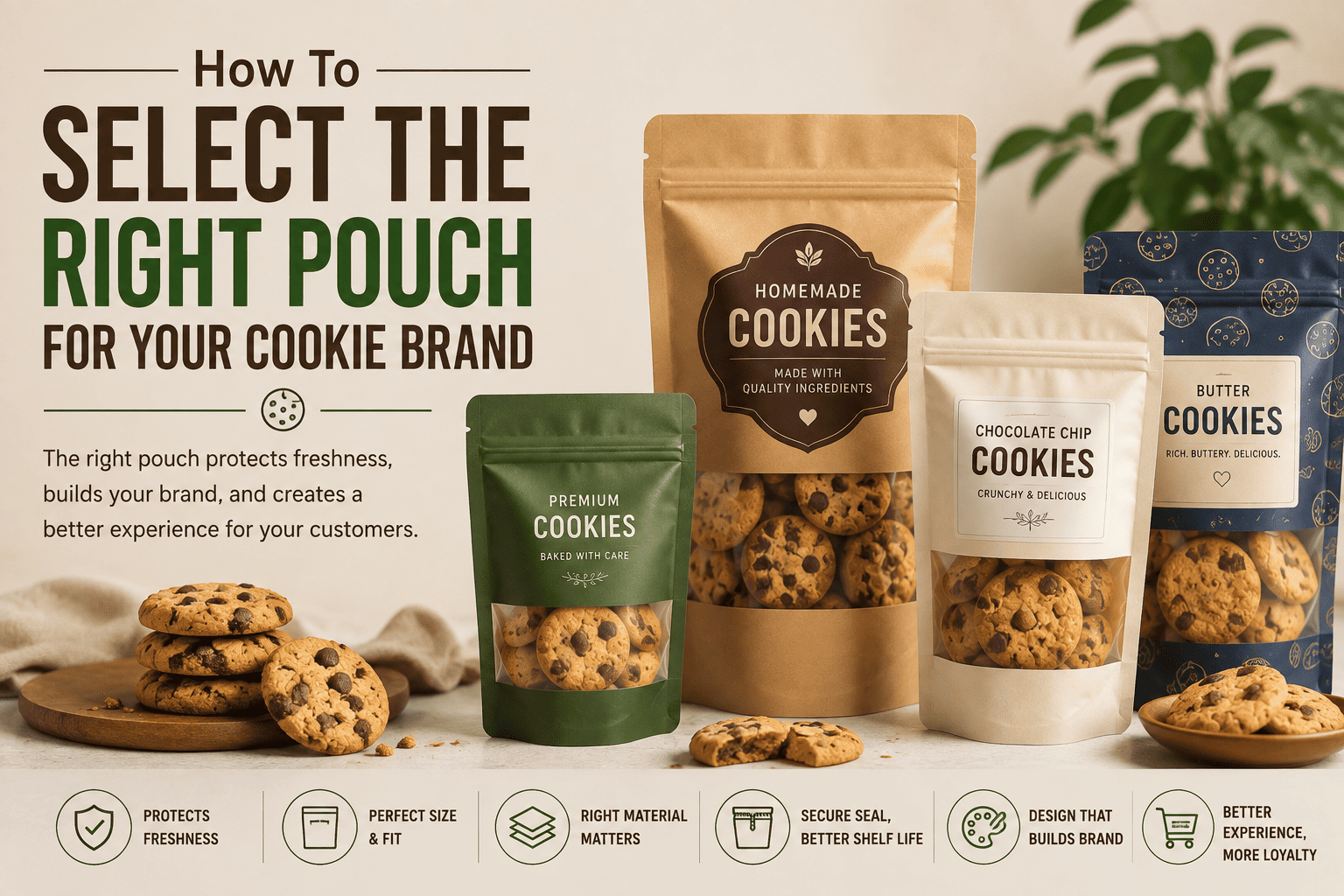
Choosing packaging for cookies is not simply about finding a pouch that looks attractive. The right pouch needs to protect the cookies, support freshness, suit the product size, reflect the brand, and work well for storage and transportation. A pouch that looks good but does not provide the right level of protection can affect the customer experience and the quality of the cookies inside.
For cookie brands, packaging also plays an important role in how the product is presented. Customers often see the pouch before they taste the product, which makes packaging part of the overall buying experience. The right format can help your cookies stand out on a shelf, look professional online, and communicate the quality of the product.
This guide explains how to select the right pouch for cookies based on the product, protection requirements, pouch style, size, printing, closure, and brand positioning. It also explains what cookie brands should consider before choosing custom packaging.
Why The Right Pouch Matters For A Cookie Brand
Cookies can be sensitive to moisture, air, light, handling, and changes in temperature. Depending on the recipe and product type, exposure to these conditions can affect texture, freshness, appearance, and shelf life.
A good pouch creates a protective barrier between the cookies and the outside environment. This helps the product remain closer to its intended condition from production through transportation and finally to the customer.
Packaging also influences how customers perceive the product. A carefully designed cookie pouch can make a small bakery look established and help a growing food brand create a consistent identity across its product range.
For brands selling premium cookies, gift cookies, filled cookies, or everyday snacks, packaging needs can be different. This is why choosing a pouch based only on appearance is rarely the best approach.
Start With The Type Of Cookies You Sell
The first step in choosing the right pouch for cookies is understanding the product itself. Different cookies can have different packaging requirements.
A dry and crunchy cookie may need protection from moisture to help maintain its texture. A soft cookie may require a different level of protection because freshness and moisture balance are more important. Cookies containing chocolate, cream, nuts, or other sensitive ingredients may also require packaging that provides stronger protection from external conditions.
The shape of the cookie matters as well. Thin cookies may need less internal space than large or decorated cookies. Delicate cookies may need a pouch that reduces movement and provides enough room to prevent unnecessary crushing.
Before selecting a pouch, consider the cookie size, texture, ingredients, expected shelf life, filling quantity, and how the product will be stored and transported. These factors give you a better starting point for selecting the packaging format.
Choose A Pouch Style That Fits Your Product
Once the product requirements are clear, the next step is selecting the pouch format. Different pouch styles provide different presentation and handling benefits.
Stand Up Pouches
Stand up pouches are a popular option for brands that want their cookies to have a strong shelf presence. The bottom structure allows the pouch to stand upright, which can provide a larger visible area for branding and product information.
This format can work well for premium cookies, specialty cookies, and products sold in retail environments. It also gives brands flexibility when selecting different sizes and closure options.
If you want to explore different flexible formats for your product range, our pouches provide a useful starting point for evaluating custom pouch solutions.
Flat Pouches
Flat pouches can be suitable when a simple and compact format is preferred. They can work particularly well for smaller cookie portions, sample packs, individual servings, and products where efficient storage is important.
The simpler structure can also provide a clean surface for product branding while keeping the overall package compact.
Gusseted Pouches
Gusseted pouches provide additional space because of their side or bottom structure. They can be useful for larger cookie quantities or products that require more internal volume.
For brands selling family size packs or larger quantities, a gusseted format can provide more capacity while maintaining a practical package shape.
Select The Right Cookie Packaging Material
Material selection is one of the most important decisions when developing cookie packaging. The material should match the protection requirements of the product rather than being selected only for appearance or cost.
Cookie packaging can be produced using different flexible packaging structures. These structures can be designed to provide protection against moisture, oxygen, light, and other external conditions.
For crunchy cookies, moisture protection can be especially important because exposure to moisture may cause the product to lose its desired texture. For products where freshness is a major concern, oxygen protection can also become an important consideration.
The right material structure depends on the recipe, expected shelf life, filling process, storage conditions, and distribution requirements. Working with a packaging supplier can help you identify a suitable structure instead of choosing a material based only on general recommendations.
This is particularly important when cookies are expected to remain fresh for an extended period or will travel through different distribution environments.
Think About Freshness And Protection
A cookie pouch has an important job beyond carrying the product. It needs to help protect the cookies throughout their intended shelf life.
Moisture can be a major concern for crunchy cookies because it can change the texture. Oxygen can also affect certain ingredients and may contribute to quality changes over time. Light can matter for products containing ingredients that are sensitive to exposure.
The level of protection required depends on the product. There is no single pouch material that is automatically the best choice for every cookie brand.
A useful approach is to identify the main risks to your product first. If moisture is the biggest concern, focus on moisture protection. If oxygen exposure is important, consider structures designed to provide stronger oxygen protection. If the product is sensitive to light, the packaging structure may need to address that requirement as well.
This product first approach helps prevent unnecessary packaging decisions and allows brands to focus on what actually protects the cookies.
Select The Right Pouch Size
Pouch size affects both product protection and customer perception. A pouch that is too large can allow excessive movement inside the package, while a pouch that is too small can make filling difficult and increase the risk of product damage.
Start by determining the actual weight and volume of cookies that each pouch needs to hold. Then consider the shape of the cookies and how much space is required during filling and sealing.
The pouch should provide enough room for efficient production without creating unnecessary empty space. The final dimensions should also support transportation, storage, and shelf presentation.
If your brand offers several cookie varieties, consider creating a consistent pouch system with different sizes. This can make the product range easier to recognize while allowing each product to use an appropriate package size.
Decide Whether You Need A Resealable Pouch
A resealable pouch can be valuable when customers are unlikely to consume the entire package at once.
For larger cookie packs, resealable packaging can make it easier for customers to open the package, enjoy part of the product, and close it again for later consumption. This can improve convenience and may also help protect the remaining cookies after opening.
For single serving or small packs, a resealable feature may not be necessary.
The decision should therefore be based on how the cookies are consumed. Think about the typical serving size, package quantity, customer usage, and expected time between opening and finishing the product.
Consider The Pouch Opening And Sealing
The opening and sealing system can affect both production and customer experience.
A pouch should be easy for the customer to open without damaging the package or spilling the cookies. At the same time, the sealing system needs to work reliably during production.
For cookie brands, this means considering how the pouch will be filled, sealed, packed, transported, displayed, and opened.
If your production process uses automated or semi automated equipment, pouch specifications should also be compatible with the filling and sealing process. This is an area where discussing your production requirements with your packaging supplier can help prevent problems later.
Make Your Cookie Packaging Part Of Your Brand
The pouch is also a marketing tool. Customers use packaging to understand what a product is and what kind of experience they can expect.
A premium cookie brand may use a clean and refined visual approach. A family focused brand may prefer a warmer and more approachable design. A specialty bakery may use packaging that emphasizes craftsmanship and product quality.
The design should make important information easy to understand. Product name, flavor, brand identity, product information, and other required details should have a clear place on the pouch.
A digital printing pouch gives cookie brands more control over this presentation. Instead of relying on generic packaging, brands can develop a pouch that is closely connected to their visual identity.
For brands looking for a broader packaging solution, our cookie packaging can help connect pouch structure, product protection, printing, and presentation into one packaging approach.
Choose Packaging That Supports Your Sales Channel
Where you sell your cookies should also influence your pouch selection.
Cookies sold in supermarkets may need stronger shelf presentation because customers are comparing several products at the same time. Products sold through specialty stores may benefit from packaging that emphasizes premium positioning.
Online cookie brands have different considerations. The packaging needs to look professional when customers receive it, while also being suitable for transportation and handling.
If you sell through multiple channels, your packaging should be evaluated across the entire distribution process rather than only at the point of sale.
Consider Custom Pouches For Growing Cookie Brands
Generic packaging can be useful for testing a product, but growing brands often need more control over their packaging.
Custom pouches allow a brand to select the format, size, material structure, printing, and other packaging details based on its product requirements.
This can be especially useful when a cookie brand has several flavors or product lines. A consistent packaging system can create a stronger visual identity while allowing individual products to remain easy to distinguish.
Custom packaging can also help a brand move away from a standard appearance and create a package that feels designed specifically for its product.
Common Mistakes To Avoid When Selecting Cookie Pouches
One common mistake is choosing packaging based entirely on appearance. A pouch may look excellent but fail to provide the protection the cookies require.
Another mistake is selecting the size before understanding the actual product quantity and dimensions. This can create filling problems, excessive empty space, or an awkward presentation.
Some brands also focus heavily on the initial packaging cost without considering product waste, transportation, shelf life, and customer experience. A lower cost package is not always the most cost effective option if it provides inadequate protection.
Choosing a pouch without considering the filling and sealing process can also create production challenges.
The better approach is to evaluate the complete packaging requirement before making the final decision.
A Simple Way To Select The Right Pouch For Cookies
The selection process becomes easier when you approach it in the right order.
- Start with the cookie itself. Understand its texture, ingredients, size, quantity, and expected shelf life.
- Next, identify the main protection requirements. Consider moisture, oxygen, light, handling, storage, and transportation.
- Then select the pouch format that suits the product quantity and presentation requirements.
- After that, determine the pouch dimensions, material structure, closure, printing requirements, and production compatibility.
Finally, review the complete package from the customer perspective. Ask whether it protects the product, looks appropriate for the brand, is convenient to use, and supports the way the cookies are sold.
This process helps turn packaging selection from a simple design decision into a practical product strategy.
How ContipackInc Can Help With Cookie Packaging
Choosing the right pouch becomes easier when you can discuss the product requirements with a packaging supplier that understands flexible packaging.
ContipackInc works with brands looking for custom flexible packaging solutions for different products and applications. For cookie brands, the focus can be placed on the combination of product protection, pouch format, package size, printing, and overall presentation.
Instead of starting with a generic pouch, brands can begin with the requirements of their cookies and then develop a packaging solution around those needs.
This approach can be useful for established brands that want to improve existing packaging as well as growing brands preparing to launch a new cookie product.
Final Thoughts
The right pouch for cookies should do more than hold the product. It should help protect freshness, support the expected shelf life, fit the quantity, provide a convenient customer experience, and communicate the identity of the brand.
The best choice depends on the cookie itself and the way the product will be filled, stored, transported, sold, and consumed. Pouch format, material structure, size, closure, printing, and protection requirements should therefore be considered together.
For cookie brands, the goal is not simply to find an attractive package. The goal is to create packaging that supports the product from production to the customer’s hands.
When those decisions are made together, cookie packaging customization can become more than a protective layer. It can become an important part of the product experience and a practical tool for building a stronger brand.