
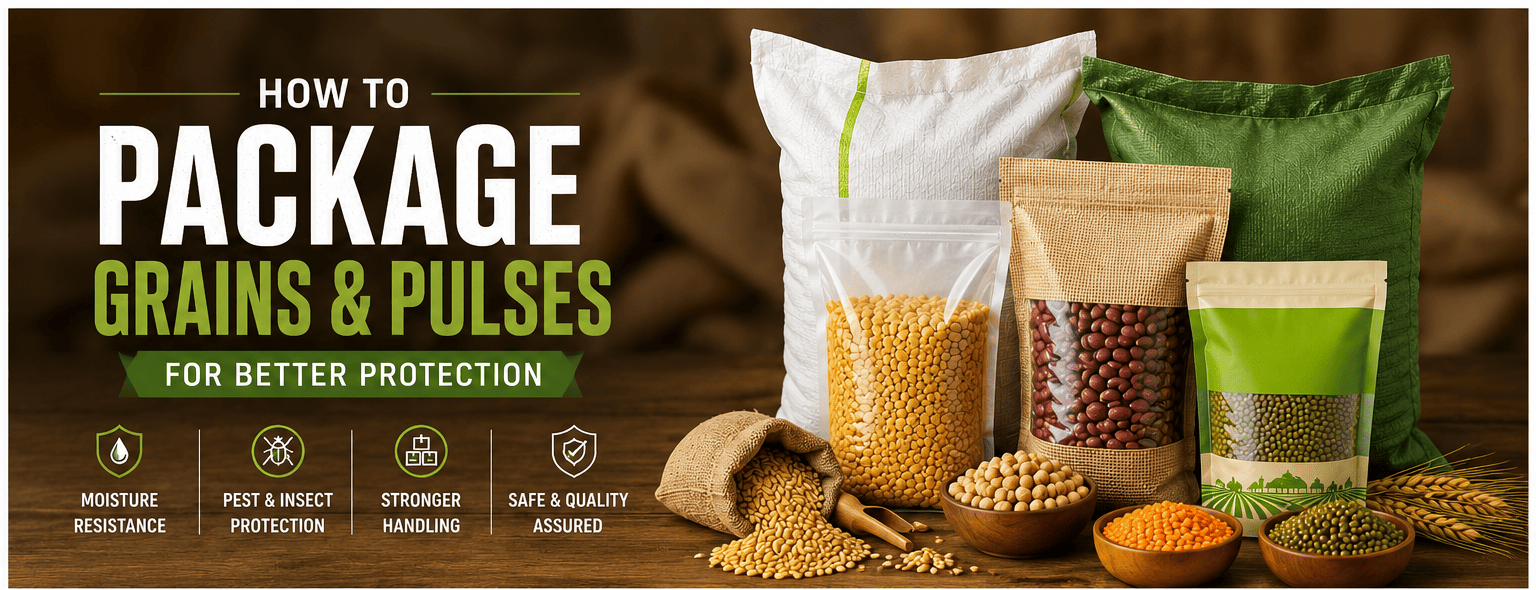
Grains and pulses go through several stages before they reach their final customer. After harvesting, products may be cleaned, processed, sorted, packed, stored, transported, and distributed. At each stage, the right packaging can help protect the product from conditions that may affect its quality.
Rice, wheat, maize, lentils, chickpeas, beans, peas, and similar dry products have different characteristics. Some may require stronger packaging for bulk handling, while others may need additional protection from moisture or greater emphasis on retail presentation.
For food processors, distributors, wholesalers, and brands, packaging is therefore part of the product’s supply chain. The choice of material, construction, size, sealing method, and barrier properties can influence how well the product performs during storage and transportation.
Understanding how to package grains and pulses starts with the product itself. From there, businesses can determine the level of protection required and select a packaging structure that fits the application.
Why Packaging Matters for Grains & Pulses
Dry grains and pulses are generally stable products when they are properly processed and stored. However, they can still be affected by external conditions.
Moisture is a major concern because dry food products can absorb water vapor from humid surroundings. Insects and pests can also become a problem during storage, particularly when products are exposed or packaging is damaged.
Physical handling creates another challenge. Commercial packages may be filled, stacked, lifted, transported, unloaded, and moved several times before reaching their destination.
Packaging creates a barrier between the product and these external factors. A suitable package can help reduce exposure to moisture, dust, contaminants, insects, and physical damage.
For businesses handling agricultural commodities, this makes packaging for agricultural products an important consideration across the supply chain.
What Should You Consider Before Choosing Packaging?
There is no single packaging structure that works for every grain and pulse. A company packaging retail lentils may have different requirements from a business shipping large quantities of wheat. Likewise, a product stored for several months may need different protection from one that moves quickly through the supply chain.
The first step is to understand the product, its destination, and how it will be handled.
1. Product Characteristics
The physical characteristics of a grain or pulse can affect packaging requirements.Size, shape, weight, density, moisture content, and handling behavior all matter. A heavy product may place more stress on a package, while smaller products may require different filling and sealing considerations.
The product’s expected shelf life should also be considered before selecting the packaging structure.
2. Storage Conditions
The environment in which a product will be stored can influence packaging selection. A controlled warehouse may present fewer challenges than a facility exposed to high humidity or significant temperature changes. Products transported between different environments may face additional exposure during the journey.
Understanding these conditions helps businesses determine the required level of moisture and barrier protection.
3. Transportation & Handling
Packaging must perform beyond the filling line. A commercial package may be stacked, moved with handling equipment, loaded onto a vehicle, transported, and unloaded several times. During this process, it can experience compression, vibration, friction, and impact.
The packaging structure should therefore have enough strength for the intended application.
Common Packaging Materials For Grains & Pulses
Different materials are used for grain and pulse products because they offer different combinations of strength, protection, printing quality, flexibility, and cost. The best choice depends on the product and the supply-chain requirements.
1. Polypropylene Packaging
Polypropylene, often called PP, is commonly used for agricultural and dry food products. PP-based packaging can provide good mechanical strength while remaining relatively lightweight. Woven polypropylene structures are particularly useful for larger quantities where bags need to withstand stacking and repeated handling.
For bulk applications, strength and durability are often major considerations. The final construction should be selected according to the weight of the product and the way the bags will be handled.
2. BOPP Laminated Packaging
BOPP stands for biaxially oriented polypropylene. BOPP laminated bags are often used when businesses want a combination of strength, printing quality, and product presentation. The outer surface can support detailed graphics and product information.
This can make BOPP structures useful for grain and pulse products sold through retail channels, where packaging needs to protect the contents while also presenting the brand clearly.
3. Multi-Layer Packaging
Some grain and pulse products may require a combination of material properties. Multi-layer packaging can bring different characteristics together. One layer may provide strength, while another provides improved resistance to moisture or other environmental factors.
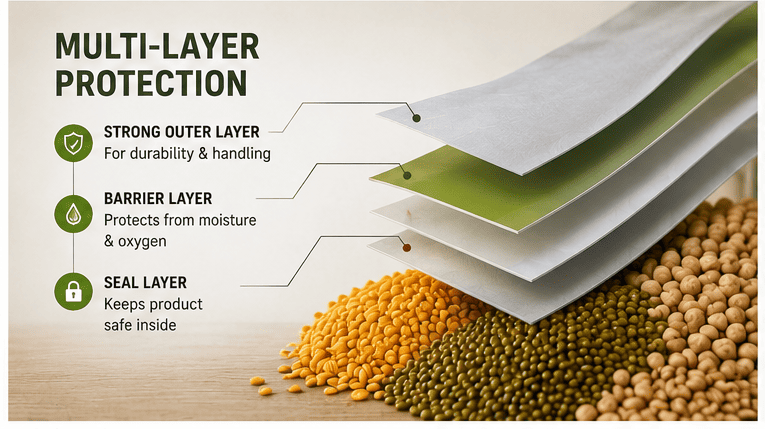
This approach is useful when a single material cannot provide all the required properties.
How Moisture Affects Packaging Selection
Moisture is one of the most important factors to consider when packaging dry grains and pulses. Even products that are properly dried can be affected by humid conditions if the package does not provide adequate protection. Over time, moisture exposure can affect product quality and storage stability.
The packaging should therefore be evaluated for its moisture barrier performance.
1. Moisture Barrier Properties
A moisture barrier helps reduce the movement of water vapor between the surrounding environment and the packaged product.
The required level of protection depends on the product and its storage conditions. A product expected to remain in a humid environment for an extended period may require a different packaging structure from one stored in a controlled facility.
Sealing also matters. Good barrier material cannot provide its intended performance if the package is poorly sealed or damaged.
2. Humidity & Temperature Changes
Environmental changes can affect packaged products during storage and transportation.
Temperature fluctuations may create condensation in certain situations, while high humidity can increase moisture exposure. These conditions should be considered when selecting both packaging material and storage practices.
A packaging structure should be selected based on the conditions the finished package is expected to experience, not only the conditions at the point of packing.
The Importance of Packaging Strength
Protection is not limited to environmental barriers. A package for grain and pulses also needs to withstand the physical demands of the supply chain. This becomes particularly important for larger grain and pulse bags.
1. Tear Resistance
Tears can expose the product and cause leakage.Packaging should be strong enough to withstand normal handling during filling, stacking, transportation, and unloading. The required level of tear resistance depends on package size, product weight, and handling conditions.
2. Puncture Resistance
Packages can come into contact with rough surfaces or equipment during transportation. Puncture resistance helps reduce the risk of sudden package failure. This is especially important when bags are stacked or moved frequently.
3. Seams & Closures
The package’s seams and closures are just as important as the main material. A strong bag can still fail if its seam or closure cannot withstand the weight and stress placed on it. Packaging performance should therefore be considered as a complete system rather than focusing on one component.
Choosing the Right Package Size
Package size affects product protection, logistics, and handling. Large commercial formats can reduce the number of individual units that need to be moved, but they also require enough strength to carry their contents safely.
Smaller formats may place greater emphasis on convenience, retail presentation, opening, and storage after purchase.
The right size depends on the target customer, filling equipment, transportation method, warehouse setup, and distribution channel.
Packaging For Bulk Grains & Pulses
Bulk products create specific packaging challenges because of their weight and handling requirements. Large bags may be stacked on pallets and moved using forklifts or other equipment. They may also be transported over long distances and handled multiple times.
Packaging for these applications should provide the necessary mechanical strength while remaining practical for filling and storage.
Dimensions are another consideration. Properly designed package sizes can improve pallet utilization and make warehouse and transportation operations more efficient.
Packaging for Retail Grains & Pulses
Retail packaging has a broader role. The package must protect the food while providing consumers with clear product information. Depending on the market and product, this may include the product name, net weight, storage information, preparation details, branding, and other required information.
Printing quality is therefore an important consideration. A consistent package design can also help a brand create a recognizable product range. At the same time, the printed surface needs to remain clear through normal transportation and handling.
How Packaging Supports Shelf Life
Packaging can support shelf life by reducing exposure to external conditions, but it does not determine shelf life on its own.
The final storage life of grains and pulses depends on product quality, moisture content, processing, storage temperature, humidity, packaging structure, sealing, and handling.
1. Protection During Storage
A suitable package can help limit contact with moisture, dust, insects, and contaminants. The level of protection required depends on how long the product will be stored and where it will be kept. Packaging should be selected with these conditions in mind.
2. Protection During Transportation
Transportation can expose packages to vibration, compression, impact, and changing environmental conditions.
A package that performs well in a warehouse may face different stresses during distribution. Testing and evaluation should therefore consider the entire journey.
The Role of Barrier Properties
Barrier properties are an important part of packaging design for dry food products. Depending on the material and structure, packaging can provide different levels of protection against moisture, oxygen, light, and other environmental factors.
Not every product requires the same level of barrier protection. Adding unnecessary layers can increase material use and cost, while insufficient protection may create product-quality risks.
The right approach is to select a structure based on the actual requirements of the product and supply chain.
Flexible Packaging For Grains & Pulses
Flexible packaging can be useful when businesses need a combination of lightweight construction, barrier protection, printing, and different package formats.
Its structure can be adapted to specific product and handling requirements. This makes flexible packaging solutions relevant for a range of dry food applications.
For grains and pulses, the choice of flexible structure should still be based on factors such as moisture sensitivity, product weight, storage duration, transportation, and sealing requirements.
Packaging Design For Agricultural & Food Products
Different agricultural products require different forms of protection. Grains and pulses are generally dry products, while other agricultural products may have higher moisture levels and different handling requirements.
This is why packaging design should begin with the product rather than the package itself.
For example, packaging for fresh produce may need to address ventilation, condensation, impact, and moisture management. In contrast, dry grains may place greater emphasis on moisture barriers, strength, and long-term storage.
Understanding these differences helps businesses avoid using a packaging format that does not match the product.
The Role Of Packaging In Produce Supply Chains
The wider agricultural supply chain includes many products beyond grains and pulses. Produce can move from farms and processors to distributors, retailers, foodservice businesses, and other commercial customers. Packaging helps support this movement by providing protection during handling and transportation.
For products with different storage needs, packaging for fresh produce may require a different approach from packaging designed for dry grains and pulses.
This distinction is important for businesses managing multiple product categories because packaging performance should always match the characteristics of the product.
1. Sealing & Closure Considerations
A package’s protective performance depends heavily on how it is closed. The appropriate sealing or closure method depends on the packaging material, package format, filling equipment, and intended application.
A reliable closure can help contain the product and reduce the chance of moisture, dust, or other contaminants entering the package.
For high-volume B2B operations, consistency is also important. The packaging system should work reliably with production equipment and support efficient filling and sealing.
2. Packaging & Brand Presentation
Packaging also serves as a communication tool. For retail grain and pulse products, the package may be the first interaction a customer has with a brand. Clear graphics, readable information, and consistent design can help create a professional presentation.
However, appearance should not come at the expense of function. The best packaging balances visual presentation with strength, product protection, storage requirements, and practical handling.
How To Select The Right Packaging Structure
Selecting packaging should begin with a clear understanding of the application. Businesses should consider the type of grain or pulse, product weight, expected shelf life, moisture sensitivity, storage environment, transportation conditions, filling equipment, and customer requirements.
Once these factors are understood, the appropriate material and structure can be evaluated. Testing is also useful. Strength, sealing, moisture resistance, handling performance, and other characteristics can be assessed before moving into larger production volumes.
This process can help businesses identify potential weaknesses before the packaging reaches the wider supply chain.
Working With A Packaging Manufacturer
For B2B buyers, packaging selection is often a technical decision rather than a simple purchasing exercise.
The supplier needs to understand how the packaging will be filled, sealed, stored, transported, and used. Material selection, dimensions, construction, printing, closure, and performance may all need to be customized.
A packaging manufacturer with experience across different applications can help businesses evaluate these requirements and develop a suitable structure.
For companies exploring custom packaging solutions, ContiPackInc can be considered as a packaging manufacturing partner for developing packaging according to specific product and supply-chain requirements.
Final Thoughts
Learning how to package grains and pulses requires more than choosing a bag that can hold the product.
The packaging needs to match the physical characteristics of the grain or pulse, expected storage conditions, transportation requirements, handling processes, and desired shelf life.
Material selection is an important starting point, but performance also depends on construction, moisture protection, barrier properties, seams, closures, package size, and storage conditions.
For B2B food businesses, the most effective approach is to look at packaging as part of the complete supply chain. When the packaging structure is matched to the product and its real-world conditions, it can help protect quality, reduce product losses, improve handling, and support more efficient distribution.