
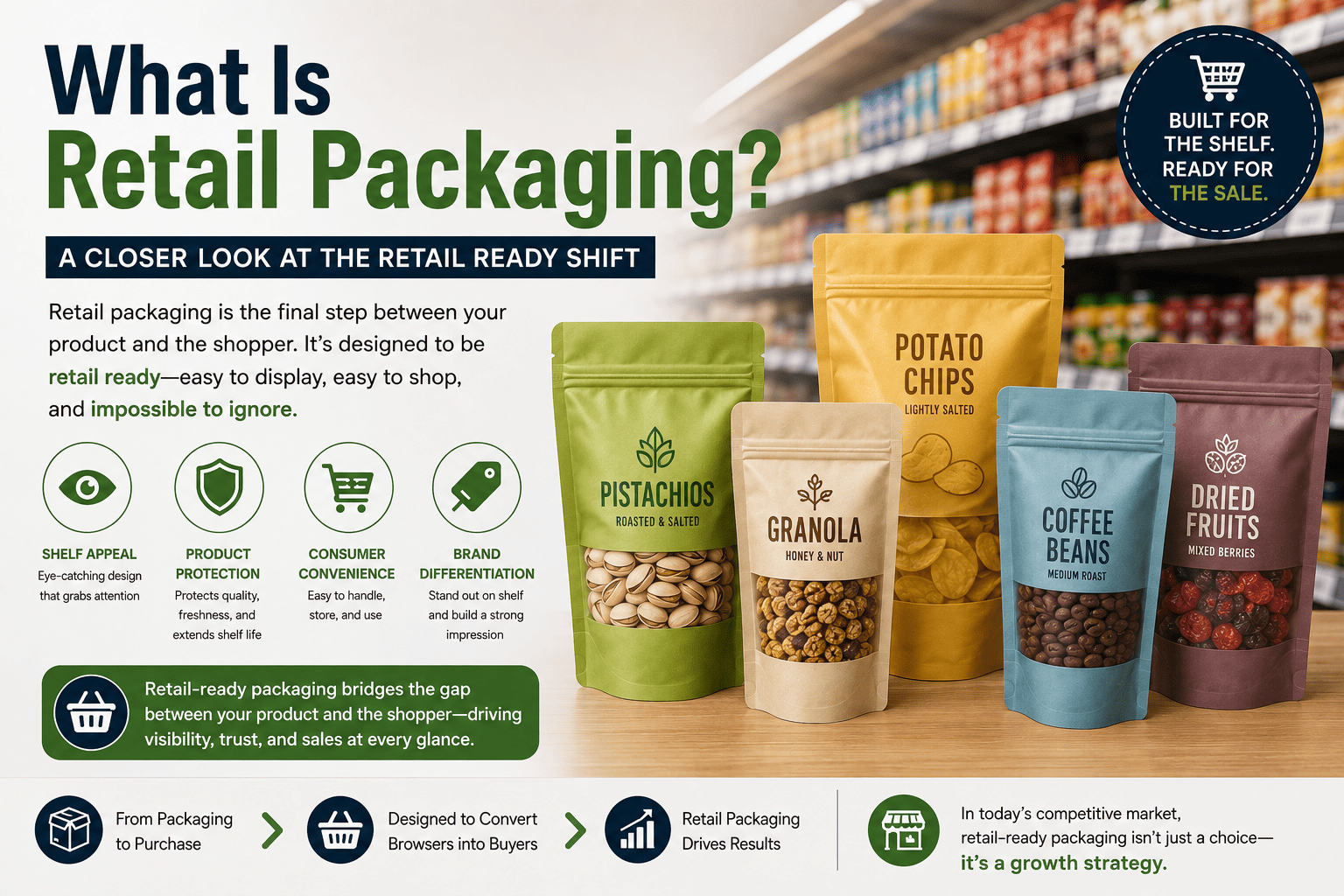
Ask ten people what “retail packaging” means, and you’ll probably get ten slightly different answers. Some picture a colorful box on a store shelf. Others think of the plastic wrap around a multipack of drinks. Both are technically right, but the term covers a lot more ground than most people realize, and the way it’s evolved over the past decade says a lot about how retail itself has changed.
This guide breaks down what retail packaging actually is, how retail ready packaging fits into that picture, and why so many brands are rethinking how their products show up on shelves.
What Is Retail Packaging?
At its core, retail packaging is any packaging that a customer sees and interacts with at the point of sale. Unlike shipping packaging, which is designed purely to protect a product on its way to the store, retail packaging has a second job: it needs to sell.
Balancing a few competing priorities at once is part of what makes this format tricky to get right. It needs to be sturdy enough to survive handling by both store employees and browsing customers. It also needs to communicate what the product is, often within a second or two of a shopper’s glance. And increasingly, it needs to reflect a brand’s identity clearly enough that customers recognize it again the next time they’re shopping.
None of this applies to shipping packaging in the same way, since most customers never even see it. Retail packaging is public-facing, and that changes almost everything about how it gets designed.
Where Retail Ready Packaging Fits In
Retail ready packaging builds on the idea of retail packaging by adding an operational layer on top of it. Rather than packaging that simply looks good on a shelf, it’s engineered so it can move from delivery truck to shelf display with almost no extra handling.
Picture a case of snack bags with a perforated strip running along one side. A store employee tears along that line, folds back the top, and places the entire case directly onto the shelf. No individual unpacking. No manually arranging each bag. The branding already faces forward, and the case itself often doubles as a temporary display tray.
So the difference comes down to this: all retail ready packaging is retail packaging, but not all retail packaging is retail ready. The “ready” part is about efficiency, and it’s become one of the most requested features retailers look for when choosing which suppliers to work with.
How Retail Ready Packaging Differs From Traditional Retail Packaging
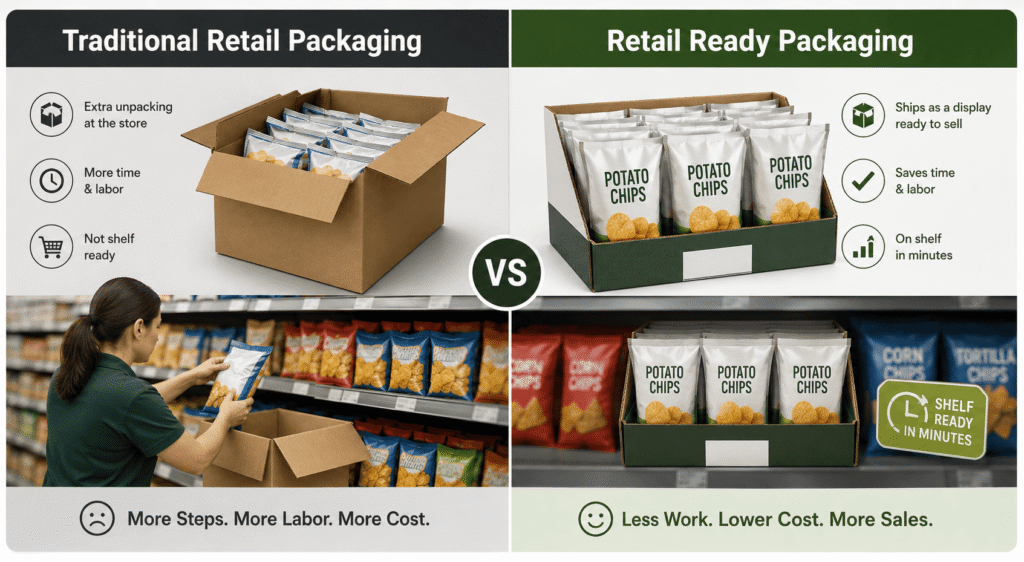
Beyond the perforated opening, the differences run deeper than they first appear. Traditional retail packaging is often designed with the shelf in mind but built without much thought toward how it actually gets there. A product might look great once it’s unpacked, but the unpacking process itself, done by hand, one unit at a time, still eats into store labor hours.
Priorities flip once retail ready packaging enters the picture. Structural engineering happens earlier in the design process, with case dimensions, opening mechanisms, and even the weight distribution of the product itself factored in from the start. What comes out of that process is packaging that performs two jobs simultaneously: it protects the product in transit and functions as an instant, ready-to-use display once it arrives.
Many large retail chains now include these specifications as part of their supplier requirements, which is part of why the shift has picked up so much momentum. Brands that haven’t adapted yet risk losing shelf space to competitors who have.
Why More Brands Are Investing In Retail Ready Packaging?
Consumer goods companies have grown quickly over the past several years, creating more competition for limited shelf space across grocery chains, convenience stores, and specialty retailers. That kind of pressure tends to push packaging decisions from the back burner to the front of the conversation.
Suppliers offering retail ready formats have responded by expanding their design capabilities and shortening turnaround times compared to a few years ago. Strong local logistics and distribution networks add another layer of advantage, letting brands move retail ready products from warehouse to shelf faster, a benefit that only grows more valuable as retail competition intensifies.
A Growing Priority Across Local Retail Markets
Retail ready packaging has picked up momentum well beyond large national chains. A mix of long-established producers and newer, fast-growing brands has created steady demand for suppliers who can deliver reliable, well-tested retail ready formats at scale.
What makes this shift interesting is the range of retail environments a single brand often needs to serve. A product might need to meet the strict case specifications of a major grocery chain one week and the more flexible expectations of an independent specialty store the next. Brands and suppliers who can adapt across that range tend to build the strongest, most durable retail relationships over time.
The Business Case for Retail Ready Packaging
Speed at the Shelf
Every minute a store employee spends manually stocking shelves is a minute pulled away from other tasks, whether that’s customer service, inventory management, or simply keeping the store running smoothly. Retail ready packaging cuts that time down dramatically, sometimes by more than half, depending on the product category.
Reduced Damage and Waste
Because retail ready packaging is structurally designed to handle both shipping stress and shelf display, products inside tend to arrive in better condition. Less handling means fewer dented cans, torn bags, or crushed boxes, which translates into fewer returns and less wasted inventory.
Building Retailer Trust
Retailers remember which suppliers make their jobs easier. Consistently delivering retail ready packaging tends to build stronger, longer relationships with retail buyers, which can translate into better shelf placement, more reliable reordering, and fewer negotiations over shelf space during category reviews.
Materials That Make Retail Ready Packaging Work
Material choice often decides whether a retail ready packaging strategy succeeds, since the wrong material can undercut even the best structural design. The right choice also depends heavily on the product category, since a bag of chips and a bottle of detergent have very different packaging needs once they hit the shelf.
Snack categories tend to lean the hardest into retail ready formats, and it’s easy to see why once you walk down a snack aisle. Chip bags are almost always shipped and displayed in retail ready cases, since the product is lightweight but bulky, making fast, low-handling stocking essential. Cookie packaging follows a similar pattern, though it often needs slightly more structural rigidity in the case to prevent crushing during transit and shelf restocking. Gummy and candy packaging tends to prioritize vibrant, eye-catching graphics within a retail ready case, since impulse purchases in this category rely heavily on visual appeal at the exact moment a shopper glances over.
Retail ready packaging isn’t limited to snacks either. Cosmetic brands increasingly use retail ready formats for smaller items like sample kits, travel-size products, and multi-unit bundles, where a clean, organized display case reinforces a premium brand image. Detergent and household cleaning brands have adopted retail ready packaging too, particularly for pod-style products and refill pouches, where the case itself often becomes part of the shelf display rather than something that gets discarded after unpacking.
Flexible Packaging
Flexible packaging has become one of the most popular material choices for retail ready formats because it’s lightweight, cost-efficient to ship, and easy to print high-quality branding directly onto. Its adaptability also makes it easier to design clean perforation lines and shelf-ready openings compared to more rigid materials.
Stand Up Pouches
Self-supporting design is what makes stand up pouches such a strong fit for retail ready cases, since they don’t require extra shelf inserts or trays to stay upright. This keeps retail ready cases lighter and simpler to design while still giving products a clean, organized appearance once displayed.
Flat Bottom Pouches
A wider base gives flat bottom pouches added shelf stability, making them a strong choice for retail ready packaging in categories like coffee, snacks, and specialty foods where a premium look matters as much as function. Their sturdier structure also holds up well during the kind of repeated handling that comes with high-traffic retail environments.
Other Pouch Formats Worth Considering
Beyond the core formats, a few other pouch styles show up regularly in retail ready packaging, each suited to slightly different product needs.
Digital printing pouches have become popular for brands that need shorter production runs, seasonal packaging updates, or frequent design changes without committing to large minimum order quantities. Since the artwork is printed digitally rather than through traditional plate-based printing, brands can update graphics, run limited editions, or test new branding far more easily than with conventional printing methods.
Vacuum seal pouches remove excess air before sealing, which extends shelf life and keeps products like coffee, jerky, and cheese fresh for longer. This format works particularly well in retail ready cases where extended shelf stability matters as much as visual presentation, since the tight seal also helps the product hold its shape during shipping and handling.
Quad seal pouches use four seals instead of the usual two or three, creating a boxier, more rigid shape that stands upright with a flat top and bottom. This structure gives products a shelf presence closer to a rigid box while still keeping the material lightweight, making it a solid middle ground for brands that want a premium look without the added weight and cost of rigid packaging.
Gusseted pouches include folded side or bottom panels that expand outward, allowing the pouch to hold more volume while still lying flat when empty. This makes them a practical choice for bulkier products like pet food, rice, or frozen items, where extra capacity matters but the packaging still needs to fit neatly into a retail ready case.
Designing Retail Ready Packaging That Performs
Good retail ready packaging design starts long before the artwork stage. It begins with understanding exactly how a product will move through the supply chain, from initial packing to final shelf placement, and designing around every touchpoint in that journey.
Testing plays a central role in getting this right. Cases need to hold up under stacking pressure during transit, perforated openings need to tear cleanly without damaging the product inside, and branding needs to remain visible and undamaged even after a case has passed through several hands before reaching the shelf. Skipping this testing phase is one of the most common reasons retail ready packaging fails to deliver on its promise once it reaches real-world conditions.
Finding the Right Retail Ready Packaging Partner
Choosing the right packaging partner matters just as much as the design itself. A few things worth asking potential suppliers:
Do they understand major retailer specifications?
Different chains often have different case dimension and labeling requirements, and a supplier familiar with these details can save significant time and cost.
Can they support multiple material formats?
A partner offering flexible packaging, stand up pouches, and flat bottom pouches gives your brand room to adapt as your product line grows or shifts.
Do they offer reliable production and distribution?
Working with a supplier who has a strong, dependable production process can shorten lead times considerably compared to sourcing from a less established partner.
Can they back up structural claims with real testing?
Ask for evidence, not just assurances, that their retail ready designs have been tested under real shipping and handling conditions.
Suppliers like ContipackInc are a good example of what to look for in a packaging partner, offering experience across flexible packaging, stand up pouches, and flat bottom pouches for categories ranging from snacks to cosmetics to household products. Working with a partner who already understands the structural and branding demands of retail ready formats can save considerable time during the design and testing phase, especially for brands launching a retail ready format for the first time.
Mistakes That Undercut Retail Ready Strategy
Designing packaging after the product, not alongside it.
Retail ready packaging works best when it’s considered early in product development, not bolted on after the fact.
Ignoring how the case looks once opened.
A case that looks great sealed but messy once torn open defeats the purpose of retail ready design entirely.
Skipping retailer-specific compliance checks.
Even small deviations from a retailer’s required specifications can lead to rejected shipments and delayed shelf placement.
Under investing in material quality.
Cutting corners on material strength to save costs often backfires through increased product damage and returns, costing more in the long run than it saves upfront.
Measuring Whether Retail Ready Packaging Is Actually Working
Switching to retail ready packaging isn’t a one-time decision to check off a list. Brands that get the most value out of it tend to keep an eye on a few key indicators after the switch, rather than assuming the new packaging is automatically performing well just because it looks the part.
Sell-through rate offers one of the clearest signals. A product in retail ready packaging that’s moving off the shelf faster than it did in its previous packaging is a strong sign the format is genuinely helping at the point of sale, not just simplifying logistics behind the scenes. Retailer feedback matters too, since store managers and stocking staff often notice quickly whether a case is easy to open and display or whether it’s creating more friction than it solves.
Damage rates during transit provide another useful metric. A drop in product damage after switching to retail ready packaging usually points to better structural design, while a rise in damage suggests the packaging needs further testing or adjustment before it’s fully dialed in. Reorder consistency from retail partners is worth tracking as well, since retailers tend to keep ordering more reliably from suppliers whose packaging causes them the fewest headaches.
The Role of Packaging In Winning Shelf Space
Shelf space isn’t handed out equally, and retail buyers are constantly weighing which products deserve prime positioning versus which ones get pushed to less visible spots. Packaging plays a bigger role in that decision than many brands assume.
A product that’s easy to stock, looks organized once displayed, and holds up well under repeated handling gives a retail buyer fewer reasons to hesitate. On the flip side, packaging that creates extra work, whether through awkward unpacking or products that look messy once unboxed, can quietly work against a brand during category reviews, even if the product itself is strong.
Treating packaging as a strategic tool rather than an afterthought tends to pay off here. Brands that take this approach usually have an easier time earning and keeping the shelf placement that drives real sales volume.
If you want to know more about self planning you can check our blog “The Planogram Guidebook”
Frequently Asked Questions
1. What is the main difference between retail packaging and retail ready packaging?
Retail packaging refers broadly to anything designed for the point of sale, while retail ready packaging specifically means packaging engineered to move from shipping case to shelf with minimal handling.
2. Why is retail ready packaging gaining so much traction right now?
Growing competition for shelf space, combined with retailers’ push to cut labor costs, has made retail ready packaging a practical way for brands to stand out and stay competitive.
3. Is retail ready packaging only for large brands?
Not at all. Small and mid-sized brands increasingly use retail ready packaging to compete for shelf space against larger, established competitors.
Final Thoughts
Understanding what retail packaging is, and how retail ready packaging builds on that foundation, gives businesses a real advantage in a retail environment where shelf space is more competitive than ever. Brands across all kinds of markets are seeing this play out firsthand, investing in retail ready formats built around materials like flexible packaging, stand up pouches, and flat bottom pouches. This isn’t just about keeping up with a trend. It’s about making sure a product gets the best possible chance to be seen, picked up, and purchased the moment it reaches the shelf.