
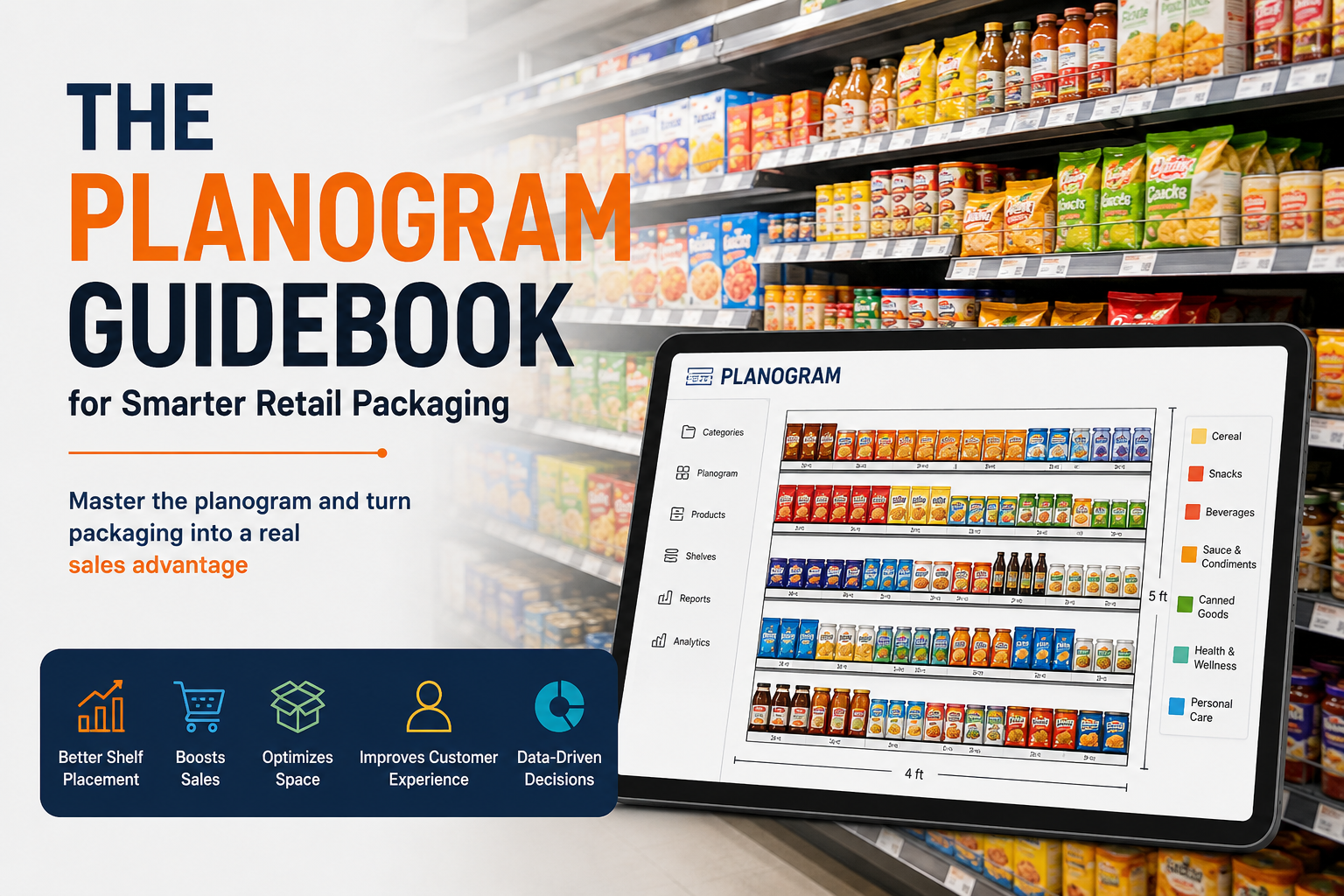
Walk into any grocery store and you’ll notice something. Nothing on the shelf is there by accident. Every product, every facing, every eye level placement has been mapped out ahead of time using a detailed shelf plan. That merchandising blueprint is what most people mean when they ask “what is a planogram.” It’s one of the most powerful, most overlooked tools in retail.
For brand owners and manufacturers, understanding this shelf planning concept isn’t just a retail operations detail. It directly affects how your product looks, how it competes for attention, and ultimately how it sells. In this guide, we’ll cover the planogram definition, explore planogram meaning in real retail contexts, show you how to read a planogram, and walk through planogram implementation from start to finish. We’ll also look at why packaging design plays a far bigger role in shelf success than most brands realize.
What Is a Planogram?
So, what is a planogram, exactly. At its core, it’s a visual diagram, often called a “plano” or “POG” for short, that shows exactly how and where products should be placed on a retail shelf, display, or fixture. It specifies the exact position of each item, the number of facings, the shelf height, and the sequencing of product categories across an entire store section.
Retailers and brands rely on this shelf mapping tool to communicate merchandising instructions clearly, so that every store location, whether it’s one grocery store or a chain of five hundred, presents products in the same optimized, consistent way. Instead of leaving shelf arrangement up to individual store staff, this system removes guesswork and replaces it with a layout built on real data that store teams can follow precisely.
Planogram Definition & Planogram Meaning in Retail
The formal planogram definition used across the retail industry is simple. It’s a diagram based merchandising plan that dictates product placement on a shelf, based on factors like sales performance, product categories, package dimensions, and consumer behavior. It’s typically built using specialized software that pulls in point of sale data, inventory management figures, and store layout measurements.
But the planogram meaning goes beyond a simple diagram. In practice, it represents a retailer’s strategy for maximizing sales per square foot of shelf space. It reflects decisions about which products deserve prime eye level real estate, which items are grouped together to encourage cross selling, and how much shelf space is allocated to each SKU based on demand. For a brand, appearing correctly and consistently within that plan can be the difference between strong sell through at retail and a product that quietly underperforms on the shelf.
Why Does Merchandising Tool Matters for Retail Stores & Grocery Stores?
Retail stores, especially high volume grocery stores, operate on tight margins and limited shelf space. Every inch of a shelf is a cost center, so retailers use a structured shelf plan to make sure that space is working as hard as possible for both the store and the brands stocked on it.
Here’s why this approach matters across the retail ecosystem.
1. Sales optimization
A well designed shelf layout places high performing products where shoppers are most likely to notice them, directly influencing sales at the point of purchase.
2. Inventory management
These layouts are tied closely to inventory management systems, ensuring that shelf space matches actual product turnover and reducing out of stocks or overstock situations.
3. Customer experience
A clean, logical, easy to navigate shelf improves customer experience by helping shoppers find what they need quickly, without frustration or wasted time in the aisle.
4. Consumer behavior insights
These layouts are often built using data on consumer behavior, including how shoppers move through a store, where their eyes land first, and which product categories they tend to browse together.
5. Customer satisfaction
When shelves are organized, fully stocked, and easy to shop, customer satisfaction naturally improves, encouraging repeat visits and stronger loyalty to the store.
5. Market share
Brands that consistently secure better shelf placement through strong retailer relationships and merchandising compliance tend to capture greater market share over competitors in the same product categories.
For any brand selling through retail stores or grocery stores, this means your packaging, product categories, and even your relationship with retail buyers all feed into whether you land a favorable spot on the shelf, and whether you keep it season after season.
How to Read a Planogram?
If you’ve never seen one, learning how to read a planogram can feel confusing at first, but the structure is fairly consistent across retailers and merchandising software platforms.
A typical layout includes the following elements.
1. Shelf sections and fixture outlines
These represent the physical shelving unit, aisle, or display in the store.
2. Product images or icons
Each one represents a specific SKU, sized proportionally to its actual packaging dimensions.
3. Facings
This is the number of times a single product appears side by side on the shelf, which usually corresponds to expected sales velocity.
4. Position coordinates
Every product has an assigned row for shelf level and column for horizontal placement, often labeled with codes for store staff to follow.
5. Category blocking
Products are typically grouped by product categories, so related items sit together, such as all snack pouches or all beverage cartons in one block.
6. Annotations and metrics
Many versions include sales data, profit margin, or inventory turn rates next to each product to justify its placement on the shelf.
Once you know how to read a planogram, you can quickly identify where your product sits relative to competitors, how much space it’s been allocated, and whether that placement matches your product’s actual sales performance. This is valuable information for any brand negotiating shelf space with a retail buyer or reviewing store compliance reports.
How to Use Planogram Implementation From Design to Store Floor?
Planogram implementation is the process of taking a shelf design from a digital layout into a physical, functioning arrangement in real stores. This is where strategy meets execution, and it typically involves several stages.
1. Data collection
Retailers gather sales data, inventory management reports, and store dimensions to understand what’s currently working and where there’s room for improvement.
2. Layout design
Using merchandising software, category managers build the visual plan, deciding on facings, shelf position, and product categories groupings for the entire section.
3. Retailer and vendor review
Brands are often invited to review the draft layout for their product categories, providing input on packaging visibility, new product launches, or promotional placements.
4. Store rollout
Store teams receive the finalized layout along with instructions for setting the shelf, often supported by photos or diagrams to ensure accuracy across every location.
5. Compliance checks
Field merchandisers or store staff verify that the shelf matches the approved plan exactly. This step is often referred to as merchandising compliance, since even small deviations can affect sales.
6. Ongoing optimization
These layouts aren’t static. As inventory management data comes in and consumer behaviour shifts, retailers revise their shelf strategy seasonally or quarterly to keep space aligned with performance.
Successful planogram implementation depends heavily on communication between retailers and brands. A product that’s hard to identify at a glance, awkward to face forward, or inconsistent in size can throw off even the best designed shelf plan, which is exactly where packaging becomes a critical, and often underestimated, factor in retail success.
The Overlooked Link Between Packaging and Shelf Success
Here’s something many brands miss. A planogram is only as effective as the packaging sitting inside it. Retail buyers build these layouts around expected shelf behavior, including how a product looks from a distance, how it stacks, how consistently it faces forward, and how clearly it stands out among competing products on the shelf.
This is where thoughtful packaging design becomes a genuine competitive advantage. Packaging that’s dimensionally consistent supports accurate facings and prevents shelf gaps that disrupt the layout. Packaging with strong shelf appeal earns better visibility even in a crowded category block, drawing the eye before a shopper even reaches for a product. And durable, well structured packaging keeps items looking retail ready through repeated restocking, which supports long term merchandising compliance rather than a one time win at launch.
For brands across food and beverage, confectionery and bakery, pet food, beauty and skincare, and rigid packaging categories, this connection between packaging and shelf performance is a strategic opportunity, not a technical afterthought. A pouch that collapses unevenly, a box that doesn’t stack cleanly, or a label that fades under store lighting can quietly undo months of merchandising strategy, no matter how carefully the shelf plan was designed.
Consumer behavior research consistently shows that shoppers make snap decisions at the shelf, often in seconds. Packaging is the last, and sometimes only, piece of brand communication a shopper sees before deciding what goes into their cart. That makes packaging design inseparable from planogram performance, whether you’re launching in a handful of independent retail stores or scaling into national grocery store chains.
How Contipack Inc Partners With Brands to Win the Shelf
We partner with product brands to design packaging that performs where it matters most, on the shelf. Our capabilities go far beyond a single format. We produce flexible packaging in stand up pouches, flat bottom bags, rollstock, and laminated films. We offer digital printing pouch for brands that need shorter runs, faster turnaround, and vibrant, high resolution designs that stand out on crowded shelves. And we build fully customized pouches with resealable zippers, spouts, and specialty finishes designed around each product’s real shelf requirements.
Whether you’re refining an existing product line or preparing for a new retail listing, packaging built for shelf appeal, structural consistency, and category standout can directly support how well your product performs within a retailer’s shelf strategy.
Explore how our packaging solutions align with specific product categories.
- Our food and beverage packaging covers digital print pouches, quad seal pouches, custom sachet packaging, flexible packaging, and fully customized packaging, all built with high barrier protection for grocery store visibility and freshness.
- Our confectionery and bakery packaging is designed to stand out in category blocks while preserving flavor and texture.
- Our pet food packaging includes resealable, high barrier bags and pouches designed for consistent facings and shelf durability.
- Our beauty and skincare packaging delivers premium presentations built for retail shelf impact.
- Our rigid packaging solutions provide structural strength and shelf presence for consumer goods and specialty retail products.
- Our outdoor and landscaping packaging is built durable and retail ready for bulk and heavy duty products.
Each of these product lines draws on the same core capabilities, flexible packaging, digital printing, and customized pouch design, all made with real retail shelves in mind. It’s not just protection and printing, it’s genuine shelf performance across grocery stores, specialty retailers, and big box chains.
Frequently Asked Questions
1. Is a planogram the same for every store in a chain?
Not always. While a retailer may use one master shelf plan for consistency, larger chains often build regional or store specific variations to reflect differences in store size, local demand, and product categories that perform better in certain markets.
2. Who is responsible for planogram implementation in a store?
Typically, category managers at the retailer’s head office design the layout, while individual store teams or third party merchandisers handle the physical setup and ongoing compliance checks on the sales floor.
3. How often do retailers update their shelf layouts?
Most retail stores and grocery stores review and update their layouts seasonally, though high turnover categories may be revised more frequently based on inventory management data and shifting consumer behaviour.
4. Can packaging really affect planogram performance?
Yes. Inconsistent packaging dimensions, poor stacking, or weak shelf appeal can undermine even a well planned layout, making packaging design a real factor in long term retail success, not just an afterthought.
Final Thoughts
Understanding what a planogram is, how to read one, and how planogram implementation works gives brands a real edge in retail. But the layout itself is only half the story. Packaging determines whether your product lives up to its assigned spot on the shelf every single day. If you’re a brand ready to strengthen your shelf presence, improve customer experience at the point of sale, and support your retail partners’ merchandising goals, the packaging behind your product is where that strategy starts.
Ready to design packaging built for retail success contact to Contact Contipack Inc today to discuss packaging solutions tailored to your product categories.