
Choosing the right printing method can have a major impact on flexible packaging. The printing process affects how packaging looks, how quickly it can be produced, how easily designs can be changed, and how practical the packaging is for different order sizes.
Two printing methods commonly considered for packaging are digital printing and rotogravure printing. Both can produce high quality packaging, but they work differently and offer different advantages.
For a brand developing new packaging, choosing between digital and rotogravure printing should not be based on print quality alone. Order quantity, design complexity, production timeline, number of versions, repeat orders, and overall packaging requirements all matter.
Understanding the difference between digital and rotogravure printing can help brands make a more informed packaging decision and select a printing method that fits their product and production needs.
What Is Digital Printing for Flexible Packaging?
Digital printing is a printing method that transfers artwork directly onto the packaging material using digital printing technology. Unlike traditional printing methods that require physical printing cylinders, digital printing allows the artwork to be sent directly to the printing equipment.
This makes digital printing particularly useful when a brand wants flexibility in its packaging production. Changes to artwork can be made digitally without creating new cylinders for every design.
Digital printing can also be useful for brands producing smaller quantities or testing a new product before moving to larger production volumes. For packaging brands, this flexibility can make digital printing a practical option for product launches, seasonal packaging, limited editions, and products with multiple designs.
What Is Rotogravure Printing for Flexible Packaging
Rotogravure printing is a traditional printing process that uses engraved cylinders to transfer ink onto the packaging material. Each color in the design is represented through an engraved cylinder. The cylinders transfer ink onto the packaging material as it moves through the printing process.
Rotogravure printing is widely used for high volume packaging production because it can provide consistent and detailed printing across large quantities.
The initial preparation process is more involved than digital printing because cylinders need to be prepared before production begins. However, once the setup is complete, rotogravure can become highly efficient for large production runs.
This makes it particularly suitable for established products with consistent packaging designs and regular high volume orders.
Digital Printing vs Rotogravure Printing
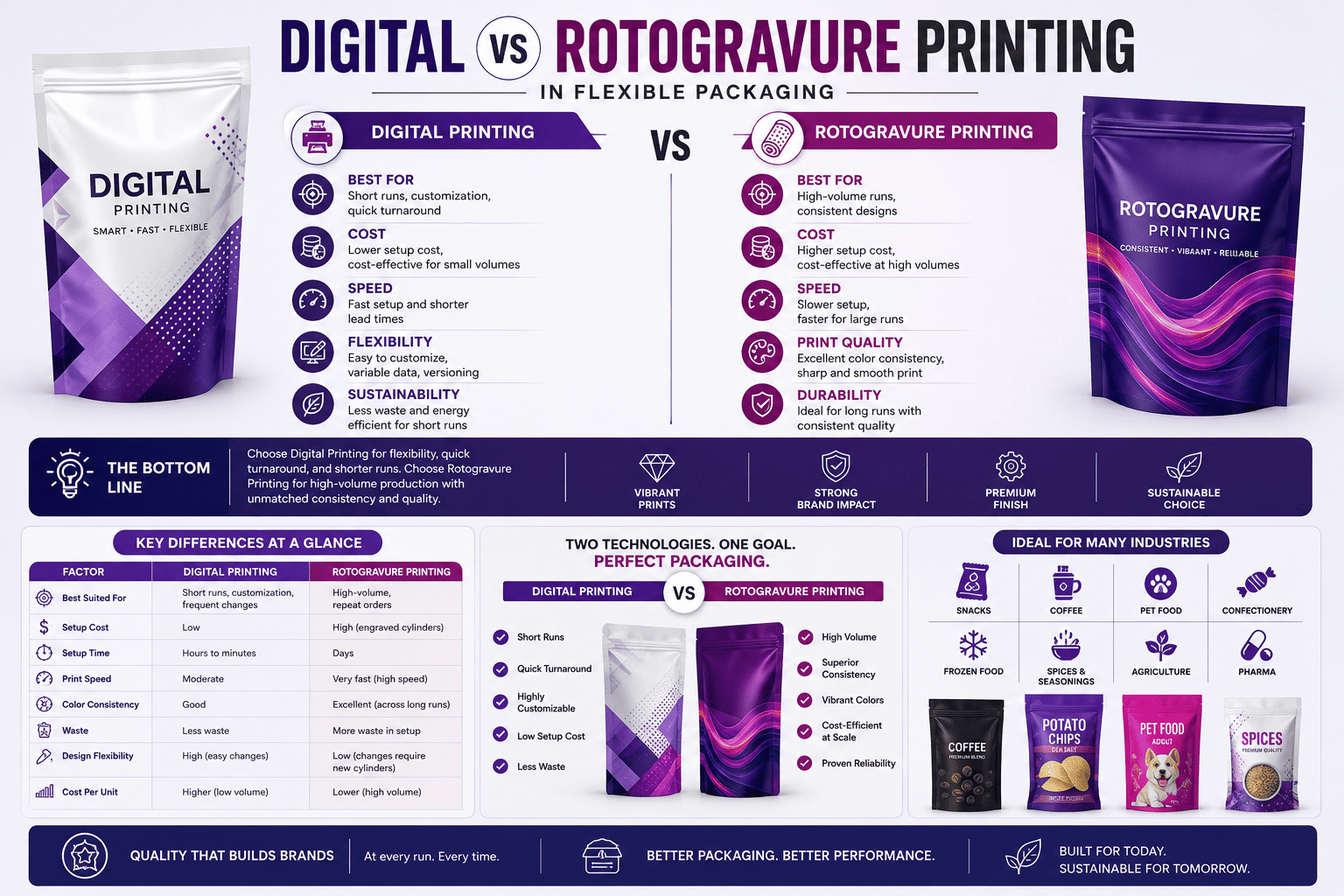
The biggest difference between digital and rotogravure printing is how the artwork is transferred to the packaging. Digital printing works directly from digital artwork, while rotogravure printing uses engraved cylinders.
This difference affects several parts of the packaging process, including setup, production volume, design changes, lead time, and cost.
Digital printing generally provides greater flexibility for shorter production runs and frequent artwork changes. Rotogravure can become more efficient when producing large quantities of the same packaging design.
Neither method is automatically better for every packaging project. The right choice depends on what the brand needs from its packaging.
How Does Printing Setup Differ
Printing setup is one of the most important differences between the two methods. Digital printing does not require the same cylinder preparation used in rotogravure printing. Artwork can be prepared digitally and sent to the printing equipment. This can simplify the process when a brand needs a small quantity or wants to make frequent changes.
Rotogravure requires engraved cylinders before the printing run can begin. This creates an additional preparation step and an initial cost. However, those cylinders can be used for subsequent production runs of the same design, making the process more practical for products that require consistent, high volume production.
The difference becomes particularly important when a brand is deciding whether it expects one small production run or many large repeat orders.
Which Printing Method Is Better for Small Orders
Digital printing is often more suitable for smaller production runs. Because digital printing does not require the same cylinder preparation as rotogravure, brands can avoid some of the initial setup associated with traditional printing.This can make digital printing useful for new brands, product testing, limited editions, seasonal products, and smaller packaging requirements.
For example, a brand launching a new snack or specialty food product may not initially know how much packaging it will need. Digital printing can provide greater flexibility during this stage. Rotogravure may become more attractive as production volumes increase and the same design is used repeatedly.
Which Printing Method Is Better for Large Volumes
Rotogravure printing can be highly effective for large production runs. Once the printing cylinders have been prepared, the process can produce large quantities of packaging with consistent results.
For established products that use the same packaging design over long production runs, the initial cylinder investment can be spread across a larger quantity of printed packaging. This can make rotogravure more economical for certain high volume applications.
Brands with predictable demand and regular packaging orders may therefore find rotogravure a suitable choice.
How Do Digital & Rotogravure Compare In Print Quality
Both digital and rotogravure printing can produce high quality packaging.The final result depends on factors such as artwork, printing equipment, inks, packaging material, color management, and production control.
Rotogravure is well known for producing detailed and consistent images across large production runs. It can be particularly useful for packaging designs with strong photographic elements and detailed graphics.
Digital printing can also produce sharp graphics and vibrant designs while providing greater flexibility for artwork changes.
Instead of choosing a printing method based only on the word quality, brands should evaluate the actual artwork and packaging requirements.
How Do They Handle Different Packaging Designs
Packaging design can change over the life of a product.
A brand may want different flavors, sizes, seasonal designs, promotional graphics, or personalized packaging. Digital printing can make these variations easier to manage because each design can be changed digitally. For example, a snack brand with several flavors may want each package to have different artwork while maintaining the same overall brand identity.
Rotogravure can also support multiple designs, but each design may require its own cylinder preparation. This can make frequent design changes more involved. For brands that regularly update packaging, digital printing may provide greater flexibility.
Digital Printing For Variable Packaging Designs
One of the major strengths of digital printing is the ability to produce variable designs.
Different packages can carry different artwork within the same production process. This can support personalized packaging, regional designs, promotional campaigns, and multiple product variations.
For brands experimenting with different designs, this can provide an opportunity to test packaging concepts without committing to very large quantities of one design.
It can also help brands respond more quickly to changing marketing campaigns.
This flexibility makes digital printing particularly interesting for brands that treat packaging as part of their marketing strategy.
What About Rotogravure Printing Consistency
Rotogravure is well suited to situations where packaging designs need to remain consistent across large quantities. Once the cylinders and production specifications have been established, the same design can be reproduced across large packaging runs. This can be valuable for established brands where consistency is important.
A product that appears on shelves across different stores and locations needs to maintain a recognizable appearance. Consistent printing can help support that brand identity. For high volume products with stable artwork, this consistency can be an important advantage.
How Does Order Quantity Affect Printing Choice
Order quantity is one of the most important factors when comparing digital and rotogravure printing. A smaller order may favor digital printing because the setup requirements are generally simpler.
A larger order may make rotogravure more attractive because the initial cylinder investment can be distributed across a larger number of packages.
The exact point where one method becomes more economical than the other depends on the project. Brands should therefore evaluate the total production cost rather than looking only at the printing cost per package.
How Do Lead Times Compare
Production timelines can also influence the decision. Digital printing can simplify the preparation process because artwork can move directly into production without the same cylinder preparation required for rotogravure.
This can be helpful when packaging is needed quickly or when artwork needs to be updated close to production.
Rotogravure requires additional preparation before printing can begin. However, once the cylinders are ready, the production process can be highly efficient for large orders. The best choice depends on the urgency of the project, order size, artwork requirements, and production schedule.
Which Printing Method Is More Flexible
When it comes to flexibility, digital printing generally has an advantage. Artwork can be changed without creating a new cylinder, making it easier to produce different versions of packaging.This can be useful for brands with multiple product varieties or frequently changing designs.
Rotogravure provides flexibility in terms of large scale production and consistent repeat orders, but changes to the artwork can require additional preparation. For brands that value design flexibility, digital printing can therefore be an attractive option.
How Do Digital and Rotogravure Printing Affect Packaging Costs
Cost should be evaluated across the entire production process.Digital printing can have lower initial setup requirements, which can make it attractive for smaller orders. Rotogravure involves cylinder preparation, which creates an initial cost. However, for large production quantities, the cost of setup can be distributed across many packages.
This means that the cheaper printing method depends on the specific project. A brand should consider order quantity, repeat orders, number of designs, setup costs, production costs, and expected packaging demand before making a decision. Looking only at the cost of the first production run may not provide a complete picture.
Digital Printing vs Rotogravure For Product Launches
New products often have uncertain demand. A brand may launch a product and initially produce a limited quantity while testing customer response. Digital printing can be useful in this situation because it supports smaller production runs and makes design changes easier.
Once the product becomes established and packaging demand increases, the brand can evaluate whether another printing approach would be more appropriate. This creates a practical path for brands that want to test packaging before committing to larger production volumes.
Digital Printing vs Rotogravure For Established Products
Established products with predictable demand may have different requirements. If a product uses the same packaging design and requires large quantities on a regular basis, rotogravure can become a practical option.
The initial cylinder preparation becomes less significant when the cylinders are used repeatedly for large production runs. For these products, consistency, production efficiency, and overall cost can become more important than short run flexibility.
Which Printing Method Should You Choose
There is no universal answer to the question of whether digital or rotogravure printing is better. Digital printing can be a strong choice when a brand needs smaller quantities, frequent design changes, multiple versions, faster setup, or variable artwork. Rotogravure can be a strong choice when a brand needs large quantities, consistent artwork, repeat production, and efficient high volume manufacturing.
The right decision should be based on the complete packaging requirement rather than one factor.
How Printing Fits Into Flexible Packaging
Printing is only one part of the packaging process. The packaging material, pouch structure, size, sealing method, finish, and printing all need to work together. A well designed package starts with the product requirements and then considers how the packaging needs to perform. For brands exploring flexible packaging options, understanding the available pouch formats can help connect printing decisions with the final package.
Final Thoughts
Digital and rotogravure printing can both produce high quality packaging, but they are designed around different production needs. Digital printing offers flexibility, easier artwork changes, and practical options for smaller or variable production runs. Rotogravure printing is well suited to high volume production where consistent artwork and repeat orders are important.
The right choice depends on your packaging quantity, design requirements, production timeline, repeat orders, and overall packaging strategy. Instead of asking which printing method is always better, ask which method fits your specific packaging requirements.
When printing, material, pouch format, and production needs are considered together, brands can create packaging that not only looks good but also supports efficient and practical product production.