
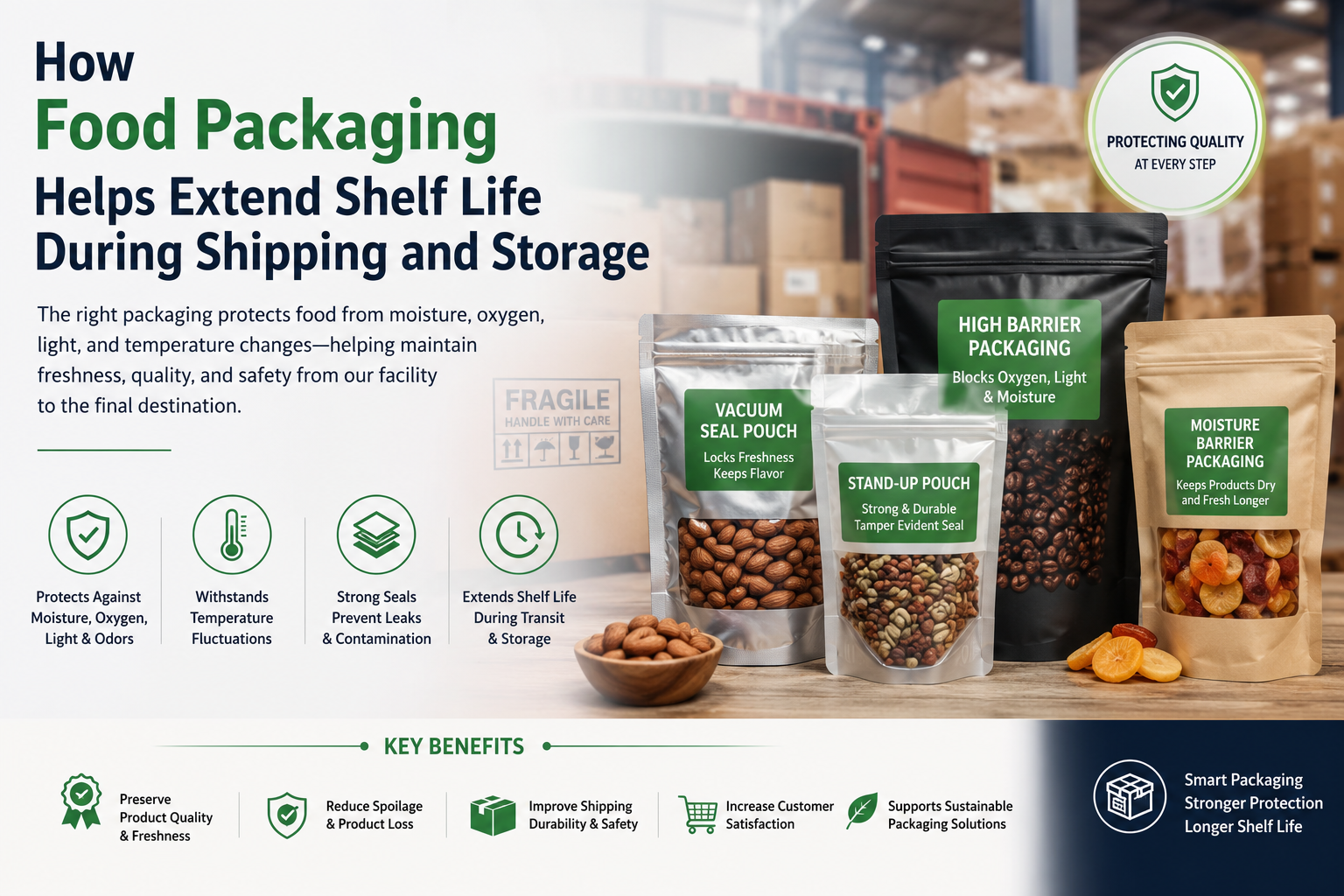
Anyone who has shipped snacks, sauces, or frozen meals knows the real test begins after the truck leaves the dock. Packaging for shelf life extension helps products maintain consistent quality throughout storage and distribution, no matter how far products travel or how long they remain on the shelf. Temperature swings, humidity, rough handling, and long transit times all work against food quality. The right pouch or bag can slow this deterioration, help maintain product quality, and give brands a real edge with customers who expect freshness every time they open a package.
What Type of Packaging Keeps Food Fresh During Shipping?
Most shipping damage isn’t visible until the box is opened. Oxygen gets in, moisture builds up, or a seal loosens just enough to let flavor escape. Food freshness depends on three packaging factors working together: the material barrier, the seal strength, and the pouch’s ability to handle pressure changes during transit.
For companies shipping snacks, jerky, or baked goods, vacuum seal pouch options remove excess air before sealing, which slows oxidation and keeps texture intact for weeks longer than a standard bag.
Retailers in the food and beverage space also lean on stand-up pouches with tamper-evident seals, since these hold up better during multi-stop distribution than boxes or loose wrap.
Handling matters just as much as material. A pallet that is dropped, tilted, or improperly stacked can crush a weak seal even if the film itself is strong enough for the job. That’s why packaging testing usually includes drop tests and compression tests, not just shelf storage checks.
Warehouse conditions play a role too. A product might survive a two-day truck ride just fine, then sit in a hot loading dock for a week before it even reaches a store shelf. Packaging built only around transit time, without accounting for storage delays, tends to underperform once it hits real supply chains.
Seasonal shipping adds another layer of difficulty. Summer heat accelerates oxidation and can soften seals on lower-quality films, while winter cold can make some plastics brittle and more likely to crack along fold lines. Brands shipping year-round often test packaging separately for both extremes rather than assuming one film handles every season equally well.
What Is High Barrier Packaging?
High barrier packaging refers to films built with multiple layers, usually combining materials like foil, EVOH, or metallized PET, to block oxygen, light, and moisture from reaching the product inside. Food preservation depends heavily on this layered structure because it provides better protection against oxygen, moisture, and light. In comparison, single-layer films usually provide limited protection against gas transfer during extended storage and shipping.
A pillow pouch packaging format is one of the more common high barrier choices for dry goods like coffee, rice, or spice blends, since the shape seals cleanly on all sides and resists puncture during stacking.
Brands moving into export markets often switch to high barrier films specifically because shipping packaging for perishables needs to survive customs delays, warehouse storage, and unpredictable weather without any drop in quality.
Light exposure is often overlooked, but UV exposure can accelerate the breakdown of fats, flavors, and certain nutrients in certain food products. Metallized or opaque films block that light entirely, which is one reason coffee and snack brands rarely use clear packaging for shelf-life products.
Not every product needs the highest barrier film available. A snack that sells out in two weeks doesn’t need the same protection as a shelf-stable soup meant to last a year, and using an unnecessarily heavy film just adds cost without adding real benefit. Matching barrier level to actual product turnover is one of the simplest ways to control packaging spend.
Seal integrity works alongside the film itself. A high barrier material with a weak or inconsistent seal still lets oxygen and moisture through at the edges, so manufacturers test seal strength as carefully as they test the film’s barrier properties before approving a run for production.
Moisture Barrier Packaging & Why It Matters
Moisture is one of the fastest ways to ruin a product. Crackers go soft, powders clump, and dried fruit turns chewy in the wrong way. Moisture barrier packaging uses films with low water vapor transmission rates to keep humidity out and internal moisture locked in place.
This matters even more for sustainable packaging made from plant-based films, since some sustainable packaging materials may require additional barrier layers to achieve the same moisture protection as conventional films.
Cold chain shippers also depend on this barrier property, because condensation inside a bag during temperature swings can be just as damaging as outside humidity.
Desiccant packets and oxygen absorbers are sometimes added inside pouches for extra protection, but they only work well when the outer film is already doing its job. A weak barrier film will let humidity back in no matter how many absorbers sit inside the bag.
Regional climate matters more than most brands expect. A pouch designed and tested in a dry, moderate climate can perform very differently once it reaches a humid coastal region or a hot inland warehouse. Suppliers that ship internationally usually adjust barrier specifications based on the destination climate rather than relying on a single standard film for every market.
Shelf-Life Packaging For Cold Chain & Export Shipping
Export shipping adds weeks of uncertainty that domestic shipping rarely has to deal with. Shelf-life packaging becomes even more important once a product sits in a shipping container for three or four weeks, since temperature and humidity are almost impossible to control that whole time.
Brands that export dairy, meat, or seafood usually rely on multi-layer films combined with proper cold storage, since packaging alone cannot fix a broken cold chain, but it can buy extra time if refrigeration is interrupted for a few hours.
Testing packaging under real export conditions, not just lab conditions, gives a much clearer picture of how a product will actually perform. Simulated humidity chambers and transit vibration tests are common steps before a new film structure moves into full production.
Customs and border inspections can also add unplanned delays that extend a shipment’s time in transit by days or even weeks. Packaging built with a wider safety margin, rather than one designed for the minimum expected shipping time, gives a product a much better chance of arriving in good condition when delays happen.
How Flexible Packaging Helps Extend Product Shelf Life?
Flexible packaging gives brands more control over shelf life than rigid containers do, mainly because the film itself can be engineered layer by layer for a specific product. A cheese brand and a coffee roaster need very different barrier properties, and flexible pouches let manufacturers adjust for that.
Resealable bags and pouch designs also extend usable shelf life after the package is opened, which matters for snack foods and pet treats that customers don’t finish in one sitting.
Adding a twist-wrap closure on individually portioned items, like candy or single-serve snacks, gives an extra layer of protection once the outer pouch is opened, so the rest of the batch stays fresh longer.
Food packaging and shelf life go hand in hand once brands start treating packaging as part of the recipe, not just the wrapper around it. A film upgrade often costs less than the returns and complaints caused by product spoiling early.
Flexible pouches also weigh less and take up less space than jars or cans, which cuts shipping costs and lowers the carbon footprint of every shipment. For brands watching both budget and sustainability goals, that combination is often what tips the decision toward flexible formats in the first place.
Choosing A Shelf-Life Packaging Supplier
Not every packaging supplier tests for real shipping conditions. A good shelf-life packaging solutions supplier runs accelerated aging tests, checks seal strength under pressure, and simulates the humidity and temperature swings a product will face on a multi-day truck route.
Ask about oxygen transmission rate data and water vapor transmission rate testing before locking in a film structure, since these numbers tell you far more than a supplier’s marketing claims.
Smaller brands sometimes skip this step to save money upfront, only to deal with returns and complaints once products start failing in transit, which usually costs more in the long run.
A supplier willing to share test data, sample runs, and packaging specs before production starts is usually a better long-term partner than one that only offers pricing sheets.
Lead times matter as well. A supplier that can turn around film samples quickly makes it much easier to test, adjust, and finalize packaging before a launch date, instead of locking in a spec early just to hit a deadline.
Testing Packaging Before Scaling Production
Skipping shelf-life testing to save time almost always costs more later. A small batch run tested under real shipping and storage conditions can catch a weak seal or a mismatched barrier film long before it turns into thousands of returned units.
Accelerated shelf-life testing speeds this process up by exposing packaged products to higher temperatures and humidity for a shorter period, mimicking months of normal storage in just a few weeks.
Real-world pilot shipments matter too. Sending a small batch through the actual shipping route a product will use often reveals handling issues that a controlled lab environment misses completely.
Working With A Protective Food Packaging Manufacturer
Working directly with a protective food packaging manufacturer instead of a generic supplier means access to custom film structures built for a specific product category, whether that’s produce, dairy, or dry snacks.
Contipack Inc works with food and beverage brands on flexible packaging built around real shelf-life data, from barrier film selection to seal testing, so products hold up from the first mile to the last.
A manufacturer that understands both the science and the shipping side can catch problems before they reach the customer, which saves money and protects a brand’s reputation at the same time.
Long-term partnerships also tend to pay off more than one-off orders. A manufacturer familiar with a brand’s product line, packaging history, and past testing data can spot issues faster and suggest film upgrades as new materials or barrier technologies become available, rather than treating every order as a fresh start.
Communication matters just as much as technical capability. Brands that stay in regular contact with their manufacturer about upcoming product changes, new markets, or shifting shipping routes tend to catch packaging mismatches early, before a new SKU ends up shipped in a film that was never tested for that specific use case.
A Quick Checklist Before Choosing Packaging
Before locking in a packaging spec, it helps to step back and look at the full journey a product will take, from the production line to the customer’s kitchen counter. Shipping distance, storage time, climate at the destination, and how the product is handled along the way all shape which film and format make sense.
A brand shipping frozen seafood across the country has very different needs than one selling shelf-stable snacks at a regional grocery chain, even though both are technically food packaging projects. Matching the barrier level, seal type, and closure style to the actual supply chain, rather than copying whatever a competitor uses, tends to produce far better shelf life results.
Reviewing packaging performance after each season or each major shipping route change also helps catch problems early. What worked during a mild spring shipping run might not hold up the same way once summer heat or holiday shipping volume adds new pressure to the supply chain.
Need packaging designed to protect freshness during shipping and storage? Contipack Inc helps food brands develop flexible packaging solutions with the right barrier properties, seal performance, and shelf-life requirements.
Frequently Asked Questions
Q1: How long can flexible packaging extend shelf life?
It depends on the product and the barrier level of the film. A high barrier pouch with proper sealing can significantly extend shelf life based on the product type, storage conditions, and barrier requirements, especially for dry goods and snacks.
Q2: What is the difference between a moisture barrier and an oxygen barrier?
A moisture barrier blocks water vapor from passing through the film, while an oxygen barrier blocks gas transfer that causes oxidation. Most high barrier films are engineered to manage both at once, since food quality depends on keeping out humidity and oxygen together.
Q3: Does sustainable packaging perform as well as traditional plastic?
It can, but not always without adjustments. Some sustainable materials need extra barrier layers to match the moisture and oxygen protection of conventional plastic films, so testing is important before switching formats.
Q4: How do I know if my packaging needs to be tested before shipping internationally?
If a product will spend more than a week or two in transit, sit in a shipping container, or pass through a different climate than it was originally tested for, it’s worth running export-specific tests before committing to full production.
Q5: What should I ask a packaging supplier before placing a large order?
Ask for oxygen and water vapor transmission rate data, seal strength test results, and sample runs. A supplier that can share this information upfront is usually better equipped to support long-term shelf-life goals.
Final Thoughts
Shelf-life packaging isn’t a small detail tucked at the end of production. It’s part of how a product performs once it leaves the building. From moisture barrier films to resealable closures, every choice affects how a customer experiences that product weeks after it ships. Brands that treat shelf-life packaging as a science instead of an afterthought end up with fewer complaints, less waste, and customers who trust the product every time they open it.