
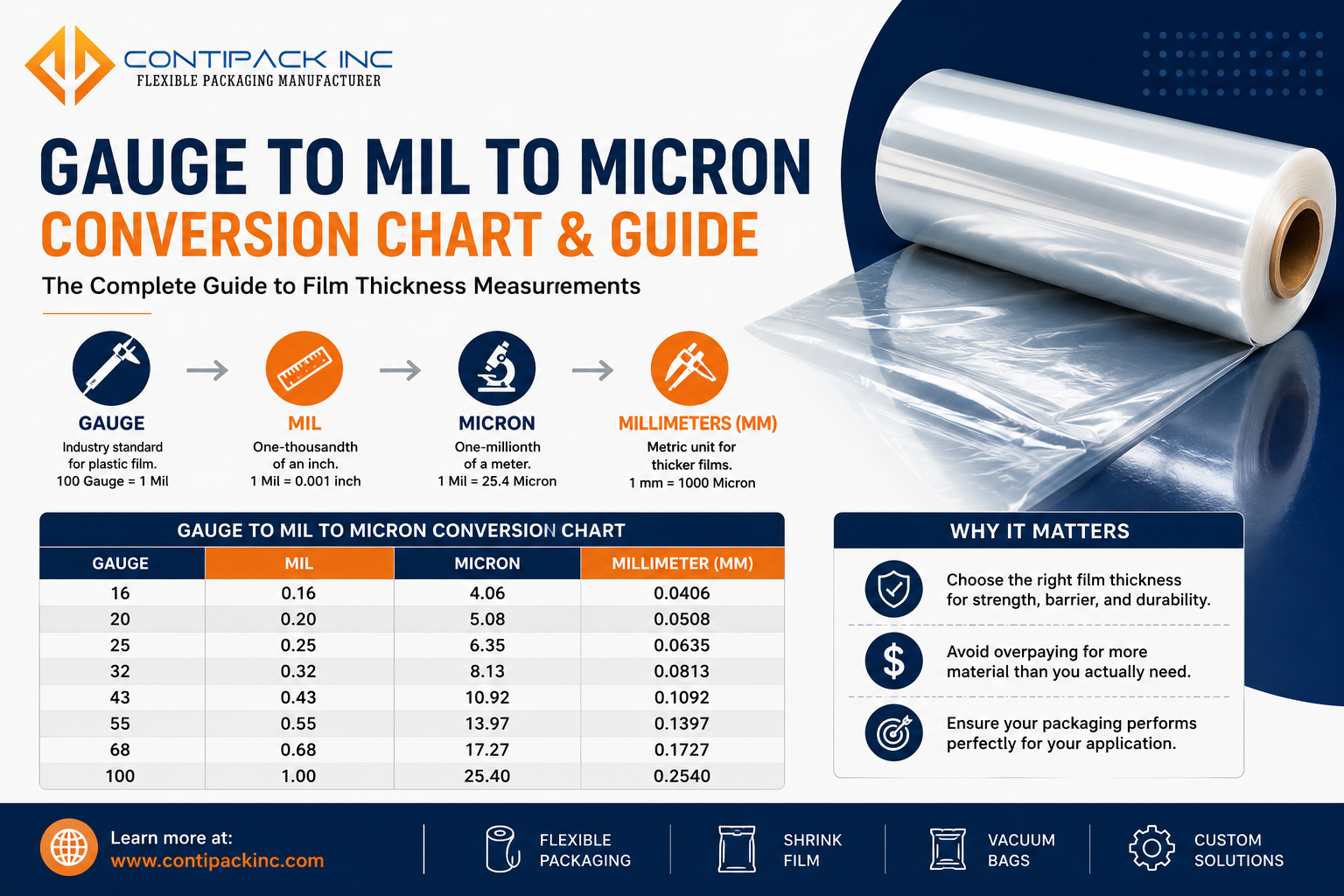
If you’ve ever tried to compare packaging film specs from different suppliers, you’ve probably run into three different units for the exact same measurement as gauge, mil, and micron. One supplier quotes film in gauge, another in mil, and a technical data sheet from overseas might list everything in microns or millimeters. Without a clear conversion reference, it’s easy to misjudge how thick, and how strong, a film actually is.
This guide breaks down exactly how gauge, mil, and micron relate to one another, gives you a full conversion chart for the most commonly requested values, and explains why getting film thickness right matters for the performance of your packaging.
Why Film Thickness Measurement Matters?
Film thickness directly affects three things the durability, barrier performance, and cost. A film that’s too thin for its application may tear, puncture, or fail to protect the product inside. A film that’s too thick adds unnecessary material cost and can create issues with sealing equipment or flexibility.
At ContipackInc, film gauge selection is one of the most common technical conversations we have with customers, whether they’re specifying vacuum seal bags for meat products, lightweight pillow pack pouches for snacks, or shrink sleeves that need to stretch precisely around a bottle. Understanding the relationship between gauge, mil, and micron helps you communicate specifications accurately and choose the right film for your product.
Understanding The Gauge, Mil, Micron, & Millimeter Units
Before jumping into conversions, it helps to understand what each unit actually measures.
What Is Mean By Mil?
Mil is a unit of length equal to one-thousandth of an inch (0.001 inch). It’s the standard unit used in the United States for measuring plastic film thickness.
What Is Mean by Gauge?
Guage is a unit specific to the plastic film industry, primarily used in the United State It’s not related to gauge measurements used for wire or sheet metal. In film manufacturing, 100 gauge equals 1 mil. This relationship is fixed and doesn’t change based on film type or material.
What Is Mean By Micron?
Micron (sometimes written as “micrometer” or abbreviated “mic” or “µm”) is a metric unit equal to one-millionth of a meter. It’s the standard unit used internationally, particularly in Europe and Asia, for measuring film thickness.
What Is Mean By Millimeter (mm)?
A millimeter is a larger metric unit, often used for thicker films or laminated structures where micron values would become unwieldy.
Because film specifications can come from suppliers using any of these four units, converting between them accurately is essential for comparing products or communicating specs across regions.
The Core Conversion Formulas
Once you know the fixed relationships between these units, converting between them is straightforward:
- 1 mil = 100 gauge
- 1 mil = 25.4 microns
- 1 gauge = 0.254 microns
- 1 gauge = 0.00254 millimeters
- 1 micron = 0.0394 mil
- 1 micron = 3.937 gauge
From these, you can derive any conversion you need:
- Gauge to Mil: divide gauge by 100
- Mil to Gauge: multiply mil by 100
- Mil to Micron: multiply mil by 25.4
- Micron to Mil: divide micron by 25.4
- Gauge to Micron: multiply gauge by 0.254
- Micron to Gauge: multiply micron by 3.937
- Gauge to Millimeter: multiply gauge by 0.00254
Gauge To Mil To Micron Conversion Chart
Here’s a quick-reference chart covering some of the most commonly used film gauge values in the packaging industry, along with their mil, micron, and millimeter equivalents.
| Gauge | Mil | Micron | Millimeter (mm) |
| 16 | 0.16 | 4.06 | 0.0406 |
| 18 | 0.18 | 4.57 | 0.0457 |
| 20 | 0.20 | 5.08 | 0.0508 |
| 25 | 0.25 | 6.35 | 0.0635 |
| 32 | 0.32 | 8.13 | 0.0813 |
| 36 | 0.36 | 9.14 | 0.0914 |
| 43 | 0.43 | 10.92 | 0.1092 |
| 48 | 0.48 | 12.19 | 0.1219 |
| 54 | 0.54 | 13.72 | 0.1372 |
| 55 | 0.55 | 13.97 | 0.1397 |
| 60 | 0.60 | 15.24 | 0.1524 |
| 68 | 0.68 | 17.27 | 0.1727 |
| 80 | 0.80 | 20.32 | 0.2032 |
| 100 | 1.00 | 25.40 | 0.2540 |
| 120 | 1.20 | 30.48 | 0.3048 |
| 150 | 1.50 | 38.10 | 0.3810 |
This chart works as a quick gauge to mil, gauge to micron, or gauge to mm calculator without needing to run the math manually every time. Bookmark it as your go-to mil conversion chart when comparing film specs.
Worked Examples: How the Conversion Actually Works
Sometimes it helps to see the formula applied step by step. Here are a few common conversions worked out in full:
- 43 gauge to mil: 43 ÷ 100 = 0.43 mil
- 54 gauge to mil: 54 ÷ 100 = 0.54 mil
- 68 gauge to mil: 68 ÷ 100 = 0.68 mil
- 1.5 mil to micron: 1.5 × 25.4 = 38.1 microns
- 3 mil to micron: 3 × 25.4 = 76.2 microns
- 16 micron to mil: 16 ÷ 25.4 = 0.63 mil
- 16 micron to gauge: 16 × 3.937 = approximately 63 gauge
- 14 micron to gauge: 14 × 3.937 = approximately 55 gauge
- 55 gauge to mm: 55 × 0.00254 = 0.1397 mm
- 80 gauge to mm: 80 × 0.00254 = 0.2032 mm
- 100 gauge to mm: 100 × 0.00254 = 0.254 mm
Once you know the base formulas, any gauge to mil, mil to gauge, or micron to gauge conversion can be calculated the same way, regardless of the specific numbers involved.
Mil vs. Gauge: What’s the Difference?
This is one of the most common points of confusion in film specifications. Mil and gauge aren’t different types of measurement, they’re simply different units describing the same physical thickness, and they’re mathematically linked at a fixed ratio of 100 gauge to 1 mil.
The confusion usually comes from industry habits. In the U.S. plastic film industry, gauge is often used for thinner films like trash bags, produce bags, or packaging film, while mil is more commonly used for thicker films or when comparing across other plastic products. Neither unit indicates anything about film strength or material composition on its own, thickness is only one factor in how a film performs. Two films of the same gauge can have very different strength and barrier properties depending on the resin, layering, and manufacturing process used.
How Thick Is 16 Microns, Really?
To put micron measurements into perspective 16 microns is roughly equivalent to 0.63 mil, or about 63 gauge. For comparison, a human hair is typically between 50 and 100 microns thick, meaning a 16-micron film is noticeably thinner than a single strand of hair. This is common for lightweight applications like light-duty produce bags or certain laminate layers, where minimal thickness helps control material cost.
Why Film Gauge Matters For Different Packaging Types
Choosing the right film gauge isn’t just a technical formality, it directly impacts how well your packaging performs for its specific use case.
- Vacuum seal bags for example, typically require a heavier gauge and multi-layer construction to withstand vacuum pressure, prevent punctures from bone or hard edges in meat and seafood products, and maintain a reliable seal through freezing and thawing cycles.
- Pillow pack packaging, used for snacks and lightweight consumer goods, often uses a lighter gauge film since the priority is production speed and cost efficiency on high-volume filling lines, while still providing adequate moisture and oxygen protection.
- Resealable pouches need a gauge that balances flexibility with durability, since the film has to withstand repeated opening and closing without cracking or losing its seal integrity at the zipper or closure point.
- Candy twist wraps are typically among the thinnest films used in packaging, since the material needs enough flexibility to hold a twisted shape without excess bulk or material cost per unit.
- Shrink sleeves require a very specific gauge range to shrink evenly around a bottle or container without distorting printed graphics, too thin and the sleeve may tear during application, too thick and it won’t shrink properly to the container’s contours.
Getting the gauge right for each of these formats is a balance between protection, functionality, and cost, which is why film specification is one of the first conversations we have with customers before production begins.
How To Choose The Right Film Gauge For Your Product
If you’re specifying film thickness for a new packaging project, a few questions can help guide the decision:
- What is the product’s weight and shape, and does it have sharp edges or points that could puncture thinner film?
- Will the package be vacuum-sealed, frozen, or exposed to temperature fluctuations?
- Does the package need to be resealable, and how many times will it realistically be opened and closed?
- Is the package designed for high-speed automated filling, where lighter gauge films reduce cost per unit?
- What barrier properties are required, moisture, oxygen, light, or all three?
Once these factors are defined, converting between gauge, mil, and micron becomes less about matching a number and more about confirming that the film meets the functional requirements for your specific product.
Common Mistakes When Converting Film Thickness
Even with a clear formula, film thickness conversions can go wrong in a few predictable ways. Being aware of these common mistakes can save time and prevent costly ordering errors.
Confusing gauge with other industries’ gauge systems
Wire gauge and sheet metal gauge use entirely different scales where a higher number means a thinner material. Film gauge works in the opposite direction, a higher gauge number means a thicker film. Mixing up these systems is one of the most frequent errors when sourcing materials across industries.
Rounding too early in multi-step conversions
When converting from micron to gauge, for example, rounding the mil value before completing the full calculation can introduce small errors that compound across large production runs. It’s best to carry a few decimal places through each step and only round the final number.
Assuming thickness equals strength
As mentioned earlier, gauge and mil measurements describe thickness only, not tensile strength, puncture resistance, or barrier performance. Two films at the same gauge can perform very differently depending on resin type, layer structure, and manufacturing process. Always confirm performance specifications separately from thickness when comparing film options.
Mixing metric and imperial specs without converting first
If one supplier’s data sheet is in microns and another is in mil, comparing the raw numbers side by side without converting first can lead to ordering the wrong material entirely. Always convert both specs to the same unit before comparing.
Frequently Asked Questions
1. How do I convert gauge to mil?
Divide the gauge number by 100. For example, 48 gauge divided by 100 equals 0.48 mil.
2. How do I convert mil to gauge?
Multiply the mil value by 100. For example, 0.25 mil multiplied by 100 equals 25 gauge.
3. How many microns is 1 mil?
One mil equals 25.4 microns, since a mil is a thousandth of an inch and a micron is a metric unit of length.
4. What is 20 gauge in mil?
20 gauge divided by 100 equals 0.20 mil.
5. What is 36 gauge in millimeters?
36 gauge multiplied by 0.00254 equals 0.0914 mm.
6. Is there a downloadable mm to micron conversion chart?
The relationship is simple enough to calculate directly: 1 millimeter equals 1,000 microns. Reach out to our team if you’d like a printable version of our full film conversion chart.
7. Why do some suppliers use gauge and others use micron?
Gauge is primarily used in the U.S. film industry, while micron is the standard in most international markets. Both measure the same physical thickness, just in different units.
Final Thoughts
Whether you’re comparing quotes from different film suppliers or specifying thickness for a new packaging project, understanding how gauge, mil, and micron relate to each other removes a lot of the guesswork from the process. Use the chart and formulas above as your reference point, and remember that the right film gauge always depends on the specific demands of your product, not just a single universal number.
If you’re not sure which gauge is right for your packaging format, whether it’s vacuum seal bags, pillow pack pouches, resealable packaging, or shrink sleeves, our team can help you match the right film thickness to your product’s performance requirements.