
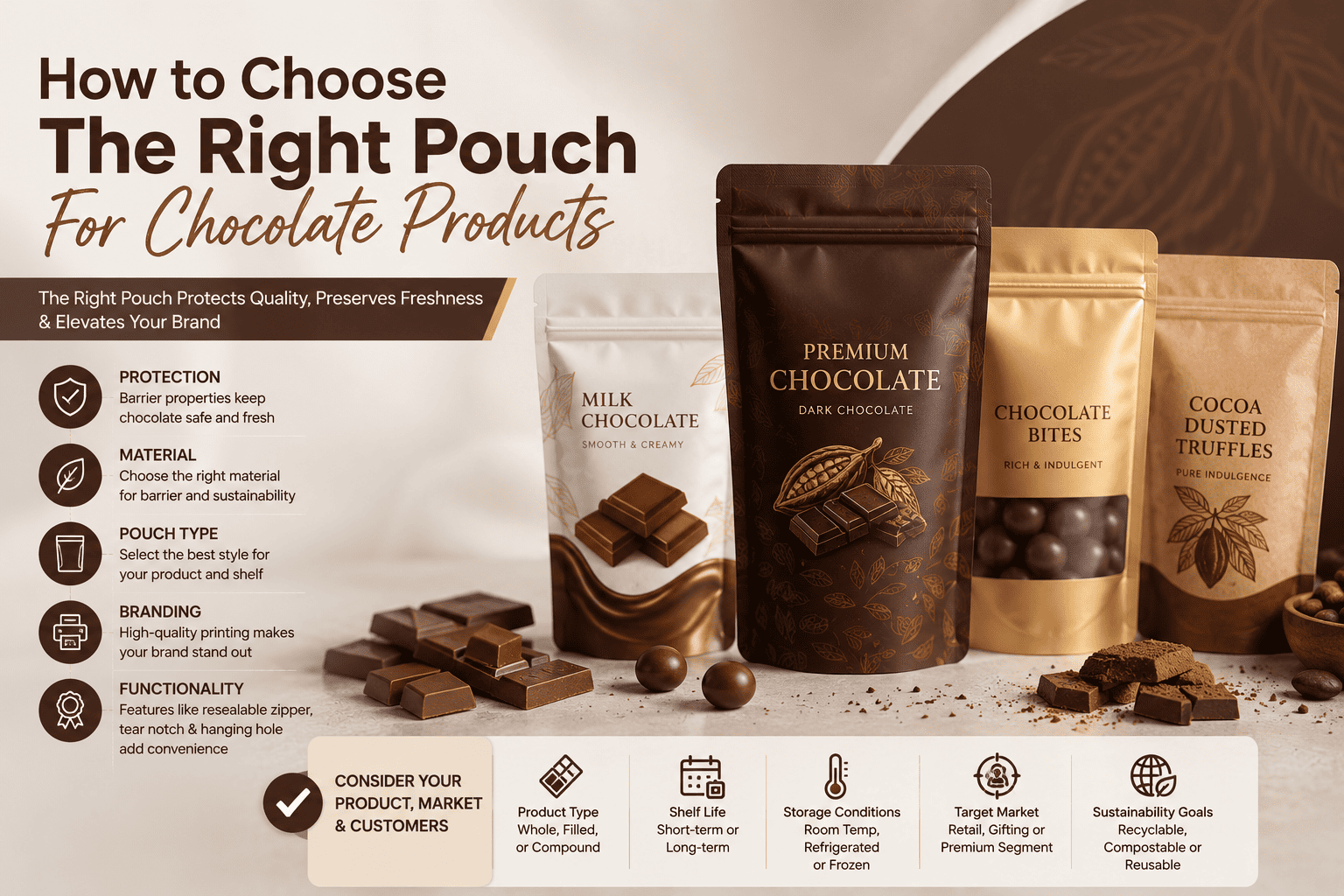
Chocolate packaging has an important role to play in protecting product quality and creating a strong customer experience. Chocolate can be affected by heat, moisture, oxygen, light, handling, and storage conditions. The right packaging helps reduce exposure to these factors while keeping the product presentable from production to purchase.
For chocolate brands, choosing packaging is not only about finding an attractive pouch. The packaging needs to match the type of chocolate, expected shelf life, product quantity, storage conditions, transportation requirements, and customer usage.
A chocolate bar may have different packaging needs from chocolate pieces, filled chocolates, truffles, or chocolate covered snacks. The right choice depends on what the product needs throughout its journey.
This guide explains how to choose chocolate packaging, what to consider when selecting a pouch, how different packaging factors affect chocolate quality, and how brands can make better packaging decisions without compromising product presentation.
Why Does Chocolate Need Protective Packaging
Chocolate may look like a simple product, but its quality can be affected by its surroundings. Temperature changes can affect its texture and appearance. Moisture can affect the surface and texture of some chocolate products. Oxygen and light can also influence product quality depending on the ingredients and storage conditions.
Packaging creates a barrier between the chocolate and the external environment. The level of protection needed depends on the type of chocolate and how long it needs to maintain its intended quality.
Packaging also protects chocolate from physical handling during transportation and storage. A suitable pouch can help reduce exposure to external conditions while providing a practical way to store and distribute the product.
The packaging therefore needs to perform two important jobs. It needs to protect the product and present the product in a way that supports the brand.
What Can Affect Chocolate Quality
Before choosing packaging, it is useful to understand what can affect chocolate during storage and transportation.
1. Heat
Temperature is an important consideration for chocolate products. Chocolate can soften or lose its intended shape when exposed to high temperatures.
Packaging cannot prevent chocolate from melting when it is exposed to excessive heat, but the right packaging structure can help provide protection from the surrounding environment.
Brands should consider where the chocolate will be stored, how it will be transported, and what temperatures it may experience before selecting the packaging structure.
2. Moisture
Moisture can affect certain chocolate products and may influence texture and surface appearance.
For products that are sensitive to moisture, packaging with suitable moisture protection can help reduce unwanted exposure.
This is one reason why chocolate packaging material should be selected according to the product rather than simply based on appearance.
3. Oxygen
Oxygen exposure can affect some chocolate products and ingredients over time. The importance of oxygen protection depends on the product formulation, ingredients, expected shelf life, and storage conditions.
When chocolate needs stronger protection, the packaging structure should be evaluated for its ability to limit oxygen exposure.
4. Light
Light can also be a consideration for chocolate packaging. Some ingredients and products may be sensitive to prolonged exposure to light.
The packaging structure and design can be selected according to how much light protection the product requires.
5. Handling
Chocolate products can be delicate. Transportation and handling can expose the package to pressure, movement, and other physical stresses.
The pouch should be suitable for the product quantity and distribution process. It should also provide enough space for filling without creating unnecessary movement inside the package.
What Type Of Packaging Is Best For Chocolate
There is no single packaging format that is automatically the best choice for every chocolate product.
The right format depends on the product type, quantity, shelf life, storage conditions, distribution requirements, and customer experience.
Flexible pouches can be a practical option for many chocolate products because they can be produced in different sizes and formats. They can also provide a large printable surface for branding and product information.
For chocolate pieces, chocolate covered snacks, specialty treats, and larger quantities, pouches can provide a combination of protection, convenience, and presentation.
When comparing packaging formats, consider what the chocolate needs rather than choosing a format simply because it is popular.
What Material Is Used for Chocolate Packaging
Chocolate packaging can use different flexible material structures depending on the level of protection required.
The material needs to provide suitable protection against factors such as moisture, oxygen, and light. The exact structure should depend on the product requirements and expected shelf life.
A chocolate brand should not select packaging material based only on the name of the material. Two products may look similar but require different packaging structures because of differences in ingredients, shelf life, storage conditions, or distribution.
The better approach is to first understand the product requirements and then select a suitable packaging structure.
This is particularly important for brands that want their chocolate to maintain its intended quality for an extended period.
How To Choose Chocolate Packaging Material
Selecting chocolate packaging material becomes easier when you evaluate the product from several angles.
Consider the Type of Chocolate
Different chocolate products can have different packaging requirements.
Dark chocolate, milk chocolate, filled chocolate, chocolate covered nuts, chocolate pieces, and specialty chocolates may require different levels of protection.
Ingredients can also influence packaging requirements. Products containing nuts, fillings, creams, or other ingredients should be evaluated according to their specific characteristics.
Start with the product rather than starting with the packaging.
Consider Shelf Life
Shelf life is another important consideration when choosing packaging.
A product that needs to remain fresh for several months may require a different packaging structure from a product intended for quick consumption.
The longer the expected shelf life, the more important it becomes to evaluate the packaging barrier and storage conditions carefully.
Brands should define the expected shelf life before finalizing the packaging structure.
Consider Storage Conditions
Think about where the chocolate will be stored before reaching the customer.
Will it remain in a controlled environment, or could it experience temperature changes during transportation and storage.
Will it be displayed under lights, stored in warehouses, or shipped directly to customers.
Understanding these conditions helps create a more accurate picture of the protection the packaging needs to provide.
Consider Transportation
Chocolate may travel through several stages before reaching the customer. It may move from the production facility to a warehouse, then to a retailer, and finally to the customer.
Online products may have an even more direct but physically demanding journey.
Packaging should therefore be evaluated based on the complete distribution process. The pouch needs to remain practical and secure during filling, handling, transportation, and storage.
How Pouches Help Protect Chocolate
Pouches can provide a flexible packaging option for chocolate brands that need protection and strong product presentation in the same package.
A pouch can be designed around the product quantity and required dimensions. The packaging structure can also be selected according to the protection requirements of the chocolate.
Another advantage is the available surface area for branding. Chocolate brands can use the pouch to communicate the product name, flavor, ingredients, brand identity, and other important information.
For brands exploring different flexible packaging formats, like standup pouches, digital printed pouches, we provide an opportunity to consider packaging based on product requirements, pouch format, size, and presentation.
How To Choose The Right Pouch Size For Chocolate
Pouch size should be based on the actual product rather than an estimated package size. Start with the quantity of chocolate that the package needs to hold. Then consider the shape and dimensions of the product.
A pouch that is too large can leave excessive empty space and allow the chocolate to move around during transportation. A pouch that is too small can make filling difficult and may create unnecessary pressure on the product.
The pouch should provide enough room for efficient filling and sealing while maintaining an appropriate appearance.
Brands selling several chocolate varieties can also use a consistent size system. Different pouch sizes can maintain similar design elements, creating a recognizable product family while accommodating different product quantities.
Should Chocolate Packaging Be Resealable
A resealable pouch can be useful when customers are expected to consume the chocolate over multiple occasions.
For example, a larger pouch containing chocolate pieces or chocolate covered snacks may benefit from a resealable feature. Customers can open the package, take the amount they want, and close the package again.
Smaller packages intended for single use may not need this feature. The decision should therefore be based on customer behavior.
Consider how much chocolate the package contains, how quickly customers are likely to consume it, and whether they are expected to store the remaining product after opening.
A convenient closure can make the packaging easier to use and can contribute to a better customer experience.
How To Package Different Types Of Chocolate
Different chocolate products can require different approaches to packaging.
1. Chocolate Bars
Chocolate bars need packaging that supports product protection while providing enough space for the shape and dimensions of the bar.
The packaging should also be suitable for transportation and handling, particularly when the product is distributed through retail or ecommerce channels.
2. Chocolate Pieces
Chocolate pieces can work well in pouches because the flexible format can accommodate different quantities.
For larger packs, a resealable pouch may provide additional convenience. The packaging should also be selected according to the protection requirements of the chocolate.
3. Chocolate Covered Snacks
Chocolate covered nuts, fruits, pretzels, and similar products combine chocolate with another ingredient.
The packaging should therefore be considered according to the characteristics of both the chocolate coating and the product inside.
Shelf life, moisture, oxygen, product size, and storage conditions should all be evaluated.
4. Premium & Specialty Chocolate
Premium chocolate products often place greater emphasis on presentation.
The pouch design can communicate quality through typography, imagery, finishes, color, and overall layout.
However, visual appeal should work alongside product protection. Attractive packaging is most effective when it also supports the quality of the product inside.
How Packaging Design Affects Chocolate Products
Chocolate packaging is often the first interaction a customer has with the product.
The design can influence how customers perceive the product before they taste it. A simple design can communicate elegance, while bold graphics can create a more playful personality.
The important consideration is consistency with the product and brand.
A premium chocolate brand may want a refined appearance. A family focused chocolate brand may use warmer and more approachable visuals. A specialty brand may focus on the origin, ingredients, or craftsmanship of the product.
Custom printing can help brands create a package that reflects their identity instead of relying on a generic appearance.
The design should also keep important information easy to understand. Customers should be able to quickly identify the product, flavor, quantity, and brand.
What Should You Consider When Choosing Chocolate Packaging
A useful way to approach packaging selection is to consider the complete journey of the product.
- Think about the chocolate itself, its ingredients, texture, shape, and quantity.
- Then consider how long the product needs to maintain its intended quality.
- Next, evaluate the conditions it will experience during storage and transportation.
- After that, determine the level of protection required and select an appropriate material structure.
- Then choose the pouch format and size.
- Finally, consider customer convenience and brand presentation.
This approach keeps packaging decisions connected to the actual needs of the product.
Common Chocolate Packaging Mistakes
Choosing packaging based only on appearance is one of the most common mistakes.
A package can look premium but still fail to provide the level of protection the product needs.
Choosing the cheapest material without evaluating product requirements can create another problem. Packaging needs to provide value throughout the product lifecycle, not simply have a low initial cost.
Another mistake is selecting pouch dimensions before confirming the actual product quantity and size.
Brands can also overlook their filling and sealing process. A pouch should work with the production process rather than creating unnecessary difficulties.
Finally, some brands focus entirely on protection and forget about customer experience. Packaging should protect the product while also being practical and appropriate for the way customers use it.
How To Choose The Right Pouch For Your Chocolate Product
The selection process can be simplified by following a product first approach.
Start by identifying the type of chocolate and the characteristics that need to be protected.
Consider the expected shelf life and the conditions the product will experience during storage and transportation.
Identify whether moisture, oxygen, light, heat, or physical handling are important concerns.Next, select a packaging structure that provides suitable protection for those requirements.
Choose the pouch format based on the product quantity, dimensions, customer usage, and presentation goals.Determine whether the pouch needs a resealable closure. Finally, develop the visual design around the brand and product.
This approach helps ensure that the final package is not only attractive but also suitable for the actual needs of the chocolate.
When Should You Consider Custom Chocolate Packaging
Once a brand understands its product requirements, custom packaging can provide more flexibility.
Custom packaging allows brands to develop the pouch around their product rather than adjusting the product to a standard package.
This can be useful when a brand has several chocolate varieties, different package sizes, or specific protection requirements.
It can also provide greater control over branding and presentation.
For readers who have finished researching how chocolate packaging works and are now evaluating packaging options, an internal link to the Chocolate Packaging page can provide a natural next step.
The blog should remain educational, while the category page can focus more directly on the available packaging solutions.
How ContipackInc Can Support Chocolate Packaging
Choosing chocolate packaging becomes easier when the decision starts with the product requirements.
ContipackInc provides flexible packaging solutions for brands across different product categories. For products, packaging can be considered around factors such as pouch format, material structure, size, printing, closure, and product presentation.
The goal is to develop packaging that supports both product protection and brand presentation.
For a brand, this means looking beyond the appearance of the pouch and considering how the package will perform throughout production, transportation, storage, and customer use.
Once the packaging requirements are clear, a packaging supplier can help evaluate suitable options and develop a solution around the product.
Final Thoughts
The right pouch depends on the type of chocolate, ingredients, expected shelf life, storage conditions, transportation, product quantity, customer usage, and brand requirements.
Protection should always be considered alongside presentation. A pouch needs to help protect the chocolate while also creating a package that customers recognize and enjoy using.
There is no single packaging structure that works for every chocolate product. The better approach is to identify the risks and requirements first, then select the pouch format, material structure, size, closure, and design around those needs.
For chocolate brands, thoughtful packaging can support product quality, improve convenience, and strengthen the way customers experience the brand. The right packaging decision begins with one simple question, what does this chocolate product need from its package.