
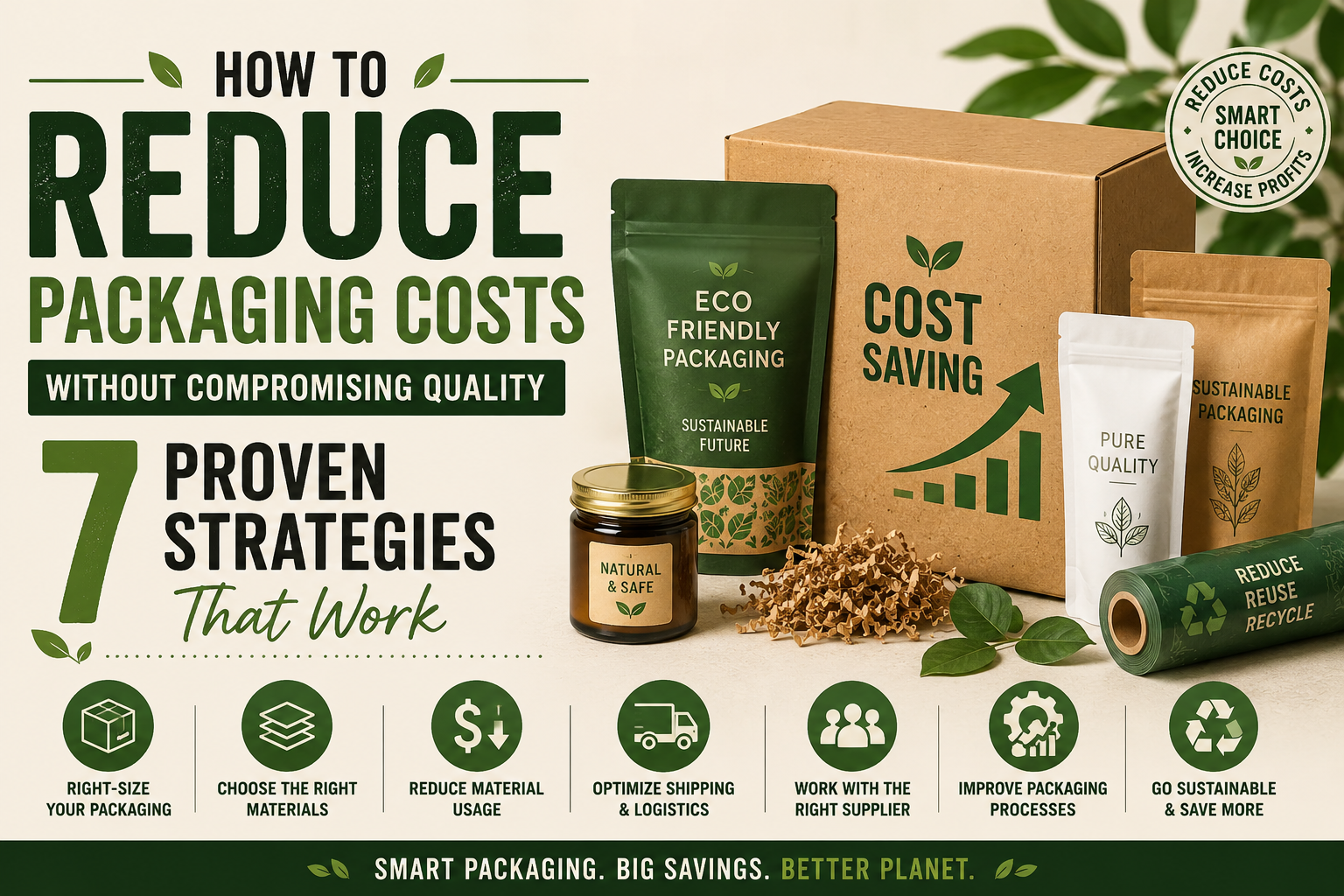
Reduce Packaging Costs Without Sacrificing Quality. If you run a product-based business, packaging is one of those expenses that quietly drains your margins. You start with a reasonable material choice, and before long you’re paying more per unit than you planned, freight bills are climbing, and your packaging budget keeps growing without a clear reason why. Knowing how to reduce packaging costs is not just a purchasing exercise. It’s a supply chain discipline, and the businesses that get it right build a structural cost advantage their competitors can’t easily close.
The pressure to cut packaging spend is real across every industry. Raw material prices shift. Carrier rates adjust. Dimensional weight rules get tighter. And when you’re shipping at volume, even small inefficiencies compound into significant annual losses. But packaging cost reduction does not require sacrificing product protection or customer experience. It requires a smarter approach to materials, design, suppliers, and processes. This guide covers seven strategies that businesses across manufacturing, e-commerce, and distribution have used to achieve real packaging cost savings without cutting corners.
Why Packaging Costs Matter for Business Profitability
Most businesses treat packaging as a fixed overhead, a cost you accept and move on from. That mindset is expensive. Packaging typically accounts for 10% to 40% of a product’s total production cost, depending on the category. Even at the low end, that’s a significant spend line, and it’s one that responds well to focused attention.
What makes packaging cost management complicated is that the real number is rarely just the material. It includes the labor hours spent packing each unit, the freight charges applied to oversized or overweight shipments, the warehouse space used to store excess packaging inventory, and the cost of damaged goods that weren’t protected adequately. When you add those together, packaging cost optimization becomes one of the highest-leverage activities a business can pursue.
The supply chain dimension matters too. Businesses that rely on imported packaging materials are exposed to currency fluctuations and logistics delays that can affect pricing unpredictably. That reality makes it even more important to have a proactive packaging cost management strategy, rather than simply reacting when margins shrink.
Start with an honest audit. Map out what you’re spending on materials, on labor per package, on freight, and on damage-related returns. Once you have a clear picture of where the money is actually going, you can prioritize which of the strategies below will deliver the fastest and largest returns for your specific operation.
Right-Size Your Packaging to Reduce Costs
Oversized packaging is one of the most common and most costly packaging inefficiencies. When your box or container is larger than it needs to be, you’re paying for extra material on every unit, extra void fill to fill the space, and, critically, extra freight through dimensional weight charges.
Dimensional weight pricing works like this: carriers measure the volume of your package, divide by a set divisor, and charge you based on whichever is greater, the actual weight or the calculated dimensional weight. If your package has significant space, you’re almost always being billed for that air. That’s a cost that adds up fast across thousands of shipments.
Right-sizing means engineering your packaging dimensions to match the product as closely as possible. This requires an SKU-level review of your product catalog. For businesses with a wide range of products, that can feel like a major project. But even addressing your top 10 or 20 highest-volume SKUs can produce meaningful packaging cost savings in the first few months. You don’t need to fix everything at once.
Some high-volume operations invest in on-demand box-making systems that cut cartons to the exact dimensions needed for each order. This is a capital investment, but for the right operation, the return through freight savings and material reduction comes quickly. For businesses not ready for that level of automation, simply working with your packaging supplier to develop a tighter, more rational range of standard box sizes can close most of the gap.
Think of dead space inside a package as a cost you’re paying twice: once for the material that fills it, and once in the freight rate applied to the extra volume. Reducing packaging expenses through right-sizing addresses both at the same time, which is why it consistently ranks as one of the highest-impact changes a business can make.
Choose Cost-Effective Packaging Materials
Material selection shapes your packaging cost per unit more than almost any other single decision. The default choice for many businesses is standard corrugated cardboard, and it works well for many products. But it’s not always the most cost-effective packaging solution for every application, and defaulting to it without comparing alternatives leaves savings unrealized.
Flexible packaging uses significantly less raw material per unit and weighs far less than rigid containers. For non-fragile goods, poly mailers, padded envelopes, and flexible pouches can reduce both material costs and shipping costs in a single move. Businesses that have shifted applicable products from corrugated boxes to flexible formats report per-unit packaging cost reductions of 20% to 50%, depending on the product and the previous packaging spec.
For industrial and bulk applications, the calculus is different but equally important. If you’re utilizing pallets for domestic or international freight, using the right gauge of stretch film is a form of material optimization that often gets overlooked. Too heavy a gauge and you’re paying for more material than you need. Too light and you risk load failures, damaged goods, and claims that eliminate any material savings and then some.
Businesses that are increasingly focused on their environmental footprint will find that Sustainable Packaging materials have become much more competitively priced in recent years. Recycled-content corrugated, paper-based void fill, and compostable mailers are now available at price points that make them viable cost choices, not just ethical ones. In some markets, they also command a premium from environmentally conscious buyers that more than covers any incremental cost difference.
The practical approach is to run a structured material comparison across your highest-volume packaging SKUs. Get quotes on two or three alternatives for each one. Factor in damage rates alongside material cost, because a cheaper material that results in a 5% increase in transit damage claims will typically cost you more than the original material did. Let the full-cost comparison drive the decision.
Reduce Shipping Costs Through Lightweight Packaging
Weight and volume are the two variables that drive freight costs, and you have more control over both than most businesses realize. Lightweight packaging is one of the most direct ways to reduce shipping costs, and because the savings apply to every single shipment, the impact compounds significantly over time.
Switching from double-wall corrugated to single-wall, where the product’s fragility and shipping environment allow, is one of the most common moves. Another is replacing heavy cardboard inserts or foam blocks with molded pulp alternatives that deliver comparable cushioning at a fraction of the weight. Even something as straightforward as switching to a lighter, high-performance tape specification can produce measurable savings across tens of thousands of packages per year.
For products sold in single-serve or portion-controlled formats, Stick Pack Packaging is worth evaluating seriously. It’s one of the most material-efficient formats in the industry, using minimal film to deliver precise dosing in a package that adds virtually no weight to a shipment. For supplement brands, beverage powders, condiment manufacturers, and similar categories, the combination of material efficiency and freight savings makes it one of the more affordable packaging solutions available.
International shippers and air freight users feel the weight impact most sharply. Carriers applying dimensional weight multipliers on international express shipments can effectively double the freight cost on a poorly designed package. Lightweight, right-sized packaging addresses both variables simultaneously, which is why it’s particularly impactful for businesses with international distribution.
The right approach is to test before committing to a change at scale. Run a batch of orders using a lighter or alternative packaging specification. Track three things: the freight cost per shipment, the damage rate, and any customer feedback. If all three hold up, roll the change out across your full operation with confidence.
Standardize Packaging Sizes for Packaging Efficiency
A wide range of bespoke packaging sizes is one of the most overlooked drivers of inflated packaging costs. When every product line has its own unique box dimension, you end up managing dozens of packaging SKUs, each with its own reorder cycle, minimum order quantity, storage footprint, and procurement complexity. The result is fragmented purchasing volume, higher per-unit costs, and a warehouse floor that’s harder to operate efficiently.
Packaging standardization means rationalizing that range down to a manageable set of sizes, typically four to six, that can accommodate the widest practical range of products. The financial benefit is straightforward: buying 15,000 units of four box sizes is far more economical than buying 3,000 units of 20 different sizes. Consolidating volume into fewer SKUs unlocks better pricing tiers, reduces the risk of obsolete stock, and simplifies the entire procurement process.
The operational benefits are just as real. When packing staff work with the same few box sizes every shift, they build speed and consistency. Packing errors decrease. Labor time per unit drops. Both of those contribute directly to lower packaging cost per unit shipped, which adds up meaningfully at scale.
Businesses that handle products requiring specific compliance packaging should factor that into their standardization plan. Companies working with regulated consumer goods, for instance, need to ensure that their chosen formats accommodate Child-Resistant Packaging requirements without creating a separate, non-standard SKU that sits outside the rationalized range. Building compliance-compatible formats into your standard offering from the start avoids cost and complexity later.
To get started, map your full product catalog against your current packaging range. Identify which non-standard sizes are used infrequently or could be replaced by the next size up with minimal impact on material cost. Phase those out as existing stock depletes, and renegotiate supplier pricing around your simplified, higher-volume range.
Automate Packaging Processes to Lower Packaging Costs
Labor is the cost in packaging operations that doesn’t show up on a materials invoice. Because it’s embedded in headcount and hourly wages, it’s easy to underestimate. But for businesses packing hundreds or thousands of units per day, labor can represent 20% to 35% of the total cost per package. That makes it a significant target for cost reduction.
Packaging automation doesn’t require a fully robotic line to deliver returns. Semi-automated additions often produce the fastest payback. An automated void fill dispenser that dispenses the right amount of fill material every time eliminates the overtaping and over-filling that’s common in manual operations. An automatic case erector that folds and opens boxes consistently reduces labor on the packing line and removes a common source of inconsistency that leads to damaged shipments.
For businesses using horizontal form-fill-seal or wrapping equipment, there is often room to optimize without replacing machinery. Older equipment running Flow Wrap Packaging lines, for example, may be cutting more film per cycle than the product requires, or running at speeds that generate excess trim waste. Recalibrating film tension, cut length, and seal temperature can reduce material consumption without any change to the product or the packaging format.
At the pallet level, automated stretch wrapping is one of the easiest automation investments to justify. Manual wrapping is inconsistent by nature. Workers apply different amounts of film on different days depending on speed, fatigue, and habit. An automated stretch wrapper applies an optimized, precise wrap pattern on every pallet, reducing film usage while improving load security and reducing damage claims in transit.
The ROI framework is simple. Take your current fully-loaded labor cost per package, multiply by daily volume, and compare that number against the capital cost of equipment and the projected material savings from consistent application. For most medium-to-high-volume operations, payback falls between 12 and 24 months, often faster when material savings are included in the calculation.
Review Supplier Agreements Regularly
Supplier agreements negotiated two or three years ago may not reflect your current purchase volumes, the current raw material market, or the competitive options now available to you. If you’re not reviewing packaging supplier agreements at least once a year, you are almost certainly paying more than you need to.
The packaging materials market moves continuously. Corrugated board prices follow recovered fiber and linerboard indices. Plastic film prices track petrochemical feedstocks. These inputs fluctuate, and suppliers adjust their margins in response to market conditions, typically in their favor unless buyers actively push back. Regular benchmarking gives you the data you need to negotiate from informed positions rather than assumptions.
The most effective negotiating tool is a credible competing quote. You don’t necessarily need to switch suppliers; most businesses have good reasons to maintain established relationships. But presenting your current supplier with a specific competing quote on a high-volume SKU almost always opens up a pricing conversation. Suppliers typically prefer to adjust their margin slightly rather than lose an established account entirely.
Look beyond unit price when reviewing agreements. Payment terms, minimum order quantities, lead times, and value-added services all have cost implications. A supplier that offers vendor-managed inventory or just-in-time delivery can meaningfully reduce your warehousing and working capital costs, making the total cost of the relationship more favorable even if the per-unit price isn’t the lowest available option.
Also consider whether your current supplier range covers all the formats your products need. Businesses that have added product lines over time sometimes end up sourcing specialty formats like Flat Bottom Pouches from separate vendors at non-preferred pricing, simply because their primary supplier doesn’t carry them. Consolidating as many format needs as possible with a single, capable supplier improves your overall purchasing leverage and simplifies supply chain management.
Final Thoughts on Packaging Cost Optimization
Reducing packaging costs without cutting quality is not a one-time project. It’s an ongoing discipline. The businesses that build lasting cost advantages in packaging are the ones that audit regularly, test alternatives systematically, and treat supplier relationships as something to manage actively rather than renew passively.
The seven strategies in this guide work across industries and business sizes. Right-sizing eliminates waste you’re already paying for. Material substitution reduces base cost per unit. Lightweight packaging cuts freight expenses. Standardization improves both efficiency and buying power. Automation reduces labor cost and material waste. Supplier reviews keep pricing competitive. And a commitment to packaging cost management as a discipline ties it all together.
Businesses exploring format-specific opportunities will find additional savings in choosing the right packaging structure from the start. For products requiring high barrier properties and long shelf life, Custom Mylar Bags offer an excellent protection-to-weight ratio that reduces both material cost and product loss from inadequate barrier performance. For multi-product operations selling through retail channels, Custom Sachet Packaging offers per-unit cost efficiency that few larger formats can match at comparable volume.
Start with one strategy. Measure the results. Then build from there. That’s how real, sustainable packaging cost savings get built, not through a single dramatic change, but through consistent, data-driven decisions made over time. Businesses that approach packaging that way don’t just cut costs. They build a more resilient, efficient operation that is harder for competitors to match.
If you’re looking for a packaging partner that can support this kind of structured approach across flexible packaging, industrial formats, and custom solutions, Contipack Inc offers the product range and supply reliability to support businesses at every stage of their packaging optimization journey.
FAQs
What is the fastest way to reduce packaging costs?
Right-sizing your packaging and switching to lighter materials are typically the quickest wins. Both reduce material spend and freight costs immediately, and neither requires significant capital investment. Start by auditing your highest-volume SKUs and running a dimensional weight analysis on your current shipping data.
Can I reduce packaging costs without affecting product protection?
Yes. In most cases, overpacked products carry more material than they need. Work with your packaging supplier to test alternative specs using drop, compression, and vibration testing before rolling out changes at scale. The test results should drive the decision, not assumptions about what’s “safe enough.”
How does lightweight packaging reduce shipping costs?
Most major carriers charge based on dimensional weight, which accounts for the volume of a package rather than just its physical weight. Lighter, right-sized packaging reduces both actual weight and dimensional volume, which directly lowers the freight rate per shipment. The savings are most significant for businesses using air freight or international express services where dimensional weight multipliers are highest.
What are the best cost-effective packaging strategies for small businesses?
Small businesses benefit most from standardizing their packaging range to increase volume per SKU, switching to flexible formats like poly mailers where applicable, and sourcing from distributors who can offer competitive pricing without requiring the high minimum order quantities typical of direct manufacturers. Reviewing supplier agreements annually and getting competing quotes regularly also delivers consistent savings even at lower volumes.
How often should I review my packaging supplier agreements?
At minimum, once a year. For high-volume commodity materials like corrugated board, stretch film, and poly-based packaging, semi-annual benchmarking is worth the time given how significantly raw material prices can shift within a six-month window.
Is packaging automation a good investment for mid-sized operations?
For operations shipping more than 300 to 500 packages per day with consistent product types, semi-automated additions like void fill machines, case erectors, and stretch wrappers typically pay back within 12 to 24 months. Full automation makes more sense at higher volumes, or when labor represents a particularly large share of total packaging cost per unit.