
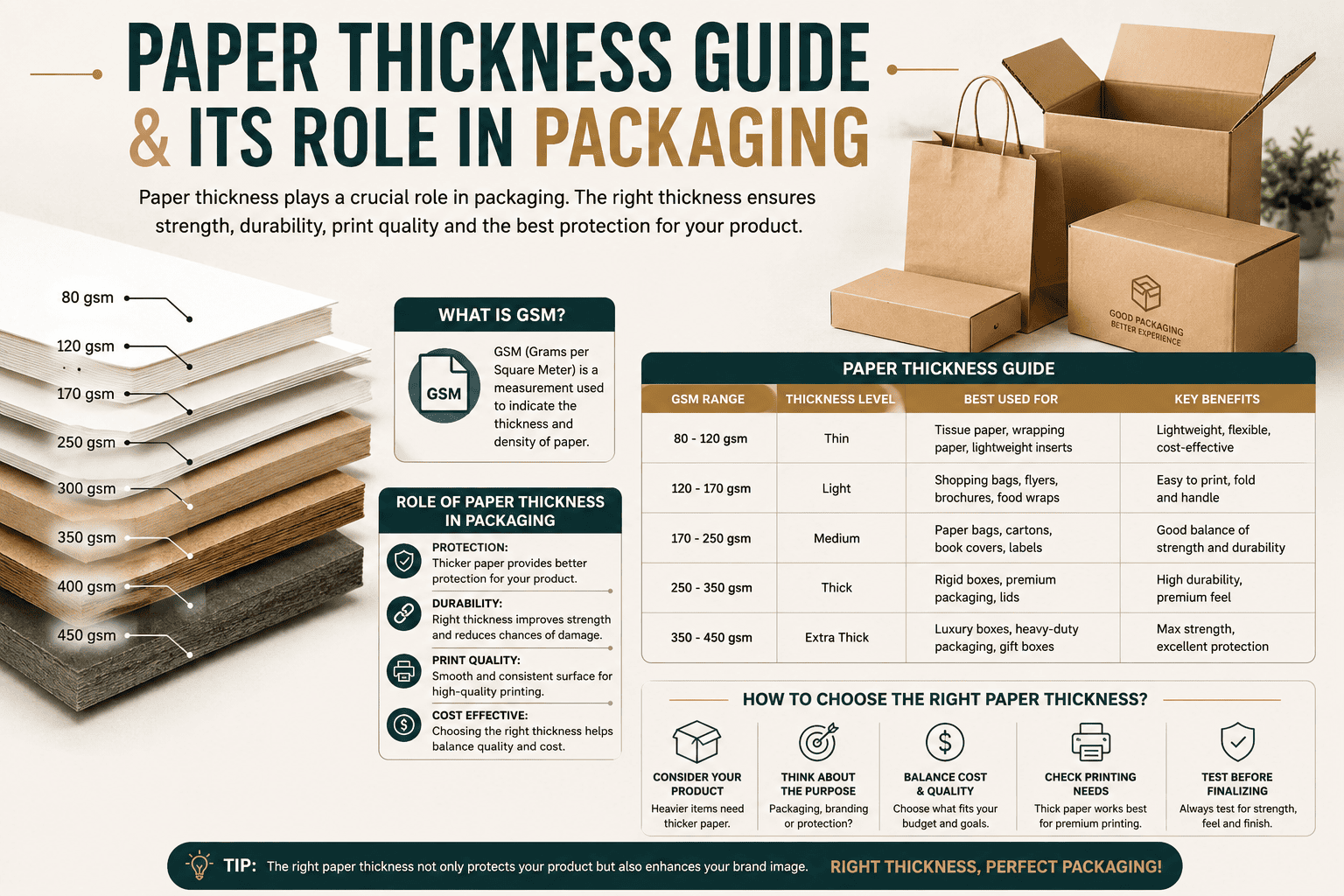
Paper thickness is one of the most important factors to consider when selecting materials for packaging, printing, and product presentation. Whether you’re comparing kraft paper for retail bags, evaluating laminated paper for coffee packaging, or trying to understand the difference between GSM and microns, choosing the right paper thickness directly influences durability, print quality, product protection, and overall packaging performance.
Many buyers assume that a higher GSM automatically means thicker paper, while others search for quick conversions between GSM, microns, millimeters, and mils. In reality, these measurements describe different material characteristics, and understanding how they relate to one another is essential when specifying packaging materials. Two papers with the same GSM can have noticeably different thicknesses because fiber composition, density, coatings, and manufacturing methods all influence the final material.
For businesses that rely on flexible packaging, paper thickness is only one part of the material selection process. Paper is often combined with high-barrier films to create packaging that protects products from oxygen, moisture, light, and handling damage while maintaining a premium natural appearance. Understanding how paper thickness works allows procurement managers, product developers, and brand owners to make better decisions based on performance rather than assumptions.
This guide explains what paper thickness means, how GSM differs from microns and millimeters, why direct conversions are not always possible, and how to choose the right paper thickness for different packaging applications. By the end, you’ll have a practical understanding of paper measurements and how they influence the performance of modern flexible packaging.
What Is Paper Thickness?
Paper thickness refers to the physical distance between the two surfaces of a sheet of paper. It indicates how thick the material feels and performs rather than how much it weighs. While thickness may seem like a simple measurement, it plays an important role in determining a package’s strength, stiffness, printability, and overall durability.
In packaging, selecting the correct paper thickness helps balance appearance with functionality. Thin papers may be suitable for lightweight wraps or labels, while thicker materials are better suited for premium retail packaging or products that require additional structural support. However, thickness alone does not determine whether a material is suitable for packaging. It must also be evaluated alongside barrier performance, flexibility, sealing compatibility, and the complete packaging structure.
Paper thickness is commonly expressed in millimeters, microns, or mils, while paper weight is usually measured in GSM. Although these measurements are related, they are not interchangeable. Understanding the distinction is essential when comparing materials for packaging applications.
Understanding GSM In Paper Thickness
One of the most common measurements associated with paper thickness is GSM, which stands for grams per square meter. GSM measures the weight of one square meter of paper rather than its physical thickness. A higher GSM generally indicates a heavier sheet, but it does not always mean the paper is thicker.
This distinction often creates confusion. Two papers can both weigh 200 GSM yet have different thicknesses because they are manufactured using different fiber densities or surface treatments. A coated paper, for example, may be denser and thinner than an uncoated paper with the same GSM. Similarly, kraft paper often appears thicker than coated paper of equal weight because of its lower density and natural fiber structure.
When selecting packaging materials, GSM provides useful information about material weight and stiffness, but it should never be the only factor considered. Packaging performance depends on how the material behaves throughout manufacturing, transportation, storage, and consumer use.
Paper Thickness vs. Paper Weight
Although people often use the terms interchangeably, paper thickness and paper weight describe two different properties.
Paper weight refers to the mass of the material, which is measured using GSM. Thickness, on the other hand, refers to the physical dimension of the paper and is typically measured in microns or millimeters. While heavier papers are often thicker, manufacturing variables prevent a universal relationship between these measurements.
For example, a 300 GSM coated art paper may feel thinner than a 300 GSM kraft paper because coated papers are compressed during manufacturing and have a higher density. Likewise, recycled papers may vary in thickness compared to virgin fiber papers even when their GSM values are identical.
For packaging manufacturers, understanding both measurements is essential. Material weight affects transportation costs and structural performance, while thickness influences rigidity, folding characteristics, print quality, and how the material performs during converting and filling processes.
GSM, Microns, MM, & Mils Explained
Several measurement systems are used throughout the paper and packaging industries, each serving a different purpose. Understanding these units makes it easier to compare specifications and communicate with suppliers.
GSM measures the weight of paper over one square meter and is widely used to classify paper grades. It provides insight into the density and strength of a material but does not indicate its exact thickness.
Microns, also called micrometers, measure the physical thickness of a material. One micron represents one-thousandth of a millimeter. Flexible packaging manufacturers frequently use microns because they provide precise measurements for films, laminates, and paper structures.
Millimeters are another way to express material thickness and are commonly used when discussing heavier papers, paperboard, and rigid packaging materials. Since one millimeter equals one thousand microns, converting between these units is straightforward.
Mils are primarily used in North America and represent one-thousandth of an inch. Packaging suppliers often specify film thickness in mils, particularly for industrial and protective packaging applications. Although mils and microns both describe thickness, they use different measurement systems.
Understanding these measurements helps buyers compare materials more accurately and avoid confusion when reviewing packaging specifications. Rather than relying on a single measurement, experienced packaging professionals evaluate GSM, thickness, density, and material construction together to determine whether a paper is suitable for its intended application.
Why Paper Thickness Matters in Flexible Packaging?
For flexible packaging manufacturers, paper thickness is more than a specification on a datasheet. It directly affects how a package performs throughout its lifecycle, from production to the moment a customer opens it.
A paper layer contributes to the package’s tactile feel, print appearance, and perceived quality. Premium brands often choose thicker kraft paper laminates because they create a more substantial look while reinforcing brand positioning. However, increasing thickness without considering the overall structure can reduce flexibility or increase material costs unnecessarily.
Most flexible packaging solutions rely on laminated constructions where paper is combined with materials such as PET, PE, metalized films, or aluminum foil. In these applications, paper provides visual appeal and stiffness, while the barrier layers protect products against moisture, oxygen, aroma loss, and light exposure. The result is a package that delivers both shelf impact and product protection.
This relationship is especially important for products such as coffee, where maintaining freshness is critical. Packages designed for roasted coffee often combine kraft paper with high-barrier films to achieve the desired appearance without sacrificing performance. Many of these products are available in stand-up pouch formats because they provide an excellent balance of shelf visibility, resealability, and structural stability while accommodating laminated paper constructions.
Can GSM Be Converted To Microns or Millimeters?
One of the most common questions buyers ask is whether GSM can be converted directly into microns or millimeters. While online searches often look for a GSM to micron converter or GSM to mm calculator, the answer is more nuanced than a simple formula.
GSM measures the weight of a sheet of paper over one square meter, whereas microns and millimeters measure its physical thickness. Since these measurements describe different properties, there is no universal conversion that applies to every type of paper. The thickness of a sheet depends on factors such as fiber density, manufacturing process, coatings, and material composition.
For example, two sheets of paper may both weigh 300 GSM, yet one could be noticeably thicker if it is made from uncoated kraft fibers, while the other may be thinner because it is coated and compressed during production. This is why packaging manufacturers evaluate both weight and thickness when specifying materials for a packaging project.
Although exact conversions are impossible without knowing the paper grade, estimated values can still serve as a useful reference during material selection.
Paper Thickness Chart
The table below provides approximate thickness values for common paper weights. Actual measurements may vary depending on the paper type and manufacturing process.
| Paper Weight (GSM) | Approx. Thickness (Microns) | Approx. Thickness (MM) | Typical Packaging Application |
| 70 GSM | 90–100 | 0.09–0.10 | Lightweight wraps and inserts |
| 80 GSM | 100–110 | 0.10–0.11 | Standard printing and labels |
| 100 GSM | 120–135 | 0.12–0.14 | Product sleeves and brochures |
| 120 GSM | 145–160 | 0.15–0.16 | Retail packaging inserts |
| 150 GSM | 180–200 | 0.18–0.20 | Premium paper packaging |
| 180 GSM | 210–230 | 0.21–0.23 | Folding cartons and sleeves |
| 200 GSM | 240–260 | 0.24–0.26 | Heavy-duty retail packaging |
| 250 GSM | 290–320 | 0.29–0.32 | Shopping bags and premium packaging |
| 300 GSM | 340–380 | 0.34–0.38 | Luxury packaging and paperboard |
| 350 GSM | 390–430 | 0.39–0.43 | Rigid promotional packaging |
| 400 GSM | 440–480 | 0.44–0.48 | Heavy paperboard applications |
These values should be treated as guidelines rather than exact specifications. When developing custom packaging, manufacturers typically verify thickness using the actual material sample before production begins.
How Paper Thickness Influences Packaging Performance
Paper thickness affects much more than the appearance of a package. It influences how the material behaves throughout production, transportation, retail display, and consumer use.
A thicker paper generally provides greater stiffness, which helps packaging maintain its shape on retail shelves. This is particularly important for premium products where visual presentation contributes to perceived quality. At the same time, increasing thickness may add material weight and cost, making it important to select only the thickness needed for the intended application.
Printing quality is another consideration. Papers with suitable thickness and surface characteristics provide better print consistency, allowing graphics and branding elements to appear sharper and more vibrant. During converting, appropriate thickness also improves folding performance and reduces the risk of cracking or tearing.
For flexible packaging, thickness must always be evaluated as part of the complete material structure rather than in isolation. A paper layer contributes to the package’s appearance and feel, while laminated barrier films provide the protection required to preserve freshness and extend shelf life.
Choosing the Right Paper Thickness For Flexible Packaging
Selecting the right paper thickness begins with understanding the product being packaged. Lightweight products often require less structural support than heavier products, but factors such as moisture exposure, shipping conditions, and retail presentation also influence material selection.
Coffee packaging is a good example. Many brands prefer kraft paper because it communicates a natural and premium image, but paper alone cannot provide the oxygen and moisture barriers needed to preserve coffee freshness. Instead, manufacturers laminate kraft paper with high-performance barrier materials that combine visual appeal with product protection.
This approach is commonly used in flat bottom pouches, which are popular for premium coffee packaging because their stable base, large printable surface, and high filling capacity create an attractive retail presentation while supporting multilayer packaging structures.
Snack foods, pet food, and powdered products present similar challenges. Their packaging must withstand transportation while maintaining freshness and protecting the contents from environmental factors. Choosing the correct paper thickness within a laminated structure helps balance durability, branding, and cost without compromising package performance.
Kraft Paper Thickness & Packaging Applications
Kraft paper remains one of the most widely used materials in flexible packaging because of its natural appearance and versatility. Available in a variety of GSM ranges, it can be incorporated into laminated packaging structures that combine aesthetics with functional barrier protection.
Lighter kraft papers are commonly used where flexibility and cost efficiency are priorities, while heavier grades create a more substantial appearance for premium retail products. The appropriate thickness depends on the product weight, desired shelf presentation, and the performance required throughout the supply chain.
High-capacity products such as pet food, grains, coffee, or bulk snacks often benefit from stronger package constructions. In these applications, quad seal pouches provide additional structural integrity by distributing weight across four sealed corners, making them well suited for heavier products packaged with multilayer paper laminates.
Paper Thickness vs. Packaging Performance
Selecting the thickest available paper is rarely the best solution. Effective packaging balances material performance with efficiency. An overly thick paper may increase shipping costs, reduce flexibility during production, or introduce unnecessary material expense. Conversely, a paper that is too thin may not provide the appearance or durability expected by consumers.
Packaging engineers evaluate thickness alongside barrier properties, sealing performance, printability, and product requirements to create a structure that delivers the desired results. This holistic approach ensures the package protects the product while remaining efficient to manufacture and transport.
For flexible packaging manufacturers, paper thickness is therefore one specification among many that contribute to overall package performance. Understanding how it interacts with other materials leads to better packaging decisions and more reliable product protection.
Paper Thickness vs. Paper Weight
Although the terms are often used interchangeably, paper thickness and paper weight describe different characteristics of a material. Paper weight is measured in grams per square meter (GSM) and indicates how much a sheet weighs, while paper thickness refers to the physical distance between its two surfaces and is typically measured in microns or millimeters.
This distinction is important because papers with the same GSM do not always have the same thickness. Manufacturing methods, fiber composition, coatings, and paper density all influence the final caliper of the material. For example, a coated paper may feel thinner than an uncoated kraft paper even when both have an identical GSM. As a result, converting GSM directly into microns or millimeters without considering the paper grade often leads to inaccurate expectations.
For packaging manufacturers, evaluating both weight and thickness provides a more complete understanding of how a material will perform during printing, converting, filling, transportation, and retail display.
Frequently Asked Questions
1. What is paper thickness?
Paper thickness is the physical measurement of a sheet of paper from one surface to the other. It is commonly expressed in microns, millimeters, or mils and influences the material’s rigidity, feel, and performance in packaging and printing applications.
2. What does GSM mean in paper thickness?
GSM stands for grams per square meter and measures the weight of paper rather than its physical thickness. While heavier papers often appear thicker, GSM alone cannot determine the exact thickness because different paper types have different densities.
3. Can GSM be converted to microns?
There is no universal GSM-to-micron conversion because the relationship depends on paper density, coatings, and manufacturing methods. Estimated conversion charts can provide guidance, but material specifications should always be verified with the supplier when accuracy is required.
4. GSM be converted to millimeters?
Like micron conversions, GSM cannot be converted directly into millimeters using a single formula. The same GSM can produce different thicknesses depending on the type of paper. Approximate thickness charts are useful for comparison, but actual measurements vary by material.
5. How thick is 80 GSM paper?
Standard 80 GSM paper is generally around 100 to 110 microns, or approximately 0.10 to 0.11 millimeters, although the exact thickness depends on the paper grade and manufacturing process.
6. How thick is 200 GSM paper?
A typical 200 GSM paper measures approximately 240 to 260 microns, or 0.24 to 0.26 millimeters. Premium coated papers and kraft papers may vary slightly from these values.
7. How thick is 300 GSM paper?
Most 300 GSM papers fall within the range of 340 to 380 microns, or approximately 0.34 to 0.38 millimeters. These heavier papers are commonly used for premium packaging, luxury printed materials, and paperboard applications.
8. Why is paper thickness important in packaging?
Paper thickness influences package durability, print quality, structural stability, and the overall customer experience. However, thickness alone does not determine packaging performance. In flexible packaging, it must work together with barrier materials, sealing layers, and laminate structures to provide the protection required for the packaged product.
Conclusion
Understanding paper thickness is about more than comparing GSM values or finding quick conversions between microns and millimeters. It involves recognizing how material weight, density, and construction work together to influence packaging performance. While reference charts and estimated conversions provide a useful starting point, selecting the right paper ultimately depends on the specific application and the performance requirements of the finished package.
For flexible packaging, paper is rarely used on its own. It is typically laminated with high-performance barrier films that protect products from moisture, oxygen, light, and other environmental factors while preserving the natural appearance that many brands value. This combination allows businesses to achieve both visual appeal and functional performance without compromising product quality.
Whether you’re developing packaging for coffee, snacks, pet food, or other consumer products, understanding paper thickness helps you make more informed material decisions. By considering GSM, thickness, barrier requirements, and package design together, brands can create packaging that not only looks premium on the shelf but also performs reliably throughout the supply chain.