
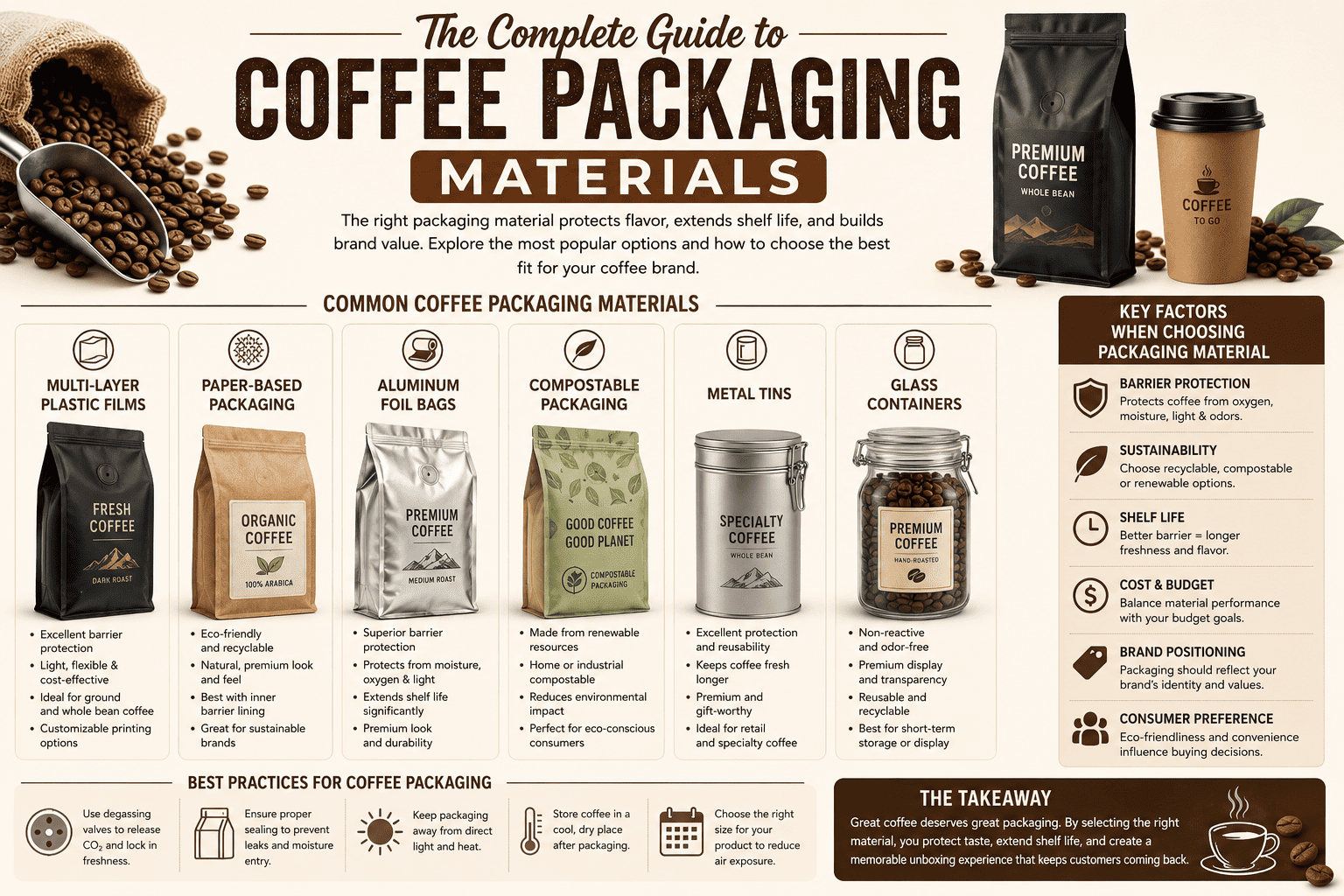
Coffee quality is shaped long before the consumer opens the package. From the moment beans leave the roaster, they begin reacting to oxygen, moisture, light, and temperature changes. Without the right packaging, these environmental factors gradually reduce aroma, alter flavor, and shorten shelf life. For coffee brands competing in today’s market, selecting the right coffee packaging material is just as important as sourcing premium beans or perfecting the roasting process.
Modern coffee packaging has evolved far beyond a simple protective bag. It has become a combination of material science, product preservation, brand communication, and consumer convenience. The materials used in a coffee package determine how effectively it protects freshness, supports printing quality, withstands transportation, and meets growing sustainability expectations.
Whether you are launching a new coffee brand or reviewing an existing coffee packaging solution, understanding the strengths of different coffee bags material options helps you make informed decisions that balance product performance with commercial goals.
This guide explores the most commonly used coffee bean packaging material, explains how flexible pouch structures improve product protection, and discusses the key considerations for selecting the most suitable material for coffee packaging applications.
Why Coffee Packaging Material Matters?
Coffee is a naturally delicate product. During roasting, beans develop complex aromatic compounds and release carbon dioxide. While these characteristics contribute to flavor and freshness, they also make coffee highly vulnerable to environmental exposure. Oxygen causes oxidation that gradually reduces flavor intensity, moisture alters taste and texture, and exposure to light accelerates quality degradation. Even minor packaging failures can significantly affect the customer’s experience.
The role of coffee packaging material is to create a protective barrier between the product and its surroundings. High-performance materials reduce oxygen transmission, limit moisture absorption, and preserve volatile aromas that define the character of freshly roasted coffee. This protection becomes increasingly important as products move through distribution channels, remain on retail shelves, or are stored by consumers over extended periods.
Beyond product preservation, packaging materials influence operational efficiency throughout the supply chain. Strong laminate structures resist punctures during filling and transportation, maintain seal integrity, and help prevent product loss. At the same time, they provide an excellent surface for high-quality printing, allowing coffee brands to showcase their identity through vibrant graphics, premium finishes, and clear product information.
Today’s packaging must also satisfy changing consumer expectations. Buyers increasingly look for resealable packaging, easy-opening features, and environmentally conscious material choices without compromising freshness. As a result, selecting the right material for coffee packaging is no longer based solely on barrier performance. It requires balancing protection, functionality, appearance, cost, and sustainability in a single packaging solution.
Factors To Consider When Choosing Coffee Packaging Materials
Choosing the right packaging begins with understanding the specific requirements of the product rather than selecting a material based only on cost or appearance. Every coffee product has unique preservation needs, and those requirements influence the structure and performance of the packaging.
One of the first considerations is the type of coffee being packaged. Whole bean coffee continues releasing carbon dioxide after roasting, making controlled gas release an important factor in maintaining freshness. Ground coffee, however, has a much larger surface area exposed to oxygen, which makes it more susceptible to oxidation and flavor loss. Because of these differences, both products often require different barrier structures despite belonging to the same category.
Shelf life expectations also influence material selection. Coffee intended for local distribution may require a different packaging structure than products shipped across regions or exported internationally. Longer storage periods generally demand higher barrier laminates capable of maintaining freshness throughout transportation, warehousing, and retail display.
Distribution conditions are equally important. Packaging experiences compression, vibration, humidity fluctuations, and temperature changes while moving through the supply chain. Selecting durable coffee bags material helps maintain package integrity and reduces the risk of punctures or seal failures that could compromise product quality.
Brand positioning should also be considered during material selection. Premium coffee products often rely on sophisticated packaging that communicates quality before the consumer even opens the bag. Materials compatible with matte finishes, metallic effects, tactile coatings, and high-definition printing help create stronger shelf presence while supporting a consistent brand identity.
Another increasingly important factor is sustainability. Many coffee brands are exploring packaging solutions that reduce material usage, improve recyclability, or incorporate mono-material structures where suitable. Although sustainable solutions continue to evolve, manufacturers must balance environmental goals with the barrier performance required to protect coffee effectively. Selecting the right coffee packaging material therefore involves evaluating both product protection and long-term sustainability objectives.
Common Coffee Packaging Materials
Flexible coffee packaging rarely relies on a single material. Instead, manufacturers combine multiple layers to create laminate structures that deliver the strength, barrier protection, sealing performance, and visual appeal required for coffee products. Each material contributes different functional properties, allowing packaging engineers to design solutions tailored to specific applications.
Understanding these individual materials provides valuable insight into why certain laminate combinations are widely used throughout the coffee industry.
1. PET (Polyethylene Terephthalate)
PET is one of the most widely used outer layers in flexible coffee packaging because it combines excellent mechanical strength with outstanding print quality. Its dimensional stability allows the package to maintain its appearance throughout manufacturing, transportation, and retail handling, making it an ideal choice for premium coffee brands seeking a polished presentation.
Although PET provides moderate barrier performance on its own, its primary function is to add structural integrity while acting as an excellent surface for high-resolution graphics and protective coatings. When laminated with high-barrier materials such as aluminum foil or metalized films, PET contributes to packaging structures capable of preserving coffee freshness over extended storage periods.
Its resistance to heat and abrasion also makes PET suitable for high-speed packaging operations, where consistent performance is essential for maintaining production efficiency.
2. BOPP (Biaxially Oriented Polypropylene)
BOPP is valued for its clarity, stiffness, and moisture resistance. It is frequently used in coffee packaging applications where attractive shelf presentation and cost efficiency are equally important. Its smooth surface supports vibrant printing while offering reliable protection against external moisture.
For products requiring enhanced barrier performance, manufacturers often choose metalized BOPP. The addition of a thin metal layer significantly improves resistance to oxygen and light while maintaining the lightweight characteristics that make BOPP popular in flexible packaging.
Because of its versatility, BOPP is commonly incorporated into laminate structures designed for retail coffee packaging, promotional packs, and products where visual appeal plays an important role in consumer purchasing decisions.
3. PE (Polyethylene)
Polyethylene serves as the inner sealing layer in many coffee packaging structures and plays a critical role in maintaining package integrity. While it is not typically used as the primary barrier material, its flexibility and excellent heat-sealing properties create strong, reliable seals that protect the coffee throughout storage and distribution.
PE also provides moisture resistance and complies with food-contact requirements, making it suitable for direct product contact. In multilayer laminates, it works alongside materials such as PET, aluminum foil, or metalized films to create durable packaging capable of preserving freshness while supporting efficient filling operations.
Its versatility allows manufacturers to produce flexible packaging solutions across a wide range of pouch formats, from stand-up pouches to side gusset bags, ensuring consistent sealing performance regardless of package design.
4. Aluminum Foil
Among all flexible packaging materials, aluminum foil offers one of the highest levels of barrier protection available. It is widely used in premium coffee packaging because it creates an almost complete barrier against oxygen, moisture, light, and external odors. These characteristics make it particularly valuable for roasted coffee products, where preserving aroma and flavor is essential throughout storage and distribution.
Coffee begins to lose its freshness when exposed to oxygen, while ultraviolet light can gradually degrade the volatile compounds responsible for its distinctive aroma. Aluminum foil minimizes these risks by creating a highly protective environment inside the package. For this reason, many specialty coffee brands choose foil-based laminate structures when targeting extended shelf life or international distribution.
Despite its exceptional barrier performance, aluminum foil is rarely used alone. It is commonly laminated with PET to provide structural strength and printing quality, while an inner PE layer creates a reliable heat seal. This multilayer construction combines product protection with durability, allowing manufacturers to produce high-performance coffee bags suitable for demanding applications.
Although foil laminates provide excellent preservation, they are generally more expensive than some alternative structures and may not always align with brands pursuing recyclable packaging solutions. The selection ultimately depends on product requirements, expected shelf life, and sustainability objectives.
5. Metalized Films
Metalized films provide many of the protective benefits associated with aluminum foil while offering a lighter and more economical alternative. These materials are created by depositing an extremely thin layer of metal onto the surface of films such as PET or BOPP, significantly improving their barrier performance without substantially increasing package weight.
For coffee packaging, metalized films offer an excellent balance between product protection, appearance, and cost. They reduce oxygen transmission, improve moisture resistance, and protect coffee from light exposure while maintaining the flexibility needed for modern pouch formats.
One of the advantages of metalized films is their attractive metallic appearance, which enhances premium branding without requiring additional decorative finishes. Coffee brands often use these structures for retail packaging because they deliver both functional performance and visual appeal.
While metalized laminates generally provide slightly lower barrier performance than full aluminum foil structures, they remain an excellent choice for many coffee products with moderate shelf-life requirements.
6. Kraft Paper
Kraft paper has become increasingly popular as coffee brands seek packaging that reflects a natural, handcrafted, or environmentally conscious image. Its textured appearance creates a distinctive visual identity that appeals to consumers looking for artisan and specialty coffee products.
However, kraft paper itself is not considered a high-barrier coffee packaging material. On its own, it provides limited protection against oxygen and moisture, making it unsuitable for preserving coffee over extended periods. To overcome this limitation, manufacturers typically laminate kraft paper with high-performance films such as PET, PE, or metalized materials.
This combination allows brands to achieve the desired natural aesthetic while maintaining the barrier properties necessary for preserving freshness. The result is packaging that combines visual authenticity with reliable product protection.
Kraft paper is therefore often selected for premium coffee packaging where branding plays a significant role in purchasing decisions.
Choosing The Right Material For Whole Bean Vs. Ground Coffee
Although whole bean and ground coffee originate from the same product, their packaging requirements differ significantly. The grinding process increases the surface area exposed to oxygen, accelerating oxidation and making ground coffee more susceptible to flavor degradation. As a result, selecting the appropriate coffee packaging material depends on how the coffee is processed and how long it is expected to remain fresh.
Whole bean coffee continues releasing carbon dioxide for several days after roasting. If this gas remains trapped inside the package, pressure can build and potentially compromise the seal. To address this challenge, manufacturers often combine high-barrier laminate structures with one-way degassing valves. These valves allow carbon dioxide to escape while preventing oxygen from entering the package, preserving freshness without affecting package integrity.
Ground coffee, by comparison, requires even greater protection against oxygen because its larger exposed surface accelerates flavor loss. High-barrier laminate structures using PET, aluminum foil, or metalized films help maintain aroma, reduce oxidation, and support longer shelf life. Many brands also choose resealable closures so consumers can continue protecting the product after opening.
Selecting the right coffee bean packaging material is therefore not simply about choosing the strongest barrier. It requires understanding how the coffee behaves after roasting, how it will be stored, and how consumers will use the product throughout its life cycle.
Barrier Properties Explained
When evaluating coffee packaging material, two technical characteristics play a major role in determining package performance: Oxygen Transmission Rate (OTR) and Moisture Vapor Transmission Rate (MVTR).
OTR measures how much oxygen passes through a packaging material over a specific period. Lower OTR values indicate stronger resistance to oxygen penetration, making the material more effective at preserving aroma and reducing oxidation. Since oxygen is one of the primary causes of coffee deterioration, selecting materials with excellent oxygen barriers is essential for maintaining product quality.
MVTR measures the amount of moisture that can penetrate a package. Excess moisture affects both flavor and texture, particularly in roasted coffee. Materials with low MVTR values help maintain product consistency by protecting coffee from humidity throughout storage and transportation.
While these measurements provide valuable insight into barrier performance, packaging engineers rarely rely on a single material to achieve the desired protection. Instead, they combine multiple layers that complement one another. PET contributes strength and printability, aluminum foil or metalized films provide high-barrier protection, and PE creates reliable heat seals. Together, these layers produce a packaging structure capable of maintaining freshness under demanding distribution conditions.
Another important component in premium coffee packaging is the one-way degassing valve. Freshly roasted coffee naturally releases carbon dioxide for several days after roasting. Without a valve, pressure can build inside the package and affect seal integrity. A degassing valve allows carbon dioxide to escape while preventing oxygen from entering, creating an ideal environment for preserving flavor and aroma.
Sustainable Coffee Packaging Materials
Sustainability has become an important consideration in packaging development, encouraging coffee brands to evaluate how materials influence both product protection and environmental impact. While preserving freshness remains the primary objective, many manufacturers are exploring packaging structures that reduce material consumption, improve recyclability, and support responsible resource use.
One approach involves designing lightweight flexible packaging that achieves the required barrier performance with less material. Compared with rigid containers, flexible pouches typically require fewer raw materials and occupy less transportation space, contributing to improved logistics efficiency.
Another area of innovation is mono-material packaging. Traditional coffee packaging often relies on multilayer laminates composed of different materials that can be difficult to recycle. Mono-material structures are being developed to simplify recycling while still providing the barrier properties necessary for coffee applications.
Some manufacturers are also incorporating post-consumer recycled (PCR) content into non-food-contact layers where regulations allow. Others continue investing in advanced barrier coatings that reduce dependence on aluminum foil while maintaining freshness.
Although sustainable packaging technologies continue to evolve, selecting environmentally responsible coffee bags material should never compromise product quality. Coffee that loses freshness prematurely creates unnecessary product waste, making effective barrier protection an important part of sustainable packaging design.
How To Select the Best Coffee Packaging Material For Your Brand?
Selecting the right material for coffee packaging begins with understanding the specific needs of the product rather than choosing a material based solely on appearance or cost.
Brands packaging specialty coffee with extended shelf-life requirements generally benefit from high-barrier laminate structures that incorporate aluminum foil or metalized films. These materials offer superior protection against oxygen and moisture while supporting premium finishes that reinforce product quality.
Coffee intended for shorter distribution cycles may achieve excellent performance using metalized laminate structures that balance protection, weight, and cost efficiency. Brands emphasizing natural aesthetics often choose kraft paper laminates, combining visual appeal with internal barrier layers that maintain freshness.
Packaging format should also influence material selection. Stand-up pouches provide outstanding retail visibility and consumer convenience, while flat bottom pouches offer premium presentation for specialty coffee. Side gusset bags continue to perform well for larger whole bean packages, and pillow pouches remain a practical solution for economical or single-serve applications.
Rather than viewing materials and pouch formats as separate decisions, successful coffee brands evaluate them as one integrated packaging system designed to protect the product while supporting marketing objectives, operational efficiency, and consumer expectations.
Coffee Packaging Material & Pouch Comparison
| Packaging Material | Barrier Performance | Common Pouch Types | Best Application |
| PET/PE | Moderate | Stand-Up Pouches, Pillow Pouches | Everyday retail coffee |
| PET/Metalized PET/PE | High | Stand-Up Pouches, Flat Bottom Pouches | Ground coffee and premium blends |
| PET/Aluminum Foil/PE | Excellent | Flat Bottom Pouches, Side Gusset Bags, Quad Seal Bags | Whole bean coffee and extended shelf life |
| Kraft Paper Laminate | Moderate to High | Stand-Up Pouches, Flat Bottom Pouches | Artisan and specialty coffee |
| EVOH Laminates | High Oxygen Barrier | Various flexible pouch formats | Premium coffee requiring advanced freshness protection |
Frequently Asked Questions
1. What is the best coffee packaging material?
There is no single material that suits every coffee product. High-barrier laminate structures combining PET, aluminum foil, or metalized films with PE are among the most widely used because they provide excellent protection against oxygen, moisture, and light while maintaining package durability.
2. What materials are commonly used for coffee bags?
Most flexible coffee bags use multilayer laminate structures consisting of PET, BOPP, PE, aluminum foil, metalized films, kraft paper laminates, or EVOH, depending on the required barrier performance and branding objectives.
3. Why do coffee bags include degassing valves?
Freshly roasted coffee releases carbon dioxide after packaging. A one-way degassing valve allows this gas to escape while preventing oxygen from entering, helping preserve freshness without damaging the package.
4. Which pouch type is best for coffee packaging?
The ideal pouch depends on the product and target market. Stand-up pouches are versatile and retail-friendly, flat bottom pouches offer premium shelf presentation, side gusset bags work well for larger coffee volumes, quad seal bags provide exceptional structural strength, and pillow pouches offer a cost-effective solution for smaller products.
5. Can sustainable coffee packaging still provide high barrier protection?
Yes. Advances in material technology have introduced recyclable and mono-material structures capable of delivering improved barrier performance. However, the appropriate solution depends on product requirements, desired shelf life, and available recycling infrastructure.
Conclusion
Choosing the right coffee packaging material is about more than selecting a film or laminate. It involves understanding how materials, barrier properties, and pouch formats work together to preserve freshness, protect aroma, and support your brand throughout the product’s journey from production to the consumer.
Whether you package whole bean coffee, ground coffee, or specialty blends, choosing the right materials and pouch format helps preserve freshness while supporting long-term brand growth. ContipackInc offers custom coffee packaging bags designed to combine high-barrier protection, premium printing, and flexible pouch formats that meet the needs of modern coffee brands.
As packaging technologies continue to evolve, investing in the right coffee bags material today helps build stronger product performance, greater consumer confidence, and a more consistent brand experience tomorrow.