
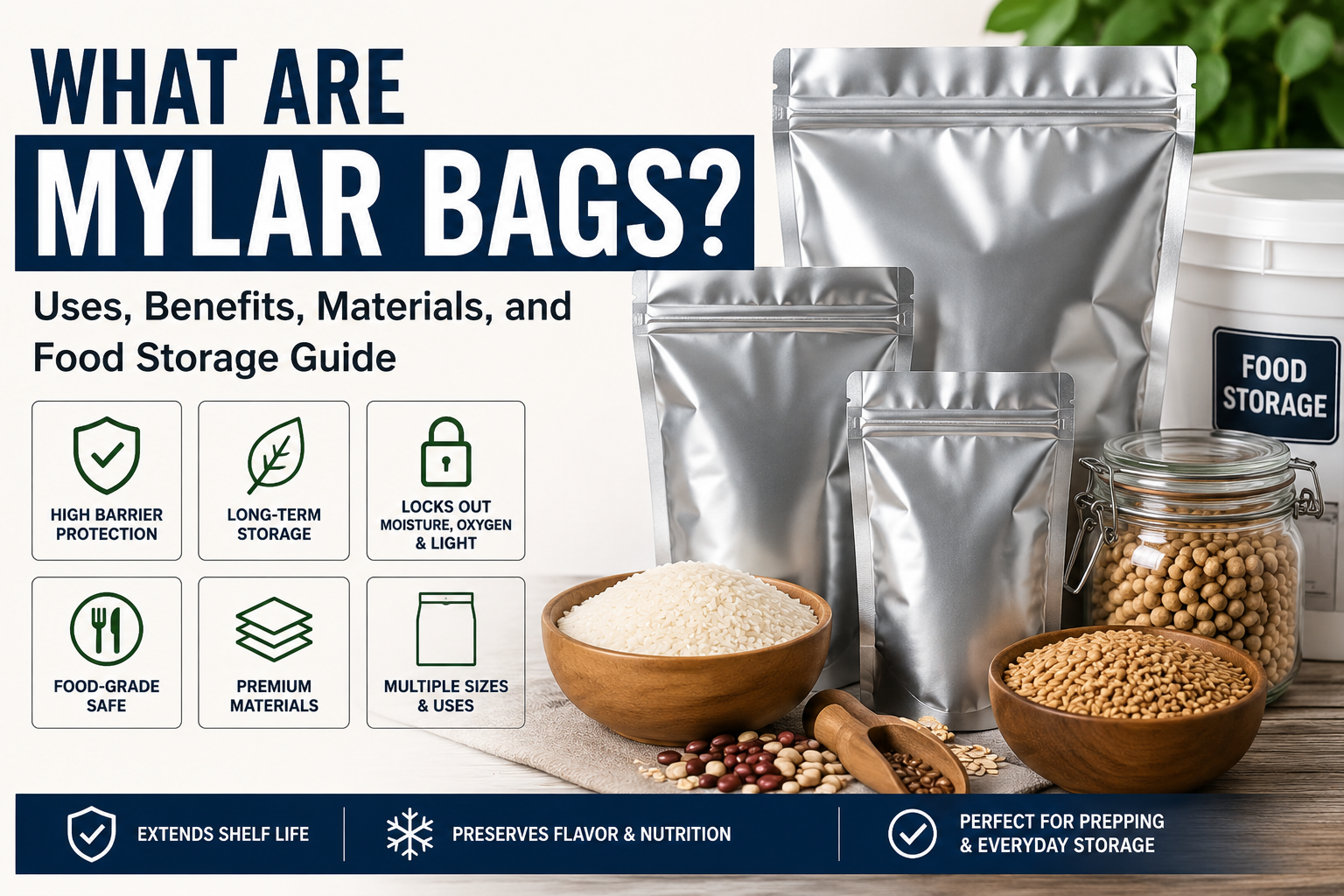
If you have ever stocked up on dry goods or prepped for emergencies, you have probably come across the term Mylar bags. These shiny, metallic-looking pouches are a staple in long-term food storage, and for good reason. They keep food fresh far longer than a regular plastic bag or even most canisters. But beyond food, Mylar bags show up in electronics packaging, pharmaceuticals, agriculture, and more. So what exactly are they, and why do so many people trust them? Let us break it all down.
What Are Mylar Bags Made Of?
Mylar is actually a brand name, a registered trademark of DuPont Teijin Films, but over time, it has become the go-to term for a type of biaxially oriented polyethylene terephthalate (BoPET) film. So when people ask what mylar bags are made of, the answer is a layered structure of this polyester film, usually combined with a thin aluminum foil layer and a heat-sealable inner coating.
The aluminum layer is the secret weapon. It acts as a high-barrier shield against oxygen, light, and moisture, three of the biggest enemies of shelf life. The outer BoPET layer adds strength and puncture resistance, while the inner polyethylene layer creates the bond when you heat-seal the bag shut.
Together, these layers form what the packaging industry calls high barrier packaging, a structure designed to lock the environment inside and keep everything outside from getting in. Some Mylar bags skip the foil layer, especially for non-food applications. These are lighter and more transparent but offer significantly less protection. For food storage, always look for true foil-laminate bags with a confirmed oxygen transmission rate (OTR) close to zero.
What Are Mylar Bags Used For?
The uses go well beyond the kitchen pantry. When someone asks what mylar bags are used for, the answer covers a wide range of industries and applications.
In the food industry, they are used to package everything from coffee and tea to dehydrated meals and powdered supplements. The bags preserve flavor, aroma, and nutritional value because no air or light gets through.
In electronics, Mylar bags protect static-sensitive components during shipping and storage. Pharmaceutical companies use them for blister packaging and single-dose sachets, especially for moisture-sensitive drugs. In agriculture, seeds packed in Mylar bags maintain viability for years longer than those stored in paper or standard plastic.
For preppers, homesteaders, and anyone thinking about emergency readiness, Mylar food storage bags have become a household name. The reason is simple: they work. And they work for a very long time. Companies that specialize in flexible packaging solutions often offer Mylar-based structures across multiple pouch formats, from small single-serve sachets to large bulk bags intended for commercial use.
How Do Mylar Bags Work?
Understanding how mylar bags work comes down to barrier science. Food degrades primarily because of three factors: oxygen (which causes oxidation and rancidity), moisture (which promotes mold and bacterial growth), and light (which breaks down nutrients and fats). Mylar bags, specifically those with the aluminum foil layer, block all three.
When you seal a Mylar bag, you are creating an airtight, opaque enclosure. If you also add an oxygen absorber before sealing, you are pulling out any remaining oxygen inside the bag. This drops the oxygen level inside to below 0.1%, which is low enough to stop most biological activity cold.
The result is a sealed environment where the food just stops deteriorating at any meaningful rate. This is why long-term food storage with Mylar bags is such a reliable method. The bags themselves do the heavy lifting; you just seal them properly and store them in a cool, dry place.
Are Mylar Bags Safe for Food Storage?
Yes, and this is one of the most common questions people have. Are mylar bags safe for food storage? Absolutely, provided you are using food-grade Mylar bags specifically designed for that purpose.
Food-grade Mylar bags are manufactured without harmful plasticizers or chemicals that could leach into food. The inner polyethylene layer used in these bags is FDA-compliant and designed for direct food contact. The outer aluminum and BoPET layers do not touch the food at all.
That said, not all shiny bags labeled Mylar are created equal. Some craft or hobby Mylar bags are not food-safe. Always check the product specs, look for food-grade certification, and ideally bags that meet FDA standards. If you are packaging dry goods for long-term storage, this distinction matters a lot.
Another popular packaging format gaining traction for safety-sensitive applications is Child-Resistant Packaging, which adds a resealable locking mechanism to prevent accidental access by children, especially relevant for supplements and pharmaceuticals stored in Mylar-style pouches.
Why Use Mylar Bags for Food Storage?
There are several strong reasons to use Mylar bags for food storage instead of regular containers, vacuum bags, or even glass jars.
First, the barrier protection is unmatched. Glass jars are great, but they let light through and can break. Vacuum seal bags block oxygen but still allow some light and moisture transmission over time. Mylar bags with foil layers do all three: block oxygen, light, and moisture, in a single package.
Second, they are light and space-efficient. A bucket of rice packed in Mylar bags takes up far less room than the same amount in rigid containers. Third, they are affordable. You can buy a pack of quality Mylar bags for a fraction of the cost of equivalent hard containers.
Brands that specialize in airtight food storage solutions frequently combine Mylar bags with food-grade plastic buckets for added physical protection. The bucket protects the bag from puncture; the bag protects the food from air and light.
How to Use Mylar Bags for Food Storage
Learning how to use Mylar bags for food storage is simpler than most people think. You do not need fancy equipment; a regular clothes iron or a hair straightener works fine for sealing smaller bags.
Start with dry, low-moisture food. Mylar bags work best for foods with less than 10% moisture content; think white rice, dried beans, pasta, rolled oats, sugar, salt, and powdered milk. High-moisture foods like fresh produce or cooked leftovers are not suitable for this method.
Fill the bag, leaving a few inches of headspace at the top. Add an oxygen absorber appropriate for the bag size. Then seal the top using a hot iron or commercial impulse sealer. Press firmly and run the heat source across the entire width of the opening. Let it cool and check the seal before placing it in storage.
If you are doing large batches, a Roll Stock Solution might be worth looking into, especially for commercial operations that need to form and fill bags at scale.
How Many Oxygen Absorbers for Mylar Bags?
This is a detail a lot of beginners get wrong. How many oxygen absorbers for Mylar bags depends on the bag size. A 1-gallon bag typically requires one 300cc oxygen absorber. A 5-gallon bag usually needs around 2,000cc worth of absorbers, often four to five 400cc absorbers. Smaller half-quart or quart bags generally need only a single 100cc to 200cc absorber.
The key is to match the absorber capacity to both the bag volume and the type of food inside. Dense foods like flour leave less headspace and need fewer absorbers. Loose foods like pasta or popcorn leave more air pockets and need more to compensate.
Work quickly once you open the oxygen absorbers; they start activating immediately when exposed to air. Seal any unused absorbers in a small Mason jar or another airtight container right away.
What Foods Can Be Stored in Mylar Bags?
Knowing what foods can be stored in mylar bags will help you plan your storage effectively. The rule of thumb is: if it is dry, it can probably go in a Mylar bag.
White rice, wheat berries, dried beans, lentils, oats, pasta, flour, cornmeal, powdered milk, sugar, salt, and freeze-dried foods all store extremely well in Mylar bags. These are your foundation foods, high-calorie, long shelf life, and generally used in most home cooking.
Brown rice and whole wheat flour have a shorter shelf life even in Mylar bags because of their higher oil content. The oils in the bran layer can still oxidize over time, even with minimal oxygen. For these, expect two to five years maximum rather than the twenty-plus years possible with white rice. Nuts and seeds are borderline; the high fat content limits shelf life, but Mylar bags still extend it significantly compared to open storage.
How Long Does Food Last in Mylar Bags?
This is where Mylar bags really prove their worth. How long food lasts in mylar bags varies by food type, but the numbers are impressive.
White rice stored properly in Mylar bags can last twenty-five to thirty years. Dried beans can reach twenty to twenty-five years. Pasta, oats, and wheat typically reach ten to fifteen years. Powdered milk can last two to five years. How long does flour last in Mylar bags? Expect about five to ten years for white flour with proper oxygen absorbers. How long does rice last in Mylar bags? Up to thirty years if stored at steady cool temperatures.
Temperature matters more than most people realize. Cooler storage extends shelf life; heat shortens it. Aim for storage below 70°F (21°C) for best results.
How to Store Rice in Mylar Bags
Storing rice in Mylar bags is one of the most cost-effective long-term food investments you can make. How to store rice in mylar bags is straightforward: use food-grade 5-gallon bags, add 2,000cc worth of oxygen absorbers, seal tightly, and place inside a food-grade plastic bucket for added protection against puncture and pests.
White rice is ideal for this method because of its low oil content. It has virtually no rancidity risk, which is why it can sit sealed in a Mylar bag for decades without any noticeable change in quality. Label each bag with the contents and seal date before storing.
How to Store Flour in Mylar Bags
Flour requires a couple of extra steps compared to rice. For how to store flour in mylar bags or how to store flour long term in mylar bags, start by freezing the flour for 72 hours before bagging. This kills any weevil eggs that might be present, a common issue with commercially bought flour.
After freezing, let the flour return to room temperature before bagging to avoid condensation inside the bag. Then pack and seal with oxygen absorbers as usual. Can you store flour in Mylar bags? Yes, and it is one of the best ways to keep flour fresh and pest-free. White flour stored this way can last five to ten years; whole wheat flour, two to five years, due to its higher oil content.
For premium food brands packaging flour or grain products at a commercial scale, Digital Printed Pouches in Mylar-based structures combine high-barrier protection with shelf-ready branding, a strong option for retail-ready formats.
Can You Vacuum Seal Mylar Bags?
Technically, yes, but it is not always recommended. Can you vacuum-seal mylar bags? Most home vacuum sealers cannot generate the heat needed to seal the thick foil-laminate walls of a true Mylar bag.
More importantly, do Mylar bags need to be vacuum sealed? Not really. The oxygen absorber method is actually more effective because it removes oxygen chemically rather than mechanically. Vacuum sealing removes most air but can leave trace amounts of oxygen behind. An oxygen absorber removes virtually all of it.
If you want both for added security, you can vacuum down the bag before adding an absorber and heat-sealing. This is overkill for most home users but makes sense for commercial-scale long-term food storage operations.
Are Mylar Bags Reusable?
This comes up often. Are mylar bags reusable? The short answer is yes, but with caveats. You can reuse mylar bags if the original seal holds and you have not damaged the foil layer. Once you cut the bag open, you lose a bit of the top, but if you left enough headspace, you can re-seal it using the same iron or heat sealer.
Over multiple uses, the foil layer can develop small cracks or weak points, especially along fold lines. If you see any silvery flaking or the bag does not feel rigid when squeezed, it has likely lost some barrier integrity. At that point, retire it from food storage. For short-term reuse, storing craft supplies, organizing small parts, or keeping electronics dry, Mylar bags can be reused many times without concern.
Are Mylar Bags Smell-Proof?
Yes. Are mylar bags smell-proof? True foil-laminate Mylar bags are highly effective at containing odors. The same barrier properties that block oxygen and moisture also block volatile organic compounds (VOCs), which are what your nose actually detects as smell.
This is why specialty packaging for coffee, spices, and strong cheeses often uses Mylar-style pouches. The smell stays locked in. This also means external odors cannot get into the bag and affect your stored food, a particularly useful property when storing multiple products near each other.
Mylar Bag Formats and Sizes
Mylar bags come in many shapes and configurations. The most common formats in consumer food storage are flat, resealable pouches ranging from small snack bags to 5-gallon capacity bags. For retail packaging, brands often use formats like Stand Up Pouches for better shelf presence, or Flat Bottom Pouches for added stability and a premium look.
In commercial settings, Quad Seal Pouches are popular for heavy or bulky products because the four-panel side gusset design distributes weight evenly. For single-serve or travel-size products, Stick Pack Packaging and Custom Sachet Packaging formats offer precise portion control in a slim, convenient profile.
If you are a brand looking to move beyond standard pre-made bags, Lay Flat Pouches or Flow Wrap Packaging might be worth exploring, depending on your product type and fill method.
The Bigger Picture: Mylar Bags in Modern Packaging
Mylar bags are not just a prepper product or a home pantry hack. They represent a serious, well-engineered packaging technology central to how the food industry handles food preservation methods and shelf life extension at scale.
The same barrier science behind a home food storage bag is used in commercial freeze-dried meal packaging, military ration pouches (MREs), and premium pet food bags. As global supply chains have grown more complex and consumers demand fresher, longer-lasting products, high-barrier flexible packaging has only become more critical.
There is also a growing conversation around Sustainable Packaging in the flexible packaging space. Traditional Mylar bags are not recyclable through standard curbside programs because of the multi-layer foil laminate construction. However, innovations in mono-material high-barrier films are creating alternatives that maintain performance while improving end-of-life recyclability.
For businesses navigating these choices, working with an experienced packaging partner matters. Contipack Inc specializes in flexible packaging solutions across a wide range of barrier structures, formats, and print finishes, making it easier for brands to find the right bag for their specific product and market.
FAQs
Are Mylar Bags Recyclable?
Standard Mylar bags with aluminum foil laminate are not recyclable through curbside programs. The multi-layer structure makes separation difficult at conventional recycling facilities. Some manufacturers are developing mono-material high-barrier alternatives that are easier to recycle, but these are not yet widely available for consumer use.
Can You Freeze Mylar Bags?
Yes, you can freeze Mylar bags without any issues. The foil-laminate structure holds up well at freezing temperatures and does not become brittle or crack under normal freezer conditions. Freezing Mylar bags is actually a common practice, particularly for storing meat, fish, or other protein items where both the freezing and the barrier properties work together to extend shelf life significantly longer than standard freezer bags alone.
Where Can I Buy Mylar Bags?
Mylar bags are widely available online through retailers like Amazon, Walmart, and specialty emergency preparedness stores. For food-grade bags, look for products that specifically state food-safe or FDA-compliant on the listing. Brands like Wallaby, Dry-Packs, and PackFreshUSA are commonly referenced in food storage communities. For commercial or bulk purchasing needs, flexible packaging suppliers and manufacturers offer Custom Mylar Bags in custom sizes, thicknesses, and print configurations.
Do Mylar Bags Need to Be Vacuum Sealed?
No, vacuum sealing is not required and in most cases is not the best method for Mylar bags. Oxygen absorbers do a more thorough job of removing residual oxygen than vacuum sealing alone. Heat-sealing the bag shut after inserting oxygen absorbers is the standard and most effective approach for long-term food storage.
How Thick Should Mylar Bags Be for Food Storage?
Most long-term food storage experts recommend 5 to 7 mil Mylar bags because they provide better puncture resistance and barrier protection compared to thinner options. Bags under 4 mil are more prone to pinhole failures over time, especially when stored in buckets with rough interior surfaces. For home food storage, 5 mil is generally considered the minimum; 7 mil is the preferred choice for maximum durability.
Final Thoughts
So, what are mylar bags? They are layered, high-barrier flexible pouches built around BoPET film and aluminum foil that effectively block oxygen, moisture, and light. They are used across food storage, electronics, pharmaceuticals, agriculture, and specialty retail. For anyone serious about long-term food preservation, they are arguably the single most effective tool available at a consumer price point.
They work with oxygen absorbers to create near-zero oxygen environments, extend shelf life by years or even decades, and come in a wide range of sizes and formats to suit virtually any need. Whether you are storing bulk rice and flour for emergency preparedness or packaging a premium food product for retail, mylar food storage bags and their commercial equivalents represent some of the best moisture barrier packaging technology in flexible packaging today.